
Ontario toddler survives rattlesnake bite, partly thanks to 18 doses of antivenom
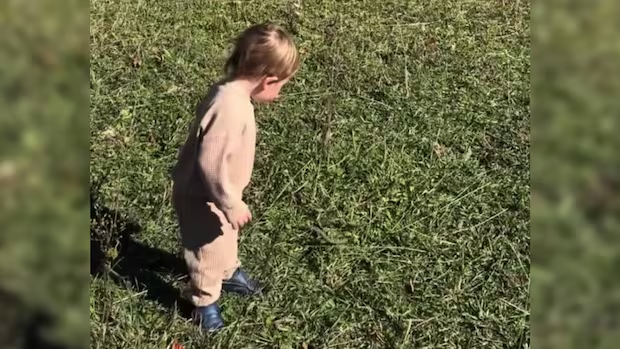
Ontario toddler survives rattlesnake bite, partly thanks to 18 doses of antivenom
Wells Gladwish, 15 months, was treated at 2 hospitals after being bitten by an eastern massasauga rattlesnake
A 15-month-old boy from Sarnia, Ont., is recovering at home after being bitten by a rattlesnake at a family cottage on the Thanksgiving long weekend, requiring treatment at two hospitals and 18 doses of antivenom.
Wells Gladwish was bitten on the thumb around 12:45 p.m. on Sunday while spending the afternoon with family at their cottage in Cape Chin North, on the Bruce Peninsula.
His father, Matt Huggett, said the toddler was walking near a family bonfire when he came upon a snake and tried to pick it up. The snake bit Wells on the thumb, which began to turn white within about five minutes.
“We knew right away we were in a pretty bad situation,” Huggett said. “The nearest hospital was Lion's Head, and we did everything we could to get him there as fast as possible.”
Staff at Lion's Head Hospital needed multiple attempts to start an IV in the active toddler. After a test dose to check for a potentially severe allergic reaction, the team administered 10 vials of antivenom. The hospital had 14 vials in total.
A family member photographed the snake, which was identified as an eastern massasauga rattlesnake, Ontario's only venomous snake species, which lives along the eastern shore of Georgian Bay and on the Bruce Peninsula.
A family member photographed the snake that bit Wells Gladwish. It was identified as an eastern massasauga rattlesnake. (Matt Huggett)
Transfer from Lion's Head to London
Huggett said doctors and toxicology specialists co-ordinated an emergency response and decided Wells needed further treatment at London Health Sciences Centre (LHSC), Victoria Hospital.
Ornge air ambulance planned a transfer, but Huggett said repeated delays and cancellations left the family waiting as the swelling continued. A nurse at Lion's Head advocated for Wells to receive the hospital's remaining four vials of antivenom and to be transported to London by land ambulance.
“We could no longer wait for Ornge to make a decision,” Huggett said. “They ended up putting him in an ambulance.”
After a three-hour ambulance ride, Wells arrived at LHSC’s Pediatric Critical Care Unit.
Wells Gladwish was eventually taken to the Children's Hosptial in London, Ont., for additional treatment for a rattlesnake bite (Matt Huggett)
Dr. Rishi Ganesan, a pediatric critical care physician at LHSC's Children's Hospital, said his first priority when he received the call was to support Wells and secure antivenom, as they don't keep it in stock in London.
He credited the Lion's Head team for having antivenom available and administering it quickly. Ganesan said they sourced additional antivenom and brought it to London under a police escort from the Toronto region to be available when Wells arrived.
Wells received two additional double doses under care in London, bringing the total to 18.
Ganesan said he had not treated a venomous snakebite during his decade in Canada, but his training in India proved valuable.
“I trained in India, many, many years back, and I have managed snakebites of every kind: cobra, viper, krait,” he said. “Some of those things kicked in from the back of my mind, and I felt very comfortable.”
Ganesan said antivenom is derived from horses and can cause a severe allergic reaction, which is why the initial dose must be administered carefully with appropriate monitoring.
He said children do not necessarily need less antivenom than adults. Treatment targets the amount of venom, rather than the patient's size, and children can become seriously ill more quickly because the venom has a greater impact relative to their body size.
Doctors treated Wells for a rattlesnake bite with 18 doses of antivenom. (Matt Huggett)
Doctors monitored Wells's swelling and blood tests to determine whether more antivenom was needed. The venom can damage tissue and interfere with blood clotting, while severe swelling can also restrict blood flow to the affected limb.
“Antivenom doesn't fix all the problems with snake envenomation,” Ganesan said. “It is definitely the cornerstone.”
He said timely treatment generally leads to a good outcome, and he does not anticipate significant long-term complications for Wells.
Huggett said many of the medical staff had never treated a case like Wells's before, but worked together and consulted specialists to guide his care.
Ganesan also praised the collaboration between hospitals, pharmacists, the Ontario Poison Centre and other specialists who helped secure the medication.
“This was a remarkable experience,” he said. “You had so many people come together and contribute in many small ways to make sure that he got the best care that he deserved.”
Wells was transferred to the children's inpatient unit before being discharged and returning home to Sarnia.
His father said Wells appears to be using his thumb normally, although a blister remains at the bite site. The family is continuing to monitor his recovery and watch for possible serum sickness, a delayed reaction to antivenom.
“We don't want to say we're 100 per cent out of the woods yet,” Huggett said. “But he's using it right now, he seems happy, and it seems to be looking better.”
Ganesan said anyone bitten by a rattlesnake should treat it as a medical emergency and call 911 immediately.
Although not every bite injects venom, he said it is not possible to confidently determine that in the field.
“With timely care, full recovery is a normal outcome in these situations,” he said. “The danger is actually the delay, not the snake.”
Eastern massasauga rattlesnakes generally avoid people and typically bite when provoked, attacked or accidentally stepped on, Ganesan said.
He advises people hiking or spending time outdoors in areas where the snakes live to watch where they step, avoid reaching into bushes or concealed spaces without checking, and leave any snake they encounter alone.
Travis Dolynny is the executive producer at CBC London. You can email him at travis.dolynny@cbc.ca.
With files from Matthew Trevithick.
Related Stories
 Canada
3.7
45 seconds ago
 Canada
New data points to strong summer for Toronto's tourism sector
53 seconds ago
 Canada
UCP divisions over Alberta separation question come into focus ahead of referendum
53 minutes ago
 Canada
Former Kugaaruk, Nunavut, hamlet employee charged with fraud
53 minutes ago
 Canada
Canada pulls off upset against England in women’s rugby, snaps 41
55 minutes ago
 Canada
Measles outbreak declared over in Manitoba
2 hours ago
 Canada
Most Albertans expect to vote on separation again, new polling suggests
2 hours ago
 Canada
Ottawa threatens forced sale of Stelco’s assets warning ‘they must keep the jobs in Canada’
2 hours ago