
Ontario wildfires accounted for highest area burned in recent history, says U.K. study of Canadian weather
Ontario wildfires accounted for highest area burned in recent history, says U.K. study of Canadian weather
How much land has burned and how quickly stands out, climate scientist says
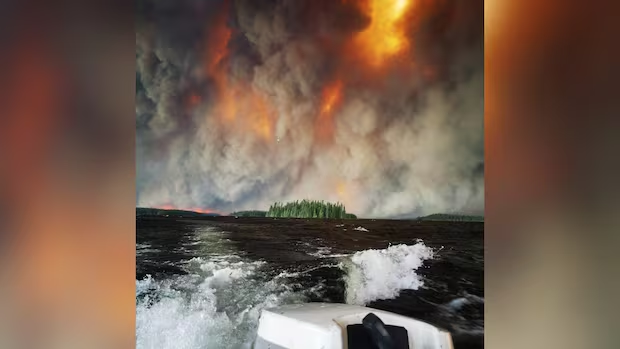
A new U.K. analysis of the wildfires in Ontario and the Northwest Territories details how their intensity this season is placing more challenges on the ability to prevent their devastating impact, and warns about what might happen if things don't change.
“The fires we see now, they're not very rare, but they're incredibly hard to suppress with the available people power, with the available technology,” Friederike Otto, a professor of climate science at Imperial College London, told a virtual news conference Wednesday.
“If you now imagine that even if it's just a little bit worse, it would mean that everything is even stretched further.”
According to the analysis, released Thursday by Imperial College London’s World Weather Attribution (WWA), human-induced climate change has made the extreme weather conditions behind the Ontario and N.W.T. wildifres about twice as likely to occur in future.
More than 3.8 million hectares of land — including over 730,000 hectares in Ontario alone — have burned across Canada this year, it notes.
Founded in 2014, U.K.-based WWA says it works with scientists around the world to measure how climate change influences the intensity and likelihood of extreme weather.
For the newly released research, researchers used observations and climate models focusing on seven-day and 30-day periods of the most extreme fire weather in Ontario and the Northwest Territories. They compared these conditions against what would have been expected in a world without fossil fuel emissions.
This aligns with the large-scale evacuation of several communities in northwestern Ontario. At its peak, more than 2,800 people from the region were displaced; that’s been reduced to just over 1,600 according to the latest Ontario government count.
July also saw the total destruction of two communities in the region: Namaygoosisagagun First Nation (also known as Collins First Nation) and Whitewater Lake First Nation.
At that time, “the fires were driven by the rapid development of a week of severe fire weather following widespread lightning activity in the region,” said Theodore Keeping, a climate scientist at Imperial College London.
Jonathan Boucher, a wildland fire research scientist for the Canadian Forest Service of Natural Resources Canada, was also involved in the WWA research.
Keeping said that what also stands out is not only how much land has burned this summer, but how quickly it was destroyed.
“Only within a few days and weeks, large areas have been burned,” Boucher said. “Also, what's making 2026 special is that Ontario reached its highest-ever recorded area burned in recent history.”
This First Nation in Ontario cautions against premature optimism over wildfire threats
First Nations chiefs call for public inquiry as Ontario defends wildfire response
Recent summers in Canada have become characterized by large plumes of smoke crossing international borders, putting millions of people’s health at risk, he said.
As well, communities are finding themselves displaced year after year, with First Nations disproportionately affected.
“I think that the message that I would want to send to Mark Carney, very simply, is that if you export fossil fuels, the impacts of the burning of those fossil fuels come home,” Keeping said about Canada’s prime minister.
Helping communities adapt, build capacity
Chris Boyer is a technical adviser of climate and health at Red Cross Red Crescent Climate Centre, which has its head office in the Netherlands, also spoke at Wednesday’s news conference.
When asked what could be done to make communities more resilient to climate change going forward, he said “continued and strengthening of risk communication and preparedness plans to build awareness is critical at the community level.”
Northern Ontario First Nations leaders criticize province's wildfire response
That suggestion is echoed by First Nations across northwestern Ontario and is at the crux of their calls for a public inquiry into the provincial government’s wildfire response.
That said, Ontario’s wildfire season doesn’t officially end until Oct. 31.
Boyer said agencies involved in the wildfire response need to continue working together, including to co-ordinate deploying fire-response teams and equipment for the rest of the wildfire season.
“An integrated risk management approach can help to effectively adapt to increasing severity of wildfires in Canada,” he said.
Calgary prof weighs in on study’s findings
Jed Kaplan is a professor in the University of Calgary’s department of earth, energy and environment, as well as Canada Research Chair in Global System Modeling.
He wasn’t involved in the Imperial College London analysis, but said he agrees with the findings.
“As long as we keep burning fossil fuels, there's going to be more and more hotter weather, which is going to lead to worse and worse wildfires,” Kaplan told CBC News on Wednesday.
While people can buy air purifiers and stay inside on smoky days, “adaptation is really hard if you are in some of Canada's biggest cities, hundreds or even thousands of kilometres away from where these massive wildfires are burning in the boreal.”
Physical donations for wildfire evacuees no longer accepted in Thunder Bay, Ont.
'A big difference': Small fire departments in area of northwestern Ontario wildfires get new equipment
The longer it takes to reduce greenhouse gas emissions, the more severe conditions will become and the harder it will be to address them, said Kaplan.
Still, he feels optimistic Canada can become a global leader in decarbonizing the economy.
“There are technologies out there that really can help us maintain our standard of living, even grow our economy significantly, but at the same time reduce our greenhouse gas emissions.”
Sarah Law is a CBC News reporter based in Thunder Bay, Ont., and has also worked for newspapers and online publications elsewhere in the province. Have a story tip? You can reach her at sarah.law@cbc.ca.
Related Stories
 Canada
Carney pitches Canada to global investors as Trump tries to pull investment south
40 minutes ago
 Canada
Carney pitches Canada to global investors as Trump tries to pull investment south
1 hour ago
 Canada
Carney eyes 'unique alliance' with EU as trade war with US intensifies
1 hour ago
 Canada
‘Can’t afford to put that pressure on our residents’: Canadian cities seek investment
1 hour ago
 Canada
Carney touts 'new, powerful, confident' Canada to business leaders ahead of summit
3 hours ago
 Canada
Breaking down canada's unusually busy 2026 tornado season
3 hours ago
 Canada
Canada taking control of its future, Mark Carney tells new investment gathering
3 hours ago
 Canada
Trump reiterates support for united Ireland, says won’t talk about Scotland ‘yet’
4 hours ago