
Opportunity profile: Debugging virtual games of real

Image: RDNE Stock project, via Pexels
UKRI opens £5 million call at the intersection of gaming and gambling
UK Research and Innovation (UKRI) has launched the Video Games and Gambling-Related Harms funding scheme, a central element of its Research Programme on Gambling (RPG).
The call is open until 23 July to research teams that are expected to be multidisciplinary. Up to £5 million is available for projects of up to three years, costing up to £1m, funded at 80 per cent of full economic cost.
David Bowkett, head of productivity and growth at the Economic and Social Research Council, discusses the real-world impact the scheme aims to generate, and how applicants can construct bids to achieve it.
How would you summarise this opportunity?
The aim of this funding opportunity is to explore the relationship between gambling and video games, and produce evidence-based insights, which can inform strategies and interventions to prevent, treat or reduce gambling-related harm. The funded projects will also aim to shape policy and regulation, and promote the design of safe and responsible video games.
Does this scheme relate to work in government around gambling?
Yes, in 2025 the UK government introduced a statutory gambling levy that is charged on all licensed gambling activity, as part of the government’s wider strategy on modernising the regulation of the gambling sector.
It was agreed that 20 per cent of the funds raised by this levy would be used for research, which has led to the creation of the RPG. We recently announced the Gambling Harms Research UK Evidence Centre, which is the first major investment as part of this programme.
The call combines video games research with gambling-related harms. Why bring those two areas together?
This came after detailed scoping work around understanding where key research gaps exist. We’ve identified that in recent years there has been a variety of practices that have emerged at the intersection of video games and gambling, which increasingly blur the lines between the two.
And there’s some current evidence suggesting that gambling or gambling-like elements and practices in video games are associated with classic gambling-related harms. But no causal link has been established. Therefore, the relationship between gambling and video games requires further research, and we’ve designed this interdisciplinary research programme to strengthen the evidence base and produce insights.
The aims are to inform policymakers and regulators, and support effective treatment and prevention of gambling-related harms. Also, to inform ethical game design and foster responsible video game experiences.
Are there particular research gaps or policy questions that UKRI is keen to address?
Yes, in the funding finder we have highlighted some areas, including loot boxes and e-sports betting. But that is not a full list of what we’re trying to address for this funding opportunity. We encourage applicants to focus on what they can identify as the most pressing challenges, to identify where new knowledge can have potential for real-world impact, and to make that case in their application.
What kinds of disciplines would you like to see represented in successful teams?
We think this is going to be quite multidisciplinary, and we don’t want to prescribe which disciplines should or shouldn’t be involved. That’s up to the applicant teams to make sure they’ve got the appropriate skills to meet the research challenge they’ve identified. Some disciplines that we might assume will be well represented include psychology and sociology, behavioural science, economics, computer studies and maybe even media communication studies.
The guidance frequently invokes real-world impact—what might that look like in bids?
This scheme aims to take high-quality research and make it accessible and usable to the people who might use the new knowledge generated. So, working with policymakers or regulators to inform policy design would be desirable, or perhaps working with parts of the NHS to inform effective treatment or prevention. Another organisation listed on the funding finder is the Office for Health Improvement and Disparities.
One thing to mention is that we’ve asked applicants not to apply with the Department for Culture, Media and Sport as a project partner, because we don’t want DCMS to be kingmakers for the call. We will arrange interactions with DCMS for the successful projects.
Given the commercial sensitivities, how important will engagement with industry be for applicants?
First, because we are operating at that intersection between video games and gambling-related harms, there are clear restrictions on working with companies associated with gambling, which pay the levy. UKRI does not permit individuals to concurrently hold funding from companies that are Gambling Commission licence holders and are subject to the levy while also receiving funds from the research programme.
For the video games industry, where firms are not subject to the Gambling Commission levy, we do encourage collaboration. There is a document called the DCMS Video Games Research Framework that sets out best practice for collaboration with the video games industry. Details of the specifics are laid out in the funding text.
What do you think will make the strongest proposals stand out?
As always, having a clearly described research challenge and an appropriate programme of work and methodologies to address it will be vital. Specifically for this funding opportunity, we’re also looking for people to demonstrate approaches to working with relevant research users and stakeholders, and how that will help shape the delivery of their projects and how working with those stakeholders will ensure the result. Setting out the approaches to achieving meaningful and usable outputs is going to be important.
It says demand management is not being applied to this funding opportunity. Why is that, given the surge in applications in other UKRI schemes?
This is an area in which we’ve not run a targeted funding opportunity before. We don’t have a lot of information on the level of demand in the research community, and we don’t want to set up anything that might exclude people from applying. As always, we have made plans to ensure high-quality peer review and assessment for however many applications we receive.
What else should applicants to this scheme be aware of?
There are two things. One is that this is part of the wider research programme on gambling, and applicants should look at that wider programme and how it relates to the gambling levy and the government strategy on gambling regulation, just so they can be clear on how this research fits into a broader strategic context.
Second, we have asked all applicants to fill out a declaration of interest form so that we can be transparent on whether applicants do have any potential conflicts—this is important because of the restrictions we have around working with companies that pay the gambling levy.
This is an extract from an article in Research Professional’s Funding Insight service. To subscribe contact sales@researchresearch.com
View this article on Research Professional
Related Stories
 Business
MAGA’s Conspiracy About Dem Star Dealt Humiliating Blow
29 minutes ago
 Business
Taxpayer support for Michigan
32 minutes ago
 Business
First Capital Startup Nation by Hatch opens new pathways for Sri Lankan and other South Asian startups
1 hour ago
 Business
Zetwerk’s early backers stand to make returns of up to 38
2 hours ago
 Business
Nous Research: $90M Round, $1.5B Valuation, $36M Run Rate
2 hours ago
 Business
A senior official from the European Affairs Department of the Ministry
3 hours ago
 Business
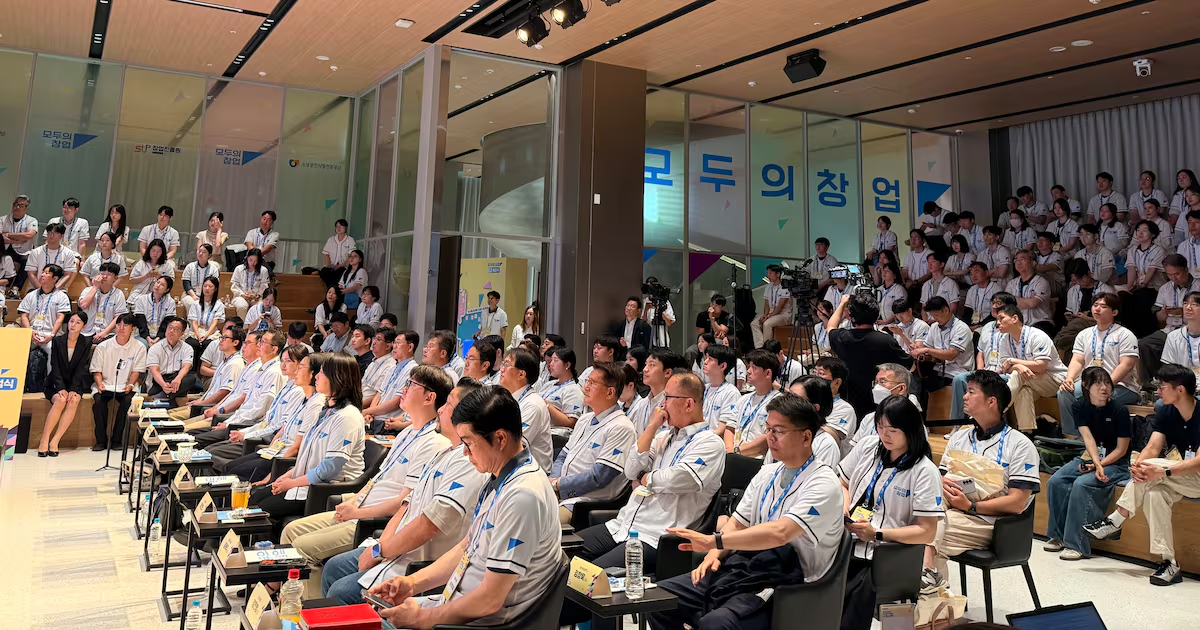
South Korea holds regional auditions for first Startup for All, selects 200
4 hours ago
 Business
'Artel,' Developer of AI Docents for Art Fairs, Wins Grand Prize at Arts Startup Competition
6 hours ago