
ORNL program helps startups thrive in East Tennessee
ORNL program helps startups thrive in East Tennessee
Entrepreneurs are marketing ORNL innovations
Since 2017, more than 50 aspiring entrepreneurs living in or moving to East Tennessee have started companies to commercialize energy and advanced manufacturing innovations with the help of Oak Ridge National Laboratory. One of the startups, Holocene, was acquired by Occidental Petroleum Corp. in 2025.
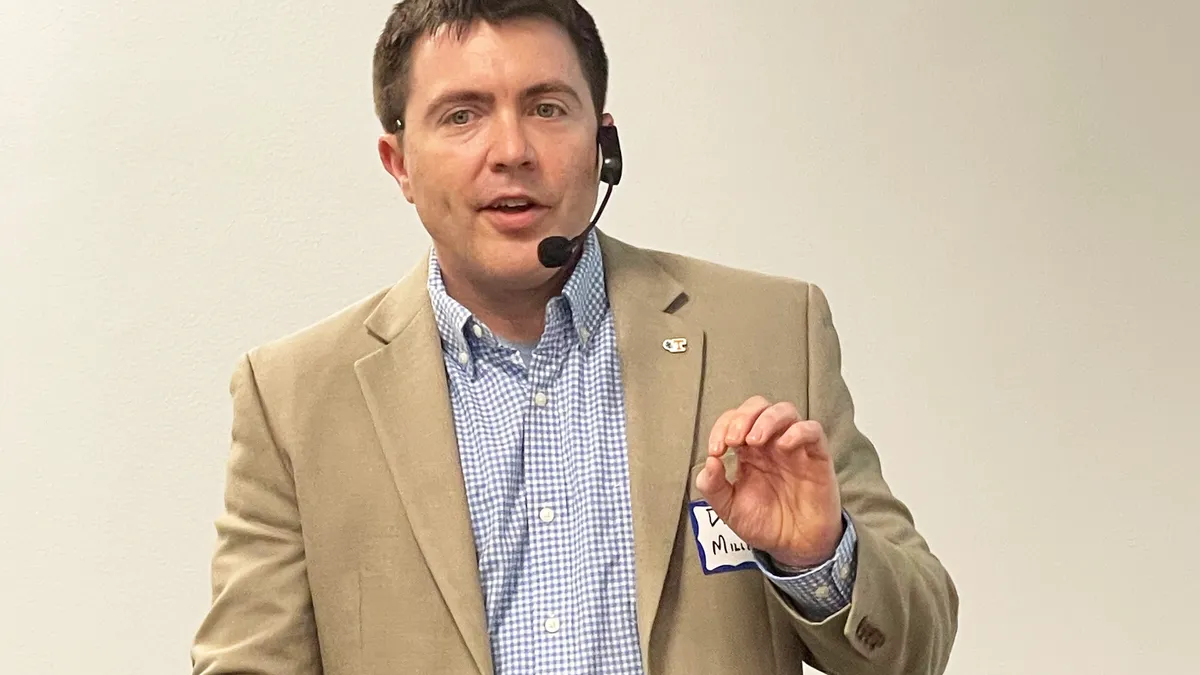
Seventeen of the startups are still receiving venture funding or are selling their products and services in East Tennessee, said Dan Miller, director of Innovation Crossroads, a program at ORNL designed to support entrepreneurs in the energy and advanced manufacturing sectors.
He described the program in a talk to Friends of ORNL earlier this year. He was joined by Alec Readel and Evan Stacy, who made brief presentations on the work of their startups. Readel is the founder of Applied 2D Materials and Stacy is the co-founder and CEO of Lumios Materials.
“The Innovation Crossroads program in East Tennessee has proven to be effective and impactful,” Miller said. “Since 2017 it has supported 51 startups that have collectively received $190 million in non-dilutive funding, created more than 320 jobs and raised $117 million in venture funding. Additionally, 22 of the startups are selling their products and services. They have received a total of $34 million in sales revenue.”
Miller called Innovation Crossroads a two-year entrepreneurial fellowship program in which selected participants receive a personal living stipend, national lab access and support and business mentoring assistance.
“We’re part of a wider Department of Energy program called the Lab-Embedded Entrepreneurship Program,” he said. “LEEP exists at four DOE national labs.
“It was started at the Lawrence Berkeley National Laboratory about 12 years ago. LBNL ran that program for a couple of years and had some great initial success. So, DOE agreed to support LEEP programs at ORNL and Argonne National Laboratory.
“About five years ago, the Innovation Crossroads program was started at the DOE lab formerly known as the National Renewable Energy Laboratory. NREL is now called the National Laboratory of the Rockies.”
In answer to a question, Miller said in East Tennessee the availability of venture capital is lower than in the regions of the three other national labs. But the cost of living here is also lower.
Miller said LEEP accelerates the deployment of transformative energy technologies that address climate change and other challenges, while also creating jobs, promoting domestic manufacturing and providing benefits to disadvantaged communities.
He added that the vision is to recruit the most talented energy and advanced manufacturing innovators, to leverage expert mentorship and world-class facilities at national labs on a win-win basis and position people and technology for market success.
Besides Holocene, he mentioned several successful startups.
One local company is SkyNano, founded by Anna Douglas, who was in the first Innovation Crossroads cohort in 2017.
“Her company uses a process to make carbon nanotubes from carbon dioxide,” Miller said. “Her company is located in a 20,000-square-foot building close to the McGhee-Tyson Airport in Knoxville. She’s doing really well.
“She secured over $20 million in funding. The ORNL technology she is commercializing won a 2020 R&D 100 award. In 2019, she was named to the “Forbes 30 under 30 in energy” list. Every year Forbes magazine recognizes 30 notable people under 30 years old in each of 20 different industries.
Also named in 2019 to the “Forbes 30 under 30 in energy” list is Megan O’Connor, a member of Innovation Crossroads Cohort 2018, Miller said. She founded NthCycle, which takes advantage of an ORNL process that reclaims and recycles rare earths and specialty elements from waste materials such as discarded battery materials and permanent magnets.
She raised more than $50 million and relocated to Boston. She has since established a production facility in Fairfield, Ohio, outside of Cincinnati, that is “doing really well,” Miller added.
He then talked about the success of Tommy Gibbons in Innovation Crossroads Cohort 2019. Gibbons founded a company called Hempitecture. He opened the first bio-based insulation manufacturing plant in the United States. The production facility in Idaho is also a domestic source of building materials based on natural fibers from hemp and other plants.
Gibbons received $1.1 million from the New York State Energy Research and Development Authority to manufacture a bio-based insulation product. In addition, he raised $5.7 million in seed funding from more than 1,700 investors via Wefunder. He has served more than 1,500 customer projects.
Miller presented a slide listing 17 Innovation Crossroads startups that are in business in East Tennessee: APT Technologies, Ascend Manufacturing, Becq, Captis Aire, Electro-Active Technologies, Endeavor Composites, Eonix, FC Renew, Lux Semiconductors, Perseus Materials, Qubit Engineering, Re-Du, Algaeo, AtomQ, Circular Biosciences, Elemental Composites and Fibarcode.
He said the Innovation Crossroads program has benefited from the support received from the Spark Innovation Center headed by Brett Malone, who was present in the audience. The Spark Innovation Center, which is located at the University of Tennessee Research Park, provides labs and incubator space for the new entrepreneurs.
Through a partnership, all Innovation Crossroads cohorts “go into the center’s Spark Accelerator, which is a fantastic three-month crash course on business-related and entrepreneurial-related fundamentals for starting and running hard-tech businesses,” Miller explained. “Brett’s team does an awesome job in introducing many local and regional people to the cohorts to help them make important connections.”
Providing stipends and benefits to the selected cohorts is administered by the Oak Ridge Institute for Science and Education (ORISE), which is managed for DOE by the Oak Ridge Associated Universities (ORAU).
“We couldn’t do the program without ORISE,” Miller said.
Funding for the cohorts to work at ORNL with its researchers on further developing a lab invention or new process comes through a Cooperative Research and Development Agreement, commonly called a CRADA.
“That money enables the entrepreneurs to come on site and work with our staff and in our facilities,” he added.
He also mentioned that the Tennessee Valley Authority is a sponsor of Innovation Crossroads and funds a fellowship. He credited people he works with in the ORNL Partnerships Directorate. They include Kelly Wampler, Innovation Crossroads program manager, Jennifer Caldwell, director of Technology Transfer, and Shaun Gleason, director of Partnerships.
In addition, Innovation Crossroads works with external entrepreneurial/business mentors, including Angelique Adams, business solutions consultant, John Derrick, strategic consultant, Mike Paley, government funding consultant, and Gary Rawlings, commercialization consultant.
Related Stories
 Technology
Israel wants startups to become a bigger part of its $19 billion defense export industry
5 minutes ago
 Technology
Zoe Kleinman: Nobody is irreplaceable
5 minutes ago
 Technology
Anthropic’s stock debut could hurt tech startups
1 hour ago
 Technology
EU plans to help bring quantum technology to market
1 hour ago
 Technology
Trump says pardon for Nvidia boss Huang ‘always an option’ after accusations of breaking export laws
3 hours ago
 Technology
How Leading Associate Degree Programs Prepare Students for Anesthesia Technology Careers
3 hours ago
 Technology
InnoTek acquires 60% stake in Ablewin Technology Sdn Bhd for RM20.3 mil
3 hours ago
 Technology
Stirlingshire Investments Appoints Daniel Gicklhorn as Chief Technology Officer
3 hours ago