
Ottawa and B.C. agree to maintain tanker ban. What’s in the new deal?
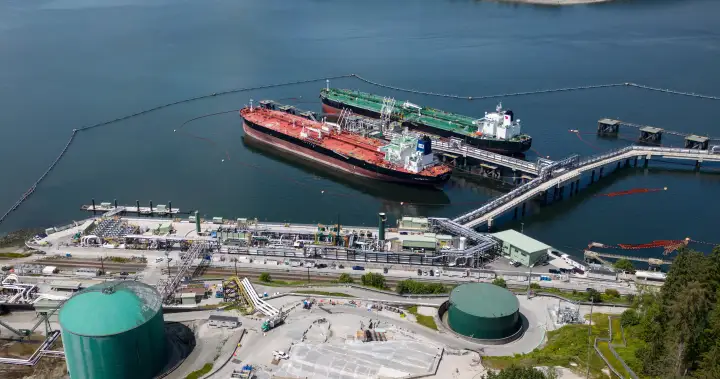
British Columbia’s ban on oil large tankers off its northern coast will be “fully maintained” under an agreement between the federal and provincial governments, Prime Minister Mark Carney and B.C. Premier David Eby said at a Thursday press conference.
The two governments announced a multi-billion dollar deal on Thursday, which includes a commitment to protect the oil tanker ban, as well as funding for critical infrastructure projects in B.C.
Bill C-48 — the Oil Tanker Moratorium Act — was first introduced by the Liberal government in 2017, and became law two years later after a protracted battle in the House of Commons and Senate and opposition from Alberta and the oil industry.
The legislation bans tankers carrying more than 12,500 metric tonnes of oil from docking in waters off the north of B.C.’s coast. The affected area stretches from the northern tip of Vancouver Island to the Alaska border, and encompasses the archipelago of Haida Gwaii.
The future of the ban came into question after the federal government and Alberta signed a memorandum of understanding in November to lay the foundation of a new oil pipeline.
The flagship proposal in the MOU is a bitumen pipeline from Alberta to Canada’s West Coast that would carry an additional 300,000 to 400,000 barrels per day destined for Asian markets.
Alberta and federal Conservatives have long argued the 2019 federal law prevents the building of new pipelines and therefore constrains the oil and gas industry, and have called for the federal government to repeal it.
The B.C. government and Coastal First Nations, however, vowed to do everything in their power to keep the tanker ban in place, citing the “catastrophic” impact a future oil spill could have in the region.
The “Canada-B.C. agreement will maintain the federal North Coast tanker ban in accordance with a proposed route of a new trans-provincial pipeline under the bilateral agreement with Canada and Alberta,” Carney said Thursday.
“We have secured a commitment to keep the northern tanker ban firmly in place, protecting British Columbia’s pristine northern coast and the $2 billion plus economy that relies on it,” Eby said.
The Coastal First Nations Great Bear Initiative welcomed the federal-B.C. agreement.
“British Columbians, Canadians and the First Nations who call this place home want this region to remain protected. There is no technology that can clean up an oil spill at sea, and a single oil spill could destroy our way of life,” Marilyn Slett, president of the Coastal First Nations – Great Bear Initiative and elected Chief of the Heiltsuk Nation, said in a statement.
“We remain steadfast in our position that oil tankers will never be part of our vision for a healthy, productive and sustainable North Coast,” Slett added.
This will include $3 billion on the Fraser River Tunnel Project, “as well as commitments to the Red Chris mine expansion and the North Coast Transmission Line.”
The Fraser River Tunnel Project is being proposed to replace the aging George Massey Tunnel, a critical highway tunnel into Metro Vancouver.
The Red Chris Mine Expansion Project is a copper and gold mine in northern B.C., with the expansion proposal focused on critical minerals development and clean power transmission.
The NCTL project is a proposed expansion of BC Hydro’s electricity transmission infrastructure by “building new transmission lines, upgrading existing lines, expanding or upgrading substations, and expanding capacitor stations.”
The federal government will work with private sector proponents, communities and First Nations to accelerate the permitting, financing and the construction of major LNG projects in B.C., Carney said.
In addition to spending money on upgrading the Port of Vancouver, Ottawa will also spend $10 billion at the Robert Bank’s terminal, a deep-sea terminal that serves as a port for the export of coal, grain and other commodities.
“We will catalyze through these initiatives over $200 billion in new investment, while advancing our trade agenda across Asia,” Carney said, adding that B.C. was the “lynchpin” in Canada’s strategy to diversify its trade relationships.
Related Stories
 Canada
B.C. man accused of heading drug
19 minutes ago
 Canada
‘Bring it on buddy’: Everything Ontario’s Doug Ford said about President Donald Trump
20 minutes ago
 Canada
Ford renews ’kiss my ass’ comment to Trump in response to Canada-U.S. trade war
20 minutes ago
 Canada
Carney faces crucial test after walking away from Trump's deal
1 hour ago
 Canada
Trump threatens to hike tariffs on Canadian autos, steel to 50% in January
1 hour ago
 Canada
Local businesses stung by fruitless Canada
2 hours ago
 Canada
Man who killed family of 6 on camping trip in 1982 denied parole
2 hours ago
 Canada
Trump slams Canada with new 50 percent auto tariffs from January
2 hours ago