
Pictou County power plants pivot to 'dry' technology, slashing need to draw groundwater
Pictou County power plants pivot to 'dry' technology, slashing need to draw groundwater
Grid operator says there isn’t enough water in the proposed locations to support the original plan
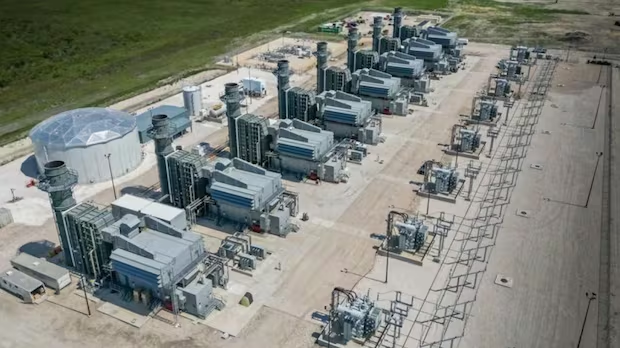
The new natural gas and diesel power plants that are on the horizon for Pictou County will not draw or discharge water at an industrial scale, the grid operator has decided.
The shift to a so-called dry system comes 10 months after plans for two gas-fired plants were made public. The proposals swiftly drew criticism from locals and organizations who highlighted potential negative environmental impacts.
Among their concerns were that aquifers that feed residential wells would be drained, and that ecosystems supported by local wetlands, brooks and rivers would be irreparably altered.
Under the original proposal, at peak operations, each 300-megawatt plant would have drawn 175,000 litres of water per hour from deep wells and used it to cool the system and quell air emissions. Much of the water would have turned into steam, but the process would have also created wastewater — 50,000 litres per hour at peak.
The wastewater would have gone through a “neutralization system” and then into nearby watercourses.
But Chris Milligan, IESO’s vice-president of planning and procurement, said new studies determined “there would not be sufficient groundwater there to use a high-water technology in our plants.”
“And so we have adjusted — based on both that fieldwork and the feedback we’ve heard from the community — our procurement process to require a low-water technology for emissions control,” he said in an interview.
According to the IESO, this type of low-water combustion system is commonly referred to as "dry low NOx."
IESO does not plan to build the power plants itself, rather it’s preparing to put out a request for proposals from companies that would build and operate the facilities under contract with the grid operator. Milligan said the request is slated to go out this summer.
The exact technology that will be used will depend on the proposals that are submitted, Milligan said. He confirmed that some dry technologies use ammonia instead of water, but he said he does not expect there to be any discharge of ammonia into any nearby watersheds.
Matt Russell, a marine ecologist and the Nova Scotia program director for the Atlantic Salmon Federation, said he also would not expect ammonia to be intentionally discharged into the environment, but he’s worried about “mistakes.”
“Spills happen.… Very small amounts can have massive impacts, especially when we’re at one of the most critical junctures of the entire system,” he said, referring to the East and West River watersheds, which encompass the proposed sites.
The rivers and their tributaries both provide habitat to Atlantic salmon, and Russell said there are “core spawning and rearing grounds” less than a kilometre from where the plants could be built.
When high-water-use technology was on the table, Russell was worried the discharge of wastewater would raise river temperatures, which — even if only by two degrees — could make the area uninhabitable for salmon and other fish species, he said.
Milligan said the shift in technology means no wastewater will be discharged into watersheds, but that was not Russell’s only concern. He remains opposed to the plants being built at these specific sites.
“The introduction of a massive fossil fuel plant, regardless of the technology being used, does not help a river. It guarantees a negative impact. To what level is what we can debate, but it's a negative impact,” he said.
Pictou County gas plants will not get full federal impact assessments, agency decides
Pictou County gas power plants move forward with environmental approval
Russell said he can’t properly evaluate the potential impacts without more information about the new plan.
The original proposal was detailed in environmental assessment documents filed with the provincial government. Milligan said he does not expect a new environmental assessment will be required.
Raina McDonald said in spite of the claim that this technology shift is, in part, a response to community pushback, the IESO is “still not listening” to locals.
“Really they’re continuing to push forward fast and furious without adequate consultation with residents here,” said McDonald, who lives about four kilometres from the Salt Springs site and is part of an advocacy group — Living Ecosystems and Power, or LEAP — that has formed in opposition to the plants.
“While people can maybe rest easy for a moment that their water, their wells won't be running dry because of industrial use, both plants still sit at the top of two watersheds,” she said.
‘Wetlands in the footprints of the sites will be destroyed. So we're deeply concerned about that, still. These biodiverse wetlands feed the entire food web.”
McDonald said she also remains concerned about the potential for leaks from fuel storage containers. The plants are expected to store nine million litres of diesel on-site.
N.S. banned cellphones in classrooms 2 years ago. Here's how it's going
Halifax auditor general asks police to investigate mayor's expenses
Cape Breton couple creates foundation to support trades, sports and community groups
Judge drops sexual assault case involving RCMP officer due to delay in trial
Competition Bureau looking deeper into how Sobeys can control who sells food in your area
Taryn Grant is a CBC reporter covering daily news and original stories for and about Nova Scotians. She often covers Province House, energy, natural resources and the environment. Tips and feedback welcome at taryn.grant@cbc.ca
Related Stories
 Technology
Microsoft announces East Africa Country Lead
2 minutes ago
 Technology
8+ things to know in #MiamiTech: News from NEXA, A1R water, SPARC South Florida, tech salaries, Guident, Remitian, jobs opportunities & more
2 minutes ago
 Technology
Can tiny bubbles restore health to the River Torrens lake?
2 minutes ago
 Technology
3 Texas Tech Softball Players Injured In Offseason Jet Ski Accident
4 hours ago
 Technology
Nigerian, Türkiye Strengthen Defence Partnership on Naval Shipbuilding, Technology Transfer
6 hours ago
 Technology
NSU Technology & Entrepreneurship Summit Sept. 30
9 hours ago
 Technology
Leaked DLSS 5 code lets modders test Nvidia’s AI graphics tech
13 hours ago
 Technology
Dual
14 hours ago