
Poilievre asks Carney to recall Parliament to discuss collapsed U.S. trade deal

Poilievre asks Carney to recall Parliament to discuss collapsed U.S. trade deal
Conservative leader wants details of deal released so Canadians can 'judge what options are on the table'
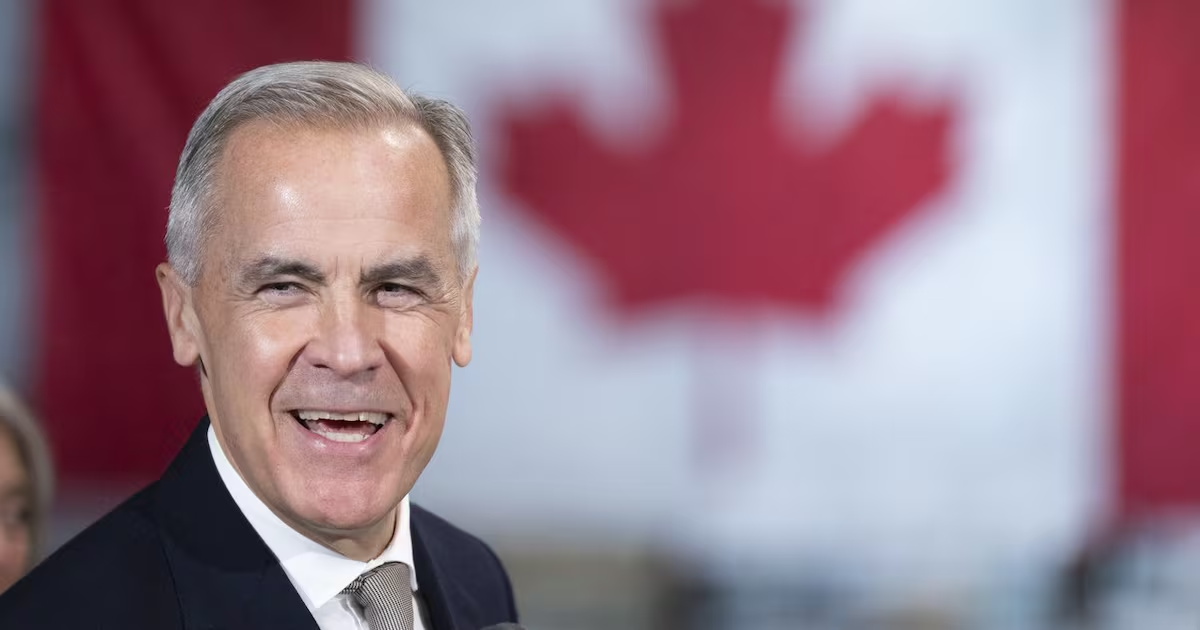
Conservative Leader Pierre Poilievre is calling for Prime Minister Mark Carney to reconvene Parliament to get details on the proposed U.S. trade deal he rejected, and answers on how Canadians will be affected by his plans to hit back.
In a letter to Carney on Sunday, Poilievre says it's time for the prime minister to release the text of the deal because "Canadians must see it to judge what options are on the table."
He also says Canadians need to know how much Carney's trade and economic policies will cost them with higher prices on groceries, gas and other items.
In addition, Poilievre asks how Carney will protect steel, aluminum, lumber and auto manufacturing jobs threatened by tariffs.
Carney suspended trade talks with the United States on Friday after accusing the U.S. administration of introducing measures that included restrictions on Canada's ability to do deals with other countries, and he promised retaliatory tariffs in response to new U.S. ones that took effect on Saturday.
Conservatives push Carney to reveal details of rejected U.S. trade deal
Poilievre says in his letter that Parliament's duty is to hold government accountable, and that job has never been more pressing.
"We must put the national interest first. The failure to secure a durable trade agreement, together with escalating tariffs, now threatens deeper economic pain on top of a decade of rising costs and zero economic growth in the Canadian economy," Poilievre said.
"In a crisis that defines the future of our people and our country, Conservatives are ready to return to Parliament, to act with the urgency our people demand, and to put Canada first."
Many of the points raised in Poilievre's letter echo those raised Sunday by Canada-U.S. relations critic Shuvaloy Majumdar, who said that while his party supports the government's decision to reject the deal, Parliament is in the dark about what was on the table.
Majumdar said he's not asking for "negotiating secrets," but rather information that both the Canadian and U.S. governments already know.
Carney says trade deal became untenable when U.S. 'asked too much and offered too little'
Mark Carney doesn't stop the United States from driving negotiations over a cliff
Poilievre said transparency is especially important, claiming Carney misled Canadians about the deal that was ultimately reached to open the Gordie Howe Bridge. He said the truth only became public when Canadians saw the deal.
"Canadians elect Parliament to defend their interests and decide the hard questions. Those questions can no longer wait," he said in his letter.
The U.S. introduced new 50 per cent tariffs on billions of dollars' worth of Canadian exports on Saturday. The new U.S. tariffs target $28 billion in Canadian goods ranging from hockey sticks and honey to essential oils and dairy products.
Carney responded that retaliatory tariffs will hit the U.S. starting Sept. 8, after Canada walked away from what he called a "bad deal."
FULL SPEECH | Carney explains why Canada suspended trade talks with U.S.
In a post early Sunday on his Truth Social account, U.S. President Donald Trump returned to mocking Canada as another U.S. state, saying "Canada wants the benefits of being a state, without being one."
Other Canadian opposition parties on Sunday stopped short of calling for details of the rejected deal to be made public, but supported the idea of the government briefing party leaders, or MPs, on what's been happening with the trade talks.
Carney on Saturday accused the U.S. administration of introducing measures in the final hours of negotiations that restricted Canada's ability to do deals with other countries.
He told reporters the U.S. also added terms near the end of negotiations that restricted Canada's protections of language and culture.
He also said the U.S. offered to lower tariffs on autos in exchange for other concessions, but said the offer didn't include medium and heavy trucks.
Related Stories
 Canada
Major projects CEO faces B.C. First Nations’ frustrations over lack of consultations
54 minutes ago
 Canada
As Americans play ‘power game,’ draft document shows Canada
54 minutes ago
 Canada
Prince Harry and Meghan cheered as they make first joint appearance since returning to U.K.
54 minutes ago
 Canada
Environment Canada warns of 'damaging' winds on the Avalon and Bonavista peninsulas, Thursday morning
1 hour ago
 Canada
She wanted to know why she was banned from Amazon. Then she encountered chatbots
1 hour ago
 Canada
Riley Laychuk's Manitoba forecast for Thursday, Oct. 15, 2026
2 hours ago
 Canada
Carney to attend pro
2 hours ago
 Canada
Steven Waldman: Canada must continue leading the way on support for local news
2 hours ago