
Pokémon Go celebrates 10 years with global festival, as fans continue to try to catch 'em all
Pokémon Go celebrates 10 years with global festival, as fans continue to try to catch 'em all
The mobile game took over the world in 2016. It still has many dedicated players today
For a short time 10 years ago, Pokémon Go ruled the world.
Millions of players came out to play the new mobile phone app, with players searching for monsters from the popular series of video games originally created by Nintendo — crowding parks, city streets and other public spaces.
"Oh my God, it felt like the closest thing we had to world peace," said Ben York, who was in downtown Toronto on Saturday catching yet more Pokémon with his friends.
"Everyone got along with everybody. There were groups of people in downtown areas that you wouldn't normally have groups of people. You met your neighbours [playing the game]," said Nick Clark, one of York's friends.
While you're not likely to see the swarms of players you did in 2016, dozens of players walking while playing on their phones — often connected to a battery pack — can still be seen if you look in nearly any direction in parts of Toronto, including Nathan Phillips Square or High Park.
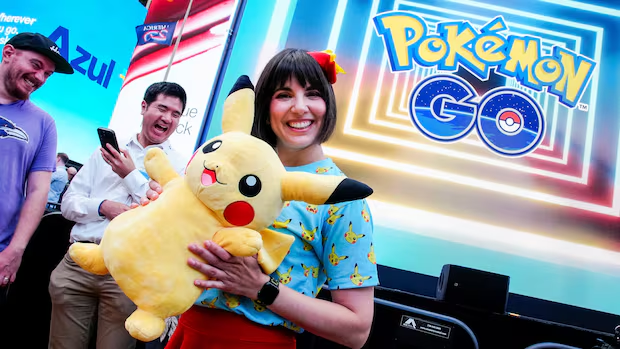
Pokémon Go publisher Scopely ran special global events to celebrate the 10 years since the game launched in July 2016. Over 1,000 players took part in an in-person raid event in New York City's Times Square, according to Scopely, as videos of Pokémon covered the square's gigantic screens.
The game was originally developed by California-based Niantic Labs. It was acquired by Scopely, which also develops Monopoly Go, in 2025 in a deal that was reportedly valued at $3.5 billion US. Scopely itself was acquired by Savvy Games Group, a subsidiary of Saudi Arabia's Public Investment Fund, in 2023.
How Pokemon became a source of soft power and among the world's biggest media franchises
Pokemon Go maker sells off games division to Saudi company for $3.5B
800 million players over the years
Pokémon Go has been played by more than 800 million people in more than 150 countries and regions since its launch, according to a news release from Scopely. The release also says it's consistently been in the Top 10 most popular lists of mobile games every year, and in 2025 alone generated over $1 billion US in revenue. (It did not specify the number of players this year.)
When it first launched, Pokémon Go was hailed by some as a new frontier for gaming tech. The app heavily features augmented reality, which superimposed virtual characters onto real-life videos taken with your phone's camera.
If you ask people still playing today, however, the appeal is more simple: it's about getting outside, meeting with friends and catching Pokémon.
"We often use it as an excuse to get together, and we always make a day out of it. Like, we get food and we hang out," said William Rapchak, who was also out searching for Pokémon with York and Clark.
"And then Pokémon becomes the background of a social event."
The game has not been immune from controversy, however. Some players voiced concern about the game's sale to the Saudi Arabia-owned Scopely as yet another chapter in the nation's growing presence in entertainment and sports that critics say whitewashes its record of human rights abuses.
From comedy festivals to women's football, Saudi Arabia is expanding its cultural power
Comedians performing at Saudi Arabia comedy festival called out for 'whitewashing' country's regime
And according to a June report from Dutch outlet Trouw, data gathered by Pokémon Go players who engaged with its optional location-scanning quests could have gone on to be used to train military drones.
In December, one of former developer Niantic's spinoff companies announced a partnership with Vantor, an intelligence company that develops software for drones, including those used by militaries.
A spokesperson for Niantic denied that any data collected from the game was part of the deal, according to gaming news site IGN.
Players who spoke to CBC News expressed a mix of concern and resignation at the situation. Rapchak says he's considered leaving the game over the years, knowing it was impossible to predict whether Niantic would sell his user and location data for an unknown purpose.
"I've never liked that, and it boggles my mind why I still play it sometimes," he said.
He says he turns off the game's augmented reality settings on his phone, hoping it might make a difference.
Clark is somewhat more resigned to the situation. "I feel like we're at a place where it's just like, what isn't selling our data? Like Facebook, Instagram, everyone has our data."
Such concerns seem unlikely to entirely slow the game's momentum, slow and steady as it may be. Scopely this week announced over two dozen upcoming community events with exclusive in-game rewards in cities around the world. Canada was listed as one of the hosts, though no cities were yet named.
Meanwhile, Japan-based The Pokémon Company, which is co-owned by Nintendo, is in the midst of celebrations for the franchise's 30th anniversary. The franchise debuted in 1996 on the Game Boy with the dual Pokémon Red and Blue games.
Jonathan Ore is a writer and editor for CBC Radio Digital in Toronto. He regularly covers the video games industry for CBC Radio programs across the country and has also covered arts & entertainment, technology and the games industry for CBC News. You can reach him at jonathan.ore@cbc.ca
Related Stories
 World
World
Manchester United weigh up stunning move for Real Betis and ex-Tottenham forward Troy Parrott
2 days ago
 World
World
Israeli police arrest 10 following weekend attacks by settlers on journalist and diplomats
2 days ago
 World
World
Trump says suspension of Russia sanctions is to keep peace negotiations going
2 days ago
 World
World
Ukrainian drones strike St. Petersburg oil facilities | NHK WORLD
2 days ago
 World
World
Victoria Falls stadium in Zimbabwe nears completion for CWC27
2 days ago
 World
World
‘The world will be amazed:’ Iran’s commanders prepare for further war
2 days ago
 World
World
Festival opens with musket salute in Sakai, Osaka
2 days ago
 World
World
Trump's new pitch for Republican candidates — they're really good
2 days ago