
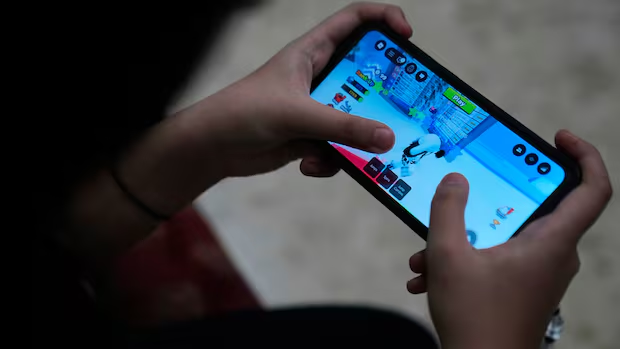
Police keep warning parents about Roblox. So why isn't it in the social media bill?
Police keep warning parents about Roblox. So why isn't it in the social media bill?
Experts say Ottawa is using an outdated notion of social media that doesn’t cover gaming
Penelope Sokolowski was among the millions of teenagers who avidly use Roblox, the online gaming platform, when she met a member of a violent, nihilistic cult.
Their conversation on the site moved to Discord, a messaging platform popular with gamers, where she was coaxed into cutting herself and trying to harm the family cat.
She sent videos and images of the damage to members of the cult, known as 764, a terrorist entity in Canada. At age 16, she died by suicide.
We know violent and gory videos exist online. Teens are seeing more of them than you'd think
Ottawa moves to restrict social media for kids under 16
"This group scooped in and took a hold of her heart and mind and body," Penelope’s father, Jason Sokolowski, told CBC News.
"I don't want any other parent or child to go through the experience that my daughter and I had. It was a horror show every single day."
Yet neither Roblox nor Discord is covered by the Safe Social Media Act, legislation the Carney government tabled earlier this month.
The bill lays the groundwork for restricting social media access for children under 16 to sites that don’t implement safety regulations, such as age-verified accounts.
While the bill doesn’t specify which platforms it will apply to, officials have said gaming and messaging platforms will fall outside its purview, at least initially.
Even supporters of the legislation say it's an alarming omission.
"It's ludicrous that they be left out of the scope," said Sara Austin, CEO of Children First Canada, an advocacy group that lobbied for regulating online spaces.
Police warn about extremism on gaming sites
In the last month alone, police in Newfoundland and Labrador, Manitoba and British Columbia have warned parents about the extremism of groups like 764 on gaming and messaging platforms like Roblox and Discord.
Late last year, Public Safety Canada authored a brief that described Roblox as "an entry point where vulnerable children and youth are targeted by malicious actors," according to The Logic.
The RCMP said its National Center for Missing and Exploited Children received more than 1,000 reports involving Roblox between 2024 and 2025.
"I was a bit dismayed to see them [the government] kick the gaming platforms down the road, given the level of ongoing grooming and extremism we are seeing on those apps," said Amarnath Amarasingam, an expert in extremism who teaches at Queen's University and a member of an expert panel the government consulted while drafting the legislation.
Roblox has an estimated 132 million active users worldwide, around 50 million of whom are under the age of 13.
The site features millions of games for users to choose from, many of them geared to younger audiences. Players can enhance their gaming experience by using an in-app currency, accessed with actual money, to buy digital products, such as clothes or tools for their avatar.
Though Roblox considers itself a gaming platform, players can interact with each other, including through voice chat.
How 764 members are targeting minors for clout
Like messaging platforms, where servers have a cap on the number of participants, Roblox doesn’t fit within the government’s existing definition of a social media service, which depends on features that allow users to communicate to the world at large.
That definition — which would apply to legacy platforms like Facebook and X (formerly Twitter) — is a holdover from the previous government’s attempt to regulate online harms, said Emily Laidlaw, a law professor at the University of Calgary who also served on the government’s advisory panel.
"I think that the threat related to gaming has just gotten that much worse. So it's more obvious we need to include gaming," she said. "It was really just a policy decision to not do it right now."
Laidlaw pointed out that the bill does call for the creation of a Digital Safety Commission to oversee compliance. It would have the power to determine whether Roblox and Discord should be subject to the new law.
Marc Miller, the minister who sponsored the bill, hinted such an outcome was likely while speaking to the media earlier this month.
"The focus of gaming is gaming, but there can be social media aspects of it," he said.
"So when I talk to those companies, I tell them, 'Look where the puck [is going] and figure out what may happen if you don't regulate your platforms that are looking more social media-ish than simply gaming.'"
Advocates calling for amendments
For advocates like Austin, that process — which would involve additional consultation — will take too long.
"We shouldn't just be waiting for the digital commissioner to put these things in place when we know the harm is already happening," she said.
Austin plans to lobby the government to introduce amendments to the bill when Parliament resumes in the fall.
Roblox, which is facing several lawsuits in the U.S. alleging poor child safety features, recently rolled out new age-verification measures and account settings aimed at responding to these concerns.
The company didn’t respond to a request for comment from CBC News.
Discord, which also didn’t respond to CBC News, adopted similar measures earlier this year, only to promptly roll them back after user backlash over privacy concerns.
These industry-led attempts at change only underscore the need for governments to regulate online spaces that are popular with children, said Jason Sokolowski.
Canada is the latest to try limiting kids' social media exposure — but new bill gives platforms room to change
Canada proposes social media ban for kids — critics say it won't work
He called the Safe Social Media Act an important "first step" in helping the public recognize that the potential harms of social media are of a different order than what children of previous generations faced.
"The people who do understand this are the owners of the platforms, the ones who are making it addictive," Sokolowski said.
"And we have to sit here and fight with our dead children to say, this has to stop."
Jonathan Montpetit is a senior investigative journalist with CBC News, where he covers social movements and democracy. You can send him tips at jonathan.montpetit@cbc.ca.
Related Stories
 Canada
Drinking among Gen Z adults has gone up, busting the sober myth
26 minutes ago
 Canada
Canadians weigh in on Carney government’s response to U.S. tariffs
26 minutes ago
 Canada
U.S.
27 minutes ago
 Canada
Strong support for Ottawa's counter
27 minutes ago
 Canada
This Ontario man thought he bought Canadian beef at Costco. Then he saw the label in the back
27 minutes ago
 Canada
8 officials suspended after probe into Pakistan hospital fire that killed 14 newborns
1 hour ago
 Canada
Alberta's first day in Canada: Sept. 1, 1905
1 hour ago
 Canada
Alberta Premier Danielle Smith to meet with U.S. officials amid trade war
1 hour ago