
Punjab needs vision beyond politics
Punjab needs vision beyond politics
The question before us is whether we have the collective will to rise together
THE story of Punjab is often told through the lens of its resilience, prosperity, and contribution to nation-building. But what many tend to overlook is that the state's contemporary history is packed with political betrayals and social disruptions that have steadily eroded all its advantages. Punjab's eagerness to contribute to nation-building found little support from the Centre. Over time, decisions taken in the name of national priorities deprived Punjab of its most valuable assets — land, water, industry, and most importantly — human capital.
For most of India, August 15, 1947 marked the dawn of freedom. But for Punjab, it pronounced the trauma of Partition. Punjab bore the heaviest cost of Independence. Land divided, millions of people killed, several million more uprooted, its cultural and commercial capital Lahore lost to Pakistan, historic trade routes wiped out and a robust economy gone almost overnight. Eight decades later, the economic, social and psychological impact of that jolt continues to shape Punjab's trajectory.
Less than two decades after the Partition, Punjab suffered another historic rupture, this time via the reorganisation of 1966, carried out on linguistic and cultural lines. Greater Punjab, which once stretched from the Hindu Kush (Kashmir) in the north to Sindh (Rajasthan) in the south, from Khyber Pass (Afghanistan) in the west to the Yamuna (Delhi) in the east was cut. The creation of Haryana and the transfer of its hill regions to Himachal Pradesh fundamentally altered Punjab's identity and psyche. Punjab again paid a heavy price. It lost not only territory, but also strategic assets like land, water, forests, key industrial centres, tourist hubs, and its exclusive claim over its capital — Chandigarh.
The militancy of the 1980s and early 1990s dealt another blow to economy. Investor confidence collapsed, industrial expansion stalled and businesses started to move out. Though peace eventually returned, Punjab had lost a crucial decade while the rest of India was reaping the benefits of economic liberalisation.
During this phase Punjab started to lose its greatest asset — its people who began to leave in large numbers. The state lost entrepreneurs, professionals, innovators and skilled workers who could have driven its next phase of growth. The resulting labour shortages in agriculture and industry started being filled by migrant workers from Bihar and Uttar Pradesh, gradually altering Punjab's demography.
The challenges faced by Punjab today are the cumulative result of decades of ignorance, neglect and selfish decisions taken both by the political leaders and bureaucrats and the people of the state.
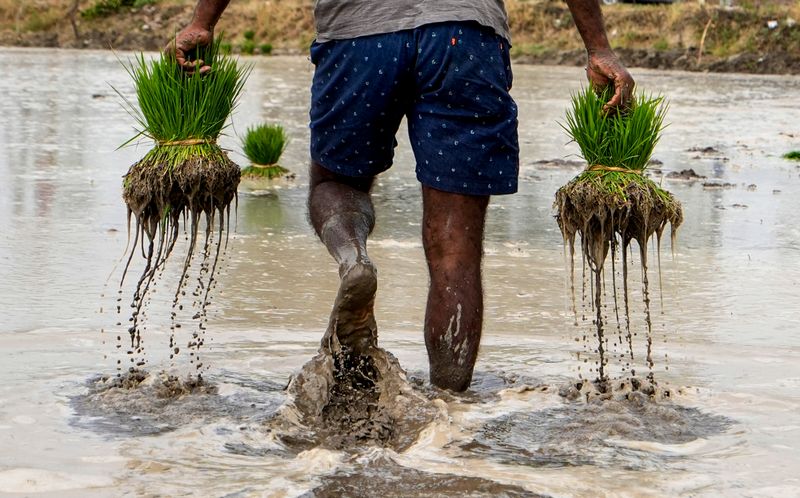
Punjab's fertile land, abundant groundwater and clean air are today under stress. Decades of excessive groundwater extraction, indiscriminate use of fertilisers and pesticides, industrial pollution and poor waste management have degraded the soil. Groundwater levels continue to fall at an alarming rate, while water contamination is being reported across Punjab. Air pollution caused by stubble burning, industrial emissions, vehicular pollution and urbanisation has become a year-round public health hazard. Yet there is still no comprehensive policy to reverse these trends or restore Punjab's ecological health.
The greatest irony is that the very land that has sustained agriculture for generations is rapidly disappearing. Every year, thousands of hectares of fertile farmland are permanently lost to national highways, unchecked urban expansion, residential colonies, educational institutions, commercial establishments, marriage palaces, etc. While development is essential, it cannot come at the cost of the very resource that defines Punjab's identity and economy. The real question is whether this relentless conversion of farmland into concrete has actually made Punjab more prosperous. Has it generated enough employment, higher incomes or sustainable economic growth? The evidence suggests otherwise.
The state's inability to diversify its economy has further weakened employment generation. Plus, PThe state has failed to invest adequately in building a workforce equipped for innovation, advanced technology and AI. Government jobs remain limited, while private-sector growth has failed to keep pace with the aspirations of a young population. Many young Punjabis now see migration as their best route to economic security.
Perhaps Punjab's most serious challenge today is the absence of a shared political vision. Its politics has become trapped in an endless cycle of confrontation. All energy is being spent on making headlines rather than solving problems. Amid this noise, the most important question remains unanswered: What kind of Punjab are we trying to build?
Today, Punjab needs a serious conversation about what it wants to become over the next 25 years. It needs all its political leaders to together draft a common charter. A shared vision should transcend party lines and survive changes in government, irrespective of who comes to power. We need to focus on finding answers to questions like:
Punjab does not need another political battle. It needs leaders who are willing to rise above personal ambition and partisan divides, who place the state's interests above their own, and work towards a common vision. Personal rivalries must give way to a shared commitment to Punjab's future. The state must come before the party, and the people before politics.
We do not need isolated solutions. We need a structured plan of action that rigorously assesses every core sector, identifies systemic gaps, recommends transformative reforms and defines realistic, time-bound targets to ensure accountability. No single government or political party can achieve this alone. It demands a collective effort. The question before us is not whether Punjab can rise again. It is whether we have the collective will to rise together.
Related Stories
 Finance
Crypto startup Alpaca targets prime brokerage technology market
3 hours ago
 Finance
Trump ousts Kimberly Guilfoyle as US ambassador to Greece after corruption allegations
5 hours ago
 Finance
Deloitte helped in falsifying documents to evade tax on Abramovich’s wealth, BBC finds
1 day ago
 Finance
El
1 day ago
 Finance
Côte d’Ivoire appoints Tenon Coulibaly as technical adviser for sustainable digital development
1 day ago
 Finance
From start-ups to scale-ups (2/2)
1 day ago
 Finance
Top Senate Republican calls Guilfoyle reports ‘very troubling’
1 day ago
 Finance
Judge orders Trump administration to end taxpayer
2 days ago