
Q&A: Economist explains why Alberta’s economic growth is leaving the rest of Canada behind this year
Q&A: Economist explains why Alberta’s economic growth is leaving the rest of Canada behind this year
ATB’s chief economist says other provinces are much more vulnerable to tariffs
Despite recent geopolitical and trade turbulence, a new report from ATB Financial projects Alberta’s economy will finish the year in a strong position compared to the rest of the country.
The firm’s latest Quarterly Alberta Economic Outlook report says, so far this year, the province is far outpacing the national average across a range of indicators, including employment, population and retail sales growth.
The report, which was published Thursday, projects Alberta's real GDP will grow by 2.6 per cent in 2026, well above the 0.9 per cent projected nationally.
To unpack that outlook, the CBC’s Radio Active spoke with ATB chief economist Mark Parsons about the strengths, challenges and other key factors shaping the province’s economy this year.
This interview has been edited for length and clarity.
What does the report say when it comes to economic growth so far this year and into next year?
So all things considered, the Alberta economy is doing fairly well. There's been a lot of geopolitical issues, obviously, with the war in Iran and Trump tariffs, but I would say that Alberta has weathered the storm relatively well.
But if a lot of people are listening and thinking "It doesn't feel like that,” it's because it's not a classic energy boom like we've had in the past.
Companies are being cautious about their investments. They're waiting for more details about the West Coast pipeline and maybe getting some production incentives. So it's a bit of a wait-and-see there. But all things considered, Alberta is doing relatively well.
What could possibly derail or change this trajectory of growth?
There are a lot of things I’m keeping my eye on right now. Inflation has reared its ugly head again. You fill up at the pumps, you know that gas prices are higher. Diesel prices have shot up.
My concern there, though, is that inflation becomes generalized. So it's not just energy. It spills over to food and things that we purchase every day.
And if that happens, the Bank of Canada is going to have to lean against that with higher interest rates. So what I don't want to see is a new rate-hiking cycle.
We do think the Bank of Canada is going to have to raise interest rates next year, but if they have to aggressively increase interest rates, that could cause a lot of pressure for consumers.
Around this time last year, Alberta was facing a $9.4-billion deficit because of low oil prices. Then the war in Iran started and basically wiped that out. Realistically, though, how long can Alberta keep relying on oil and gas revenue to support the economy's health?
That's not changing anytime soon. This is a budget that relies heavily on resource revenues, and it’s very sensitive to the price. We've seen that it went from a deficit to a surplus. That could go the other way anytime soon.
So that's, I think, a longer-term issue around fiscal sustainability and how much we should be relying on volatile resource revenues. That's a long-term problem that needs to be solved. I think in the short term it does provide a lift for Alberta that other provinces simply do not have.
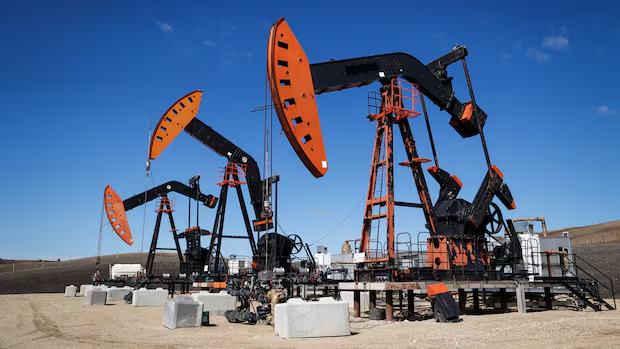
The big question on my mind though is: Is that extra cash being generated by oil and gas producers? Like, is that going to end up in the ground? Are we going to go through a new growth cycle, investing in the oil sands, filling new pipelines? That is the big upside in our forecast.
Alberta leading country in economic growth while rest of Canada stalls: report
In my forecast I'm really cautious. I'm not building that in because we just don't know if it's going to happen. But I think we're potentially on the verge of a new wave of spending.
I know everything seems negative right now, like high inflation and everything, but there is the possibility that we can be in a stronger growth environment.
How is Alberta doing amidst the Trump tariff situation compared to the rest of Canada?
So Alberta is being impacted. All the trade uncertainty is making businesses a little bit more cautious than they otherwise would be in hiring and investment. But I would say Alberta has a lighter tariff touch.
Right now, the new tariffs that were introduced impact about one per cent of our exports to the U.S. It's five per cent nationally. So Alberta is still being impacted, but just not near as much.
The reason for that is the Trump administration is really targeting certain sectors like steel, aluminum, autos and lumber. We have some of that here in Alberta, but not near as much as Quebec, Ontario and B.C.
What's the situation when it comes to unemployment in Alberta right now?
Unemployment is still a bit of an issue. It's elevated at 6.8 per cent right now.
The reason it's higher than you would expect given how the economy is doing is because we're getting so many people moving here looking for work.
So it's not about job growth. Our job growth has been pretty good. It's just that we're getting so many job seekers.
Alberta municipalities want slice of provincial surplus to pay for infrastructure
When you have job seekers outpacing job growth, then you have higher unemployment. We do expect that to change because population growth is slowing.
So we expect some balance to return to the labour market, and we do see that unemployment rate heading a little bit lower into kind of the low sixes next year.
What about youth unemployment specifically?
It’s still an issue at 15 per cent. That's too high.
A lot of youth are struggling to find work and it's actually worse than that because if you look at labour force participation, that's also lower.
The share of youth with jobs is just over 50 per cent. So that's been trending down for a while.
One of the challenges right now is we've had a fast growth in the youth population. So it's creating a lot of competition for youth looking for work and youth sometimes don't have the skills that are in demand right now.
So one of the shortages we have is in trades, and it's not like youth will necessarily have those skills. They’ll have to develop them over time. So that's something I'm watching closely.
'We will still feel it here': Tariffs might hit Alberta economy, jobs more indirectly, say experts
The boomers are retiring though, so I don't think we can just wait that out, but that will eventually create some opportunities. We've seen seniors increase their participation in the workforce, but eventually that creates some shortages.
I'm hearing more and more from businesses that labour shortages could become an issue, especially in select areas, because if we start building all these projects all at once, we have a Meta data centre that’s underway, and we have Dow's Path2Zero project in this region.
If we start getting the West Coast pipeline and we're starting to fill those pipelines, we're going to be talking about labour.
There have been a couple of notable reports recently about the potentially devastating financial costs of Alberta separating and even just the talk around separation. So how do you factor that into your forecast?
So there’s a lot of uncertainty right now around the separation issue and the referendum.
We do know from business surveys that it's top of mind, and in fact, the majority of businesses say it's having some type of impact. Despite that uncertainty, the economic data has been pretty decent.
The one thing I'm looking at pretty closely is provincial migration. Are people still moving here? We've had 20 consecutive quarters of net inflows. So that's still trending pretty positively, but I think it more so speaks to other factors in Alberta's favour right now.
Alberta government commissions $1.5M economic analysis and panel on cost of separation
I think the uncertainty is weighing, but it's being offset by things like higher oil prices and the momentum we have in other areas. So I think that's why you're not seeing it really show up in the data.
What the U of C report shows though is if we do move to a separation, then that has short-term costs with uncertain long-term gains. So that's kind of what the U of C report points to. Obviously our forecast is based on status quo assumptions in keeping with the recent polling results.
How do these factors affect the overall affordability issue at large?
So this is where it gets to how people are feeling. And people are saying life is expensive. It's really, really hard to raise a family, afford groceries and things like that.
People are feeling it, including here in Alberta. So I think it's more of our relative position that you have to think of.
I think people are feeling more the economic drag from, say, the Trump tariffs in places like Ontario and Quebec because those industries are being targeted.
Alberta separation could prompt potential $62B economic hit, business exodus: Calgary Chamber report
Alberta is benefiting because we happen to produce oil, a lot of oil which has gone up in value and is not being tariffed.
So that provides an offset that other provinces don't have. But we're still facing cost-of-living pressures and we still have high youth unemployment. We still have a lot of issues. It's just that our relative position is better right now.
It's not a boom like we've had in the past. If this doesn't feel like 2010 to 2014, because it's not. We're not growing five per cent a year, we're growing at 2½ per cent.
It's just that some regions are really under a lot of pressure from tariffs. Alberta is less so, but cost of living is a problem across the country.
Alberta separatists remain motivated in face of poll suggesting dip in support
Alberta public safety minister says inmate releases to city streets aren't a common occurrence
Edmonton Police Service asks court to order homeless man to pay $8,400 before proceeding with lawsuit
Related Stories
 Canada
Panda diplomacy: China lends animals to U.S. for foreign ties
9 minutes ago
 Canada
What a historic 'Super El Niño' could mean for Canada
10 minutes ago
 Canada
Examining Canada's role at the UN General Assembly
10 minutes ago
 Canada
Demi Vollering wins UCI Road World Championships cycling event in Montreal
1 hour ago
 Canada
New U.S. bans to take effect Tuesday: Here’s what’s affected
1 hour ago
 Canada
Our supply chains are under threat,’ German minister says his country wants more Canadian LNG
2 hours ago
 Canada
Threats to Canada’s North have ‘shifted significantly,’ foreign minister says
2 hours ago
 Canada
Federal intelligence agency contacted amid U.S. interference allegations in Quebec election
3 hours ago