
Quality leader's warning: 'Bad data at AI speed is still bad data'
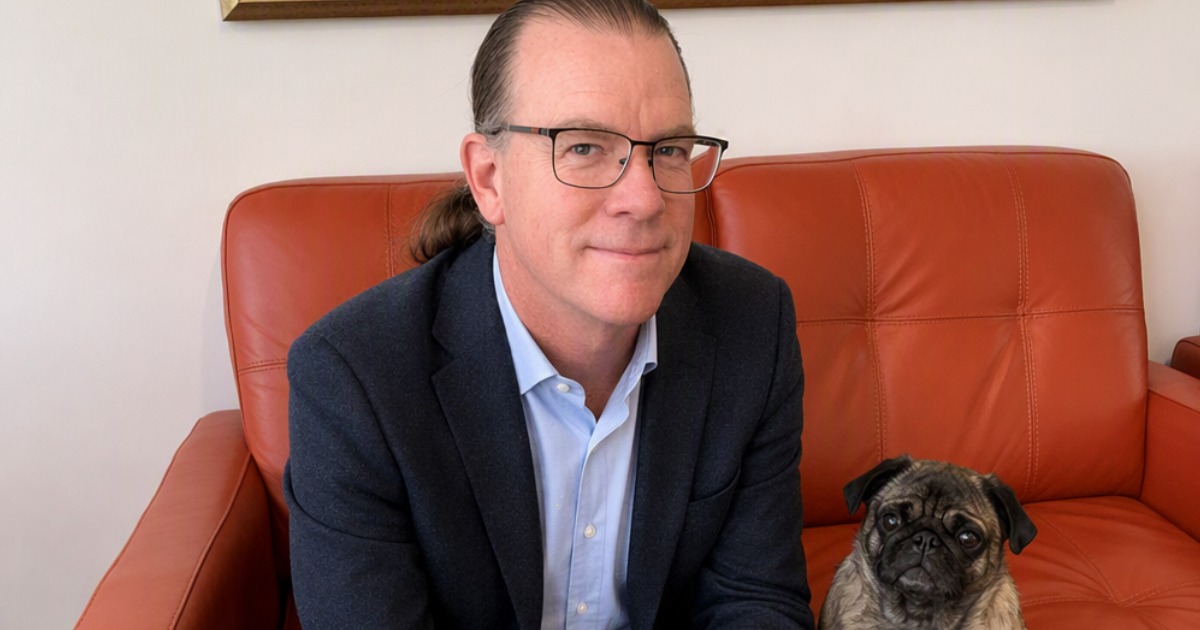
Olive, and her best friend Troy Heninger, director of data governance and data quality at St. Luke's Boise Medical Center
Artificial intelligence promises to transform healthcare, but the technology's success will depend less on the sophistication of algorithms than on the quality of the information they consume.
That's according to Troy Heninger, director of data governance and data quality at St. Luke's Boise Medical Center, who believes executives should spend just as much time strengthening data governance as evaluating AI vendors.
As health systems race to deploy generative AI for clinical documentation, analytics and operational decision-making, they're also dramatically increasing the amount of healthcare data being created, reused and analyzed – making governance more important than ever.
"Bad data at AI speed is still bad data," Heninger said. "It simply moves faster and at far greater scale."
Without trustworthy data, he said, even sophisticated AI models can generate answers built on weak assumptions, inconsistent definitions or statistical relationships that confuse correlation with causation. Those responses may sound convincing while still being fundamentally wrong.
At St. Luke's, executive leadership has treated governance as a strategic priority rather than a compliance exercise. That support helped evolve the organization's work from documentation into an enterprise capability emphasizing trust, stewardship, quality and clear decision rights.
The effort has helped St. Luke's earn, among other data governance awards, HIMSS Stage 6 recognition for its achievements with the Analytics Maturity Assessment Model.
Building trust before deploying AI
Heninger argues that governance should be woven into AI strategy from the beginning. Too often, organizations view governance as something to address after selecting technology. In reality, he said, AI initiatives are simultaneously technology, data quality, ethics, stewardship, risk and trust initiatives.
Technology alone cannot resolve disagreements over how information should be defined, owned or used. Those challenges require collaboration among clinical, operational and technical stakeholders along with governance structures that establish accountability.
At St. Luke's, the governance journey began by mastering location data before expanding into additional domains. That incremental approach helped the organization build an ontological understanding of its information, defining not only what data represents but also what it means in business and clinical settings.
Even apparently simple concepts require careful interpretation. A dermatology procedure, for example, may not be performed by a dermatologist and may not occur in a dermatology clinic. Without clear semantic definitions, AI may recognize patterns but misunderstand their significance.
"AI systems can infer patterns, but they do not independently determine whether data is accurate, contextually appropriate, clinically meaningful or fit for a high-stakes use case," Heninger said.
The growing enthusiasm for connecting additional data sources also deserves careful scrutiny, Heninger said. AI creates understandable pressure to make more information available and connect more dots – but expanding datasets does not automatically improve results.
He distinguishes between relatively closed, well-defined data environments and broader, open-world data. In many operational and clinical situations, starting with well-governed, clearly understood information is safer because definitions, intended use and quality are already established.
If organizations are not reasonably confident that information is trustworthy and fit for purpose, feeding larger volumes of data into AI models simply amplifies existing problems instead of solving them.
Business glossaries, common standards and stewardship accountability help create the context AI cannot establish on its own. While AI can assist with discovery, categorization and recommendations, Heninger said humans remain responsible for determining whether information is accurate, consistent and appropriate for high-stakes clinical use.
For CIOs and other health IT leaders, Heninger's advice is straightforward: Make data governance a core element of every AI strategy from day one. Investments in governance should include people, standards and processes – not just technology.
The payoff extends well beyond AI. Strong governance improves patient safety by supporting reliable analytics and clinical decision support. It strengthens compliance readiness, reduces regulatory risk, and enables more dependable operational and population health insights.
Perhaps most importantly, it builds clinician confidence. AI adoption will only scale if users trust the underlying information and understand why systems reach particular conclusions, Heninger said.
As AI capabilities continue advancing, Heninger expects organizations with disciplined governance programs to realize the greatest long-term value. Rather than slowing innovation, governance provides the foundation that allows innovation to be deployed safely, responsibly and at enterprise scale.
"Data governance is not a barrier to innovation," Heninger said. "It is the prerequisite for innovation that actually delivers on its promise."
Follow Bill's health IT coverage on LinkedIn: Bill SiwickiEmail him: [email protected]Healthcare IT News is a HIMSS Media publication.
WATCH NOW: EHR vendors can help providers with AI deployment
Related Stories
 AI News
Bill Gross bets AI can help mass
1 week ago
 AI News
Nigeria records 93% rise in AI micro
1 week ago
 AI News
The Italian gelato maker using AI to invent new flavours
1 week ago
 AI News
Closing the Gap Between Agentic CX Pilots and Production
1 week ago
 AI News
New Brunswick data centre debate highlights cross
1 week ago
 AI News
How to Structure an AI Agent Referral Fee Agreement Between Startups
1 week ago
 AI News
No, AI didn’t delete a Swedish reality TV series
1 week ago
 AI News
There is no AI in Armageddon. Artificial intelligence is a tool, not an apocalypse
1 week ago