
Republicans portray Canadian border as a threat, but U.S. statistics tell a different story
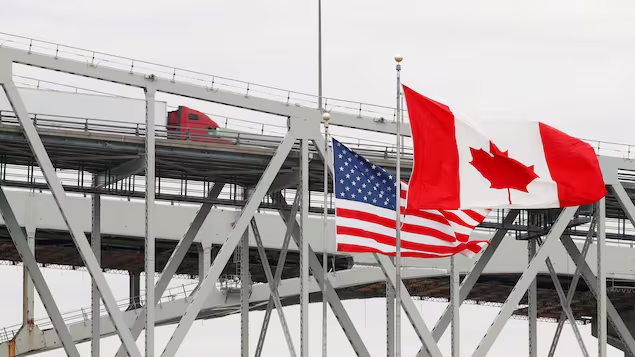
U.S. lawmakers held a hearing Tuesday on Capitol Hill they dubbed 'Northern Exposure: Assessing the Evolving Threat Landscape at America’s Northern Border.'
Photo: (Paul Sancya / The Associated Press)
Mike Crawley (new window) · CBC News ·
Republican members of Congress tried turning up the heat on Canada on Tuesday, depicting the northern border as a dangerous security threat allowing lots of drugs and illegal migrants into the U.S
But when the Republicans on the House border security and enforcement subcommittee tried to present evidence that such threats from Canada are on the rise, the statistics showed otherwise.
Tuesday's hearing (new window) on Capitol Hill was entitled Northern Exposure: Assessing the Evolving Threat Landscape at America’s Northern Border.
It kicked off with the subcommittee's chairman, Mississippi Republican Michael Guest, claiming that the Trump administration's crackdown on the southern border has driven Mexican cartels to shift their criminal enterprises to the border with Canada.
U.S. Homeland Security Secretary Markwayne Mullin made similar claims (new window) in June.
Illegal crossings have begun to shift north, claimed Guest. Drug seizures at the northern border have steadily increased, reaching record levels this year.
However, Guest and his fellow Republicans on the subcommittee often lacked the statistics to back up their rhetoric.
That became clear when the politicians got into their Q&A with several officials representing the Department of Homeland Security agencies who'd been called to testify.
Drug seizures along Canadian border 'down 55%'
Jason Schneider, acting deputy chief of U.S. Border Patrol, described narcotics trafficking from Canada as a persistent threat, but presented statistics that contradicted Guest's claim of record drug seizures this year.
Drug seizures along the northern border [by] the U.S. Border Patrol are down by 55 per cent, Schneider told the hearing.
Apprehensions of undocumented immigrants in the regions along the Canadian border have been dropping too, Schneider said. They're 22 per cent lower in the current fiscal year (which began in October) from the 2025 fiscal year, which itself was down 67 per cent from the year before.
Nevertheless, the Republicans persisted with their probing into the threats from Canada.
Congressman Josh Brecheen of Oklahoma raised the potential threat from people with commercial drivers' licences from Canada.
Are you concerned or seen any issues regarding commercial drivers, non-domiciled drivers that would utilize our northern border that could be making us vulnerable for any type of attack? Brecheen asked the witnesses.
'Not so much on the northern border'
I'm not familiar with any specific instances related to that, responded Chris Holtzer, who runs U.S. Customs and Border Protection's office of field operations.
Not that I'm aware of, added Schneider. We do encounter these subjects at our checkpoints along the southwest border, however not so much on the northern border.
Brecheen, the Oklahoma Republican, also asked about cross-border fentanyl trafficking from Canada, something U.S. President Donald Trump began complaining about even before his return to the White House last year.
The border security officials described the volume of the deadly drug coming from Canada as minimal in comparison with Mexico.
The bulk majority of what we see is coming across the southwest border, said Holtzer. The most we've seen [from Canada], I think, in one area was Blaine, Wash., with about two pounds total of fentanyl.
U.S. officials have seized just 3.2 kilograms of fentanyl along the northern border over the past eight months, according to the latest U.S. Customs and Border Protection statistics (new window) published online.
That's down sharply from the 35 kilograms of fentanyl seized along the northern border during the entire 2025 fiscal year.
Both figures are but a tiny fraction of the fentanyl seizures along the Mexican border in the same time periods: 3,200 kilograms over the past eight months and 5,200 kilograms in the 2025 fiscal year.
Buffalo Democrat blasts Trump's 'misguided priorities'
The Democrats on the subcommittee mostly used their time with the witnesses to challenge Customs and Border Patrol agents' participation in immigration raids away from the borders and to question whether agents will be deployed at voting locations during the upcoming midterm elections.
We're laser focused on the border. We have no intention to be at election sites, said Schneider.
The only Congressman at the hearing who represents a district on the northern border, Democrat Tim Kennedy of Buffalo, N.Y., warned that the Trump administration's extreme immigration enforcement agenda threatens the local economy.
We stand to lose when this administration diverts resources, harms diplomatic relationships with Canada, stifles lawful trade and surges agents into western New York to terrorize our community, Kennedy told the hearing.
Unfortunately, Buffalo has experienced all of these challenges because of misguided priorities at the White House.
Related Stories
 Canada
Albertans head to polls in historic referendum on whether they want to stay in Canada
1 week ago
 Canada
In the news today: four soldiers killed, Alberta referendum, AI privacy fears
1 week ago
 Canada
How a grass fire at a Canadian military base killed four soldiers
1 week ago
 Canada
How will household electricity rebate reduction, temporary winter pricing change impact Ontarians?
1 week ago
 Canada
Residents told to boil tap water due to bacteria
1 week ago
 Canada
Oil
1 week ago
 Canada
Albertans vote on path to independence as Carney fights to keep Canada united
1 week ago
 Canada
Two of 4 soldiers killed in fast
1 week ago