
Researchers document surge in unhoused deaths in Quebec
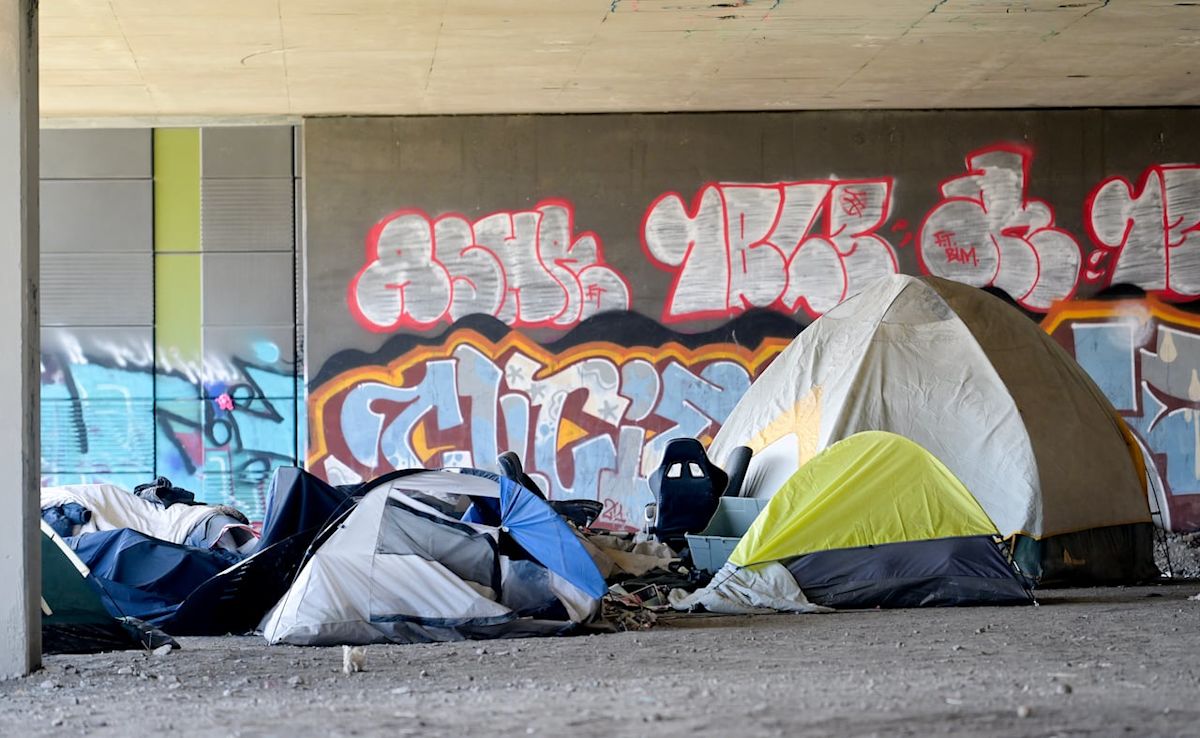
New data from the Université de Sherbrooke shows that deaths among unhoused people went up by about 180 per cent between 2020 and 2024 in Quebec.
In 2020, 45 people experiencing homelessness died, while in 2024, 127 people passed away.
Over that period, a total of 400 unhoused people died in the province. Montreal had the highest rate of death per capita, followed by the Outaouais region.
"It's a very, very sad and unfortunate event," said Dr. David-Martin Milot, a public health physician and one of the project's supervisors.
"The need was expressed by the health and public health [authorities] to better understand the phenomenon so we could better adapt interventions."
Milot says one of the study's goals was to use data to highlight the severity of the situation and bring a sense of urgency to it.
The first phase of the study was based on deaths listed in Quebec coroners' reports, which only investigate deaths where the circumstances are unclear, meaning the number of unhoused people who died is higher, according to Milot.
For example, when someone dies from a previously-diagnosed illness, it's not necessarily flagged to the coroner for review.
In order to more accurately document the deaths, the research team launched an online form this month where anyone is able to signal the death of a person experiencing homelessness. It can be accessed here.
Prior to the project, no data had been compiled on how many unhoused people die each year in Quebec.
Women more likely to die than men
The researchers found that deaths of unhoused men increased by 175 per cent, while the increase was even more pronounced for women, at 211 per cent.
The average life expectancy of unhoused men was about 47 years, versus 80 years for those with stable housing. For women the difference was even larger, with those experiencing homelessness living to an average of 42 years, compared to 84 years for those with a fixed address.
"It's very low. It's about half of the life expectancy of the general population," Milot said. "So we need to ask ourselves what is happening there."
Na'kuset is the executive director of the Native Women's Shelter of Montreal. She says that more data is not what's needed.
"The thing is that we have these numbers, right? Because we're the ones that when our community members die, we're the ones that are taking their names, their nation, their community," she said.
Na'kuset wants to see all levels of government contribute more funding to house women, especially Indigenous women, who she says make up a large portion of those who die.
"It's not normal and it's heartbreaking," said Na'kuset.
"We will continue to honor those who passed away. But we need more than just awareness. We need concrete measures."
Unhoused women often assaulted
Diane Pilote, executive director of Chez Doris, a Montreal women's shelter, said she's not surprised by the findings.
"Every month we are able to calculate around 30 to 40 new faces," she said. "So there is a real increase in the number of women in homelessness situation."
There are not many shelters that are set up to take in women and if there isn't space, women are especially at risk on the street, according to Pilote.
"Women are experiencing more violence just because of the fact that they are women," she said
Alex Desjardins, a community development coordinator at Chez Doris who has 15 years of experience working with unhoused people, agrees.
"A lot of times they're trying to find safety and protection from males on the streets," he said.
"Sometimes — it's not always like this — but a lot of times it's 'You can come live with me. You can come with me to the camp.' And then after a few days, a few weeks, it's 'You can stay, but you're gonna have to have sexual intercourse with me,'" Desjardins said.
He says if a woman refuses, physical and sexual abuse can ensue.
He says those sorts of traumatic experiences can make some women reluctant to seek medical help.
"'I don't trust the people who said they were gonna help me. I've been abused my whole life. I've been abused by this person,' they don't feel safe enough to go get that support," he said.
In order to address that need, Chez Doris has recruited volunteer medical professionals to staff a clinic in the shelter a few days a week.
"They don't want to go somewhere else. They want to stay here," said Desjardins. "It's one of the few places where they still feel safe."
The office of the minister responsible for social services says Quebec plans to develop a province-wide plan to fight homelessness, and that it's already earmarked $28 million to fast track measures in three regions particularly affected, including the Greater Montreal area, Quebec City and the Outaouais region.
Related Stories
 Canada
Albertans head to polls in historic referendum on whether they want to stay in Canada
3 days ago
 Canada
In the news today: four soldiers killed, Alberta referendum, AI privacy fears
3 days ago
 Canada
How a grass fire at a Canadian military base killed four soldiers
3 days ago
 Canada
How will household electricity rebate reduction, temporary winter pricing change impact Ontarians?
3 days ago
 Canada
Residents told to boil tap water due to bacteria
3 days ago
 Canada
Oil
3 days ago
 Canada
Albertans vote on path to independence as Carney fights to keep Canada united
3 days ago
 Canada
Two of 4 soldiers killed in fast
3 days ago