
Restrictive regulations will slow Indian startup formation by 20%, VC flows by 25%: Report

Restrictive digital regulations in India could lead to creation of 2,130 fewer startups annually; a loss of approximately ₹91,500 crore in venture investments each year and a reduction of some 2,45,000 startup jobs in India, says a study by Oxford Economics for Digital Prosperity Asia (DPA).
Digital Prosperity Asia (DPA) is a coalition representing small and medium-sized enterprises (SMEs) and startups across the Asia-Pacific that works to strengthen dialogue between the digital ecosystem and policymakers.
Oxford Economics, a global advisory firm that provides independent economic forecasting and economic modelling, suggested that a shift from India’s current enabling environment towards a more restrictive digital regulatory environment set to slow down startup formation by 20% and VC flow by 25% in India between 2025 and 2035.
According to the report, digital regulations are increasingly shaping the trajectory of India’s startup ecosystem, with the design and implementation of regulatory frameworks having significant implications for innovation, investment, and job creation.
Titled “Digital Regulations and the Startup Ecosystem in India”, the report draws on a survey of 550 ecosystem participants—including 350 startups, 100 venture capital firms, and 100 incubators—as well as expert interviews and quantitative economic modelling to assess the impact of digital regulations on India’s innovation economy.
Conversely, an even more enabling regulatory approach could boost startup formation by 7%, increase venture capital investment by 9%, and support an additional 80,000 startup jobs in 2035.
Bali Kaur Sodhi, Lead Economist at Oxford Economics said, “In an emerging market like India, maintaining proportionate, principles-based regulatory frameworks can support startup scaling, attract investment, accelerate technology diffusion, and strengthen the country’s innovation ecosystem.’’
By continuing to foster enabling digital infrastructure and adopting a balanced regulatory approach, India could unlock significant economic gains, including an estimated 80,000 additional startup jobs and ₹30,400 crore in annual venture capital investment over the next decade, he added.
The report further said, cross-cutting regulations could create overlapping obligations across AI, data governance, and cybersecurity, increasing compliance complexity and regulatory fragmentation.
Related Stories
 Business
Robot factories and hypersonic missiles: JPMorgan Chase’s first $5 billion of defense investments
1 day ago
 Business
Police say a car has hit an Australian lawmaker, critically injuring her; the driver was arrested
1 day ago
 Business
Boomi acquires Israeli startup Elementary for $43 million
1 day ago
 Business
Mega chicken farm expansion plan withdrawn
1 day ago
 Business
Data Breach at Hankyu Hanshin Department Store Common ID System Affects Nearly All 1.26 Million Members
1 day ago
 Business
Global Startup EXPO and Nippon Startup Awards 2026: METI Showcases Japan's Deep
1 day ago
 Business
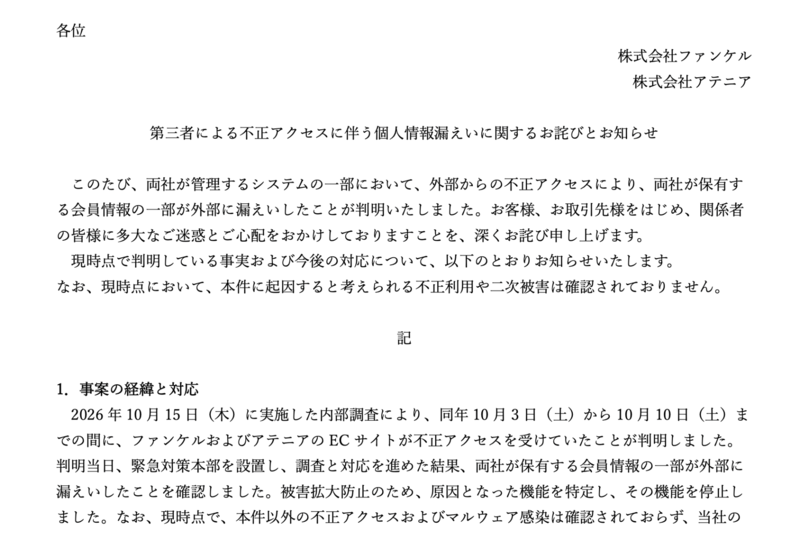
FANCL and Attenir Suffer Data Breach Affecting 780,000 Customers, Exposing Addresses, Names, Phone Numbers
1 day ago
 Business
DeepSeek Quietly Ships V4.1-Flash
1 day ago