
Retired judge appointed to electoral boundary panel donated to UCP
Retired judge appointed to electoral boundary panel donated to UCP
UCP MLA says Brian O’Ferrall is highly qualified to chair panel
An Alberta legislative committee on Tuesday appointed a former judge to chair a panel advising MLAs on new electoral boundaries, but Opposition MLAs on the committee say his recent donation history raises questions about the appointment.
Brian O’Ferrall served as a provincial court judge before being appointed to the Alberta Court of Appeal in 2011. He retired from the bench in 2022.
NDP MLAs who make up a minority on the Select Special Committee on Electoral Boundaries say they are concerned about O’Ferrall’s political donation history.
O’Ferrall has a history of donating to provincial and federal conservative parties. He contributed $1,700 and $1,725 to the Conservative Party of Canada in 2023 and 2024 respectively. He donated $500 to the UCP’s Calgary-Elbow constituency association in 2022, $1,000 to the UCP in 2024, and $1,287.50 to the UCP in 2025.
The government referred the redrawing of Alberta’s electoral boundaries to the committee of three UCP MLAs and two NDP MLAs weeks after the Boundary Commission submitted its report to the legislature.
NDP MLAs on the committee say O’Ferrall’s appointment is yet another step in a process they say is highly irregular.
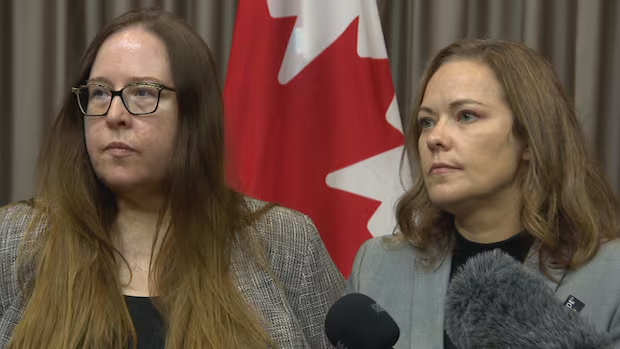
“The government should be adopting the majority report of the non-partisan Boundary Commission,” said Christina Gray, NDP MLA for Edmonton Mill Woods.
“We should not be in this committee doing this partisan process that we are having.”
UCP committee member Garth Rowswell, the MLA for Vermilion-Lloydminister-Wainwright, said O’Ferrall’s decades of experience as a lawyer and a judge make him highly qualified to chair the independent advisory panel.
Rowswell said the former judge’s “knowledge of Alberta’s legal, regulatory, institutional landscape may contribute to the credibility and partiality and public confidence in the work of the independent advisory panel.”
Kathleen Ganley, the NDP MLA for Calgary-Mountain View, acknowledged O’Farrell had the appropriate background to understand the “deeply complex” issues in the boundary commission report, but said it’s problematic to hire someone with O’Ferrall’s history of political donations for an independent committee.
“The concern here is not one of whether the justice understands the law, it is one of whether there's partisan affiliation,” said
Both Ganley and Gray expressed concern that MLAs did not interview the candidates behind closed doors, as is usually the practice. Only two people applied for the position.
The NDP MLAs argued that was because the acting chief justice of Alberta declined to share the committee's letter asking for nominees for an advisory panel chair.
The Law Society of Alberta, and the Alberta Chapter of the Canadian Bar Association also declined to help.
Rowswell dismissed the concerns by reminding the committee that retired judges are allowed to donate to political parties.
“Political donations made in compliance with applicable laws do not in and of themselves determine the applicant's ability to perform the role impartially and independently,” Roswell said.
“In the same way that applicants for judicial appointments are not required to disclose past political donations.”
Chantelle de Jonge, MLA for Chestermere-Strathmore, and Ron Wiebe, MLA for Grande Prairie-Wapiti are the other UCP members on the committee. Brandon Lunty, UCP MLA for Leduc-Beaumont is the chair.
The boundaries commission started its work in March 2025. The chair and four commissioners held public hearings across the province and collected written submissions on how the maps should be drawn.
Chair Dallas Miller and the commissioners held public meetings and accepted written submissions. When the final report was submitted to the legislature, two UCP-appointed commissioners issued their own minority report, which included maps that dramatically differed from the direction set in the interim report.
Critics have said the redrawn maps in the electoral boundaries commission’s final report constitute gerrymandering. The government has said it had no role in drafting any of the maps.
The commission’s majority report based its recommendations on an 89-seat legislature, two seats larger than the current configuration.
The government favours a recommendation from Miller, which was not endorsed by the majority, to instead add four new seats to the assembly to reflect Alberta’s 20 per cent increase in population since the last report in 2017.
The next election is set by legislation for the fall of 2027. The NDP has urged the government to abandon the legislative committee and adopt the majority report from the boundaries commission.
They say the work of drawing electoral boundaries belongs to an impartial committee not to MLAs.
Michelle Bellefontaine covers the Alberta legislature for CBC News in Edmonton. She has also worked as a reporter in the Maritimes and in northern Canada.
Related Stories
 Canada
Judge extends order blocking Trump from banning CNN, MS NOW and Politico reporters from White House
9 minutes ago
 Canada
Montreal man convicted of killing 9-year
10 minutes ago
 Canada
The cost of ALS in Canada: New study reveals financial burden pushing families to the brink
10 minutes ago
 Canada
88% of Canadians expect to spend under $100 on Halloween. Nextdoor's map helps find local events.
1 hour ago
 Canada
Geoff Russ: Anglo
1 hour ago
 Canada
Arrest after police rooftop incident
1 hour ago
 Canada
Canada’s Wonderland closes two roller coasters
2 hours ago
 Canada
N.B. group home youth targeted for human trafficking
3 hours ago