
Royster Fellow will study how AI can be manipulated
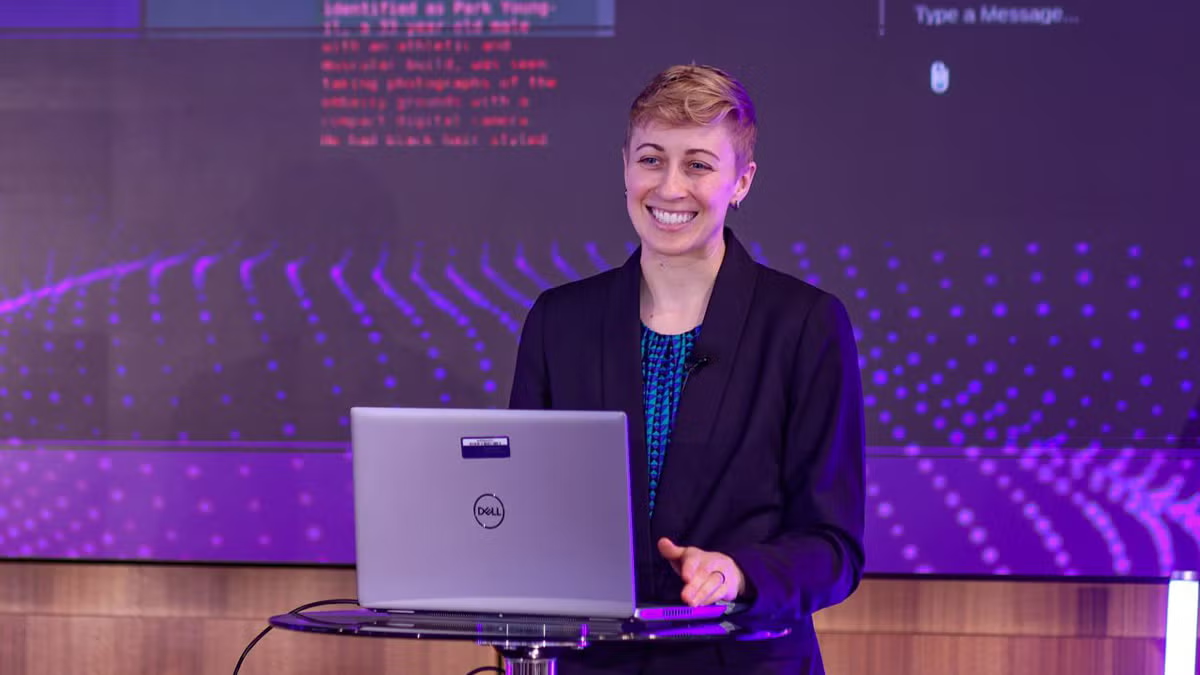
Kelsey Campbell spent a decade analyzing how foreign actors manipulate what people see online. As a doctoral student at the UNC School of Data and Information Sciences and member of The Graduate School’s prestigious Royster Society of Fellows, Campbell now will study the other half of that equation: What does this manipulation do to the people it reaches?
Campbell studied economics at Purdue University, later working as an economist in public health research at RTI International in Research Triangle Park. After earning a master’s degree in analytics at NC State University, she moved to Washington, D.C., and spent a decade doing data science in support of the intelligence community and the Department of State.
At the State Department, Campbell worked on counter-influence research, building models that detected networks of inauthentic accounts spreading coordinated narratives online. Her team’s analysis characterized how foreign governments were shaping online conversation and shaped the federal response to those campaigns. More recently, Campbell built generative and agentic artificial intelligence systems for threat detection.
The questions were compelling, but the vantage point was narrow.
“I’ve always had a very adversary-focused lens,” Campbell said. “Over time, I found myself much more interested in the impact piece. How are real people being affected by these things, instead of just what the ‘bad guys’ are doing.”
At Carolina, Campbell will study digital safety more broadly, moving from mis- and disinformation into the societal effects of generative AI and the large language model systems that increasingly decide what people find when they search. The risks are already here.
“Very little of this is by accident,” Campbell said. “There are very effective, active operations online right now, strategizing on narratives, on how to manipulate social media algorithms, on how to influence or jailbreak the LLMs being used for search. These things are strategic, which means the harms are targeted as well.”
Campbell’s adviser, SDIS associate professor Francesca Tripodi, is a principal investigator at the Center for Information, Technology and Public Life. Tripodi’s Search Prompt Integrity and Learning Lab audits what search engines and AI assistants return and studies how gaps in the information ecosystem, known as data voids, get exploited.
“I want to get into the audits of LLM search results and AI summaries, to understand how these systems portray controversial social issues and how the information they pull from can be manipulated,” Campbell said. “The capability is there to do real damage. The guardrails and governance are catching up.”
CITAP was a large part of why Campbell chose Carolina. “They’ve been a trailblazer in this kind of research, and they’re distinct because they bring a social and historical lens to it, which is exactly where I want to grow,” she said. “The collaboration you see across departments at Carolina is incredible. With problems this complex, that’s the only way we’re going to tackle them.”
Campbell spent enough time in government and industry to know what those career paths look like and now hopes to build an academic one through the Royster fellowship. “It gives you the freedom to really pursue things in a way you otherwise wouldn’t be able to. I’m excited to dig into questions at a depth and rigor you don’t usually get in industry.”
Campbell isn’t leaving old expertise behind so much as redirecting it. “I’m excited to take the adversarial knowledge I’ve gained in my career and move more into the social side and to figure out how real people are being affected by propaganda strategies and digital threats.”
Related Stories
 AI News
Israeli scientists: AI can make personality tests, predict responses
51 minutes ago
 AI News
Artificial intelligence could push up inflation
51 minutes ago
 AI News
Alberta technology minister heckled at second town hall on AI data centres as Meta project stokes distrust
1 hour ago
 AI News
World's largest open library calls for volunteers to scan and preserve physical books as AI companies buy, scan, and destroy them
2 hours ago
 AI News
After 27 years, it must have been hard for Jeff Dean to let go. Dean, who quit Google to build his own AI startup called DiscoveryLoop, briefly choked up while describing his decision to leave the search giant after more than a quarter
4 hours ago
 AI News
Why Anthropic's AI watermark for Claude text goes further than rivals
5 hours ago
 AI News
MAHA activists criticize Trump’s push for coal
5 hours ago
 AI News
Neoclouds become AI’s new power brokers
5 hours ago