
Saab's surveillance jet deal with Canada faces a U.S. stealth tech hurdle
Saab's surveillance jet deal with Canada faces a U.S. stealth tech hurdle
Trump administration's refusal to share could lead to a missing link for NATO
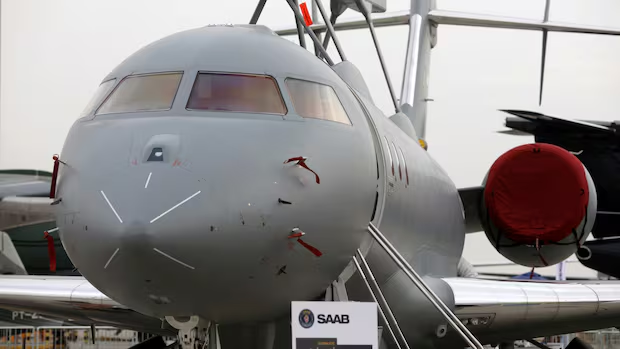
Canada's planned purchase of the Saab GlobalEye surveillance jet faces significant political and technical hurdles if the aircraft is going to be fully integrated into NORAD.
Much of the success or failure of the effort will depend on convincing the Trump administration and the Pentagon to share a key piece of technology that allows fighter jets and early warning systems to communicate while maintaining stealth.
Experts doubt the United States will allow a high-tech data link used exclusively on F-35 fighters to be installed on either the early warning aircraft or the Gripen-E — if Canada chooses to buy that warplane.
Without the Multifunction Advanced Data Link (MADL) and other associated encryption technology, they say, North American Aerospace Defence Command (NORAD) operations could become more complicated and even riskier.
Ottawa passes on U.S. bids to buy Swedish surveillance plane
That's because older, less sophisticated data technology forces stealth fighters to reveal their location.
Defence Minister David McGuinty acknowledged the government is having technical discussions with engineers at the Swedish defence giant about how to plug the GlobalEye into NORAD.
"That's a complicated technical question. It's one that we're looking at," McGuinty said last week coming of out of the House of Commons.
Prime Minister Mark Carney recently announced that the federal government would enter into negotiations with Saab to acquire the GlobalEye system, which is based on Bombardier's Global 6000/6500 long-range business jets that are manufactured in Canada.
It was chosen over the latest versions of the Boeing E-7 Wedgetail and the L3-Harris-Elta Systems Aeris X — both U.S.-made aircraft.
None of the airborne early warning aircraft come with MADL systems pre-installed.
Radio-Canada last weekend reported that Ottawa was looking at a mixed fleet of 72 F-35s and more than 60 Swedish-built Gripen-E fighters.
Data exchange is at the heart of the Royal Canadian Air Force's concerns about interoperability with allies, particularly when it comes to working alongside the United States in NORAD.
Retired Swedish air force major Jussi Halmetoja, a pilot and air capability adviser at Saab Aeronautics, acknowledged there are technical integration issues, but suggested they're not insurmountable.
He also suggested MADL isn't as important to surveillance planes, such as the GlobalEye, because they operate hundreds of kilometres behind the front and the combat aircraft they're directing.
Therefore, Halmetoja suggested it's not a big deal from an operational perspective, describing it as one "small element" of the whole data exchange network.
That's where Halmetoja and other experts disagree.
Ottawa's mixed fleet of F-35s and Gripens could total more than 100 aircraft, sources say
Canada confirms purchase of 26 HIMARS rocket launchers from U.S. government
They say MADL is an important feature of the F-35's stealth capability and relying on other "legacy" systems means an F-35 runs the risk of giving away its position.
There are a couple of different ways for modern fighter jets to communicate with each other, airborne early warning aircraft and ground stations.
The most common is a system developed in the late 1970s and refined in the 1980s known as Link 16, which broadcasts an omnidirectional signal very much like a lighthouse.
MADL, however, was developed specifically for fifth-generation stealth warplanes, such as the F-35 and B-2 stealth bomber. It was supposed to be installed on the F-22 but the Pentagon deemed it too costly for the older warplane. MADL exchanges data in short, tightly controlled bursts to keep it off the electronic warfare grid of an enemy.
When those highly advanced aircraft use the older Link 16 system, it gives away their position and advantage, said Dan Grazier, a fellow at the Washington-based Stimson Center.
"That aircraft is going to be lit up like a Christmas tree," Grazier said.
"Even though it might not be visible to the naked eye, a well-tuned electronic warfare system is going to be able to see that aircraft from a long way away just because of those [Link 16] radio emissions that the aircraft is sending out."
Americans unlikely to license high-tech data link for non-U.S. aircraft: defence expert
Former Lockheed Martin F-35 test pilot, retired Canadian air force colonel Billie Flynn, said integrating the GlobalEye and possibly the Gripen will present NORAD commanders with a unique challenge when it comes to information exchange.
"[The commander] will have to find some way to dumb down the information" before passing it "on to a GlobalEye or a Gripen," Flynn said.
Halmetoja acknowledged the absence of MADL technology on the GlobalEye may prompt stealth fighter pilots to be more careful about where and when they share data.
"I would say that the assumption can be made that there will [also] be unwillingness to transmit actively from F-35s to F-22s," Halmetoja said in an interview with CBC News.
The United States has never shared MADL technology with non-American companies and if Canada wants to fully integrate the GlobalEye and possibly the Gripen-E, it will have to convince the Trump administration.
"I don't know that I would place a lot of money on the United States licensing MADL for non-U.S. based aircraft," said Grazier.
The only way that might change, Grazier said, was if more countries already operating the F-35 start buying GlobalEyes.
Installing the system on a Boeing-manufactured E-7 Wedgetail wouldn't pose as much of an issue because the technology would remain within the U.S., he said.
Flynn suggested the current political climate between Canada and the U.S. will make the idea a tougher sell.
"There is no chance that at this point in time that the United States is going to allow anyone who is not an F-35 partner nation to get into the MADL network," Flynn said, in reference to Sweden.
It is possible, Flynn said, to create some kind of "bridge capability" allowing the different systems to talk with each other, but it would come "at the cost of multimillions of dollars and years of development."
Canada negotiating to buy Saab's GlobalEye airborne early warning aircraft
Pentagon doubles down on Canada rebuke with demand for NATO spending road map, F-35 decision
$29.3M spent to upgrade Snowbirds jets that will now be retired early
Halmetoja suggested it would be up to the Canadian government to convince the United States to share MADL technology if they thought it was important for NORAD operations.
"One can also assume that the U.S. would be restrictive in terms of releasing MADL terminals to other platforms," Halmetoja said. "That's an assumption we can make, but what happens in the future we, of course, don't know."
Recently during a meeting of the House of Commons defence committee, Conservative MP James Bezan demanded to know what assurances were being built into the GlobalEye contract regarding data link access.
Stephen Fuhr, the secretary of state for defence procurement and a former fighter pilot, said that was a matter for the Department of National Defence as it writes military requirements.
But Grazier said it's more than just a technical, bureaucratic issue.
"If these decisions don't make sense for the guy in the cockpit or the or the captain on a bridge or the lieutenant in the field, then they don't make sense for whatever political or economic reason policymakers" have fashioned to push a program through, he said.
Senior reporter, defence and security
Murray Brewster is senior defence writer for CBC News, based in Ottawa. He has covered the Canadian military and foreign policy from Parliament Hill for over a decade. Among other assignments, he spent a total of 15 months on the ground covering the Afghan war for The Canadian Press. Prior to that, he covered defence issues and politics for CP in Nova Scotia for 11 years and was bureau chief for Standard Broadcast News in Ottawa.
With files from Radio-Canada's Daniel Leblanc
Related Stories
 Canada
‘I don’t care if I go to jail’: Video shows defiant 6-year
23 minutes ago
 Canada
Changing lifestyles may be behind Canada’s near historic low fertility rate
23 minutes ago
 Canada
Residential school denialism shouldn't be illegal, Manitoba Premier Wab Kinew says
23 minutes ago
 Canada
Canada's Polka King Walter Ostanek shares Oktoberfest memories
1 hour ago
 Canada
Fact check: Is Canada building 19,000 affordable homes?
1 hour ago
 Canada
SIU clears Toronto police officer who shot suspected killer of Const. Marc Pinizzotto
2 hours ago
 Canada
Alberta Court of Appeal says Ottawa's Impact Assessment Act is still unconstitutional
2 hours ago
 Canada
‘Not as long as I’m premier’: Danielle Smith rules out 2nd separation referendum if Albertans vote to remain
2 hours ago