
Scientists used AI to crack one of water's biggest mysteries
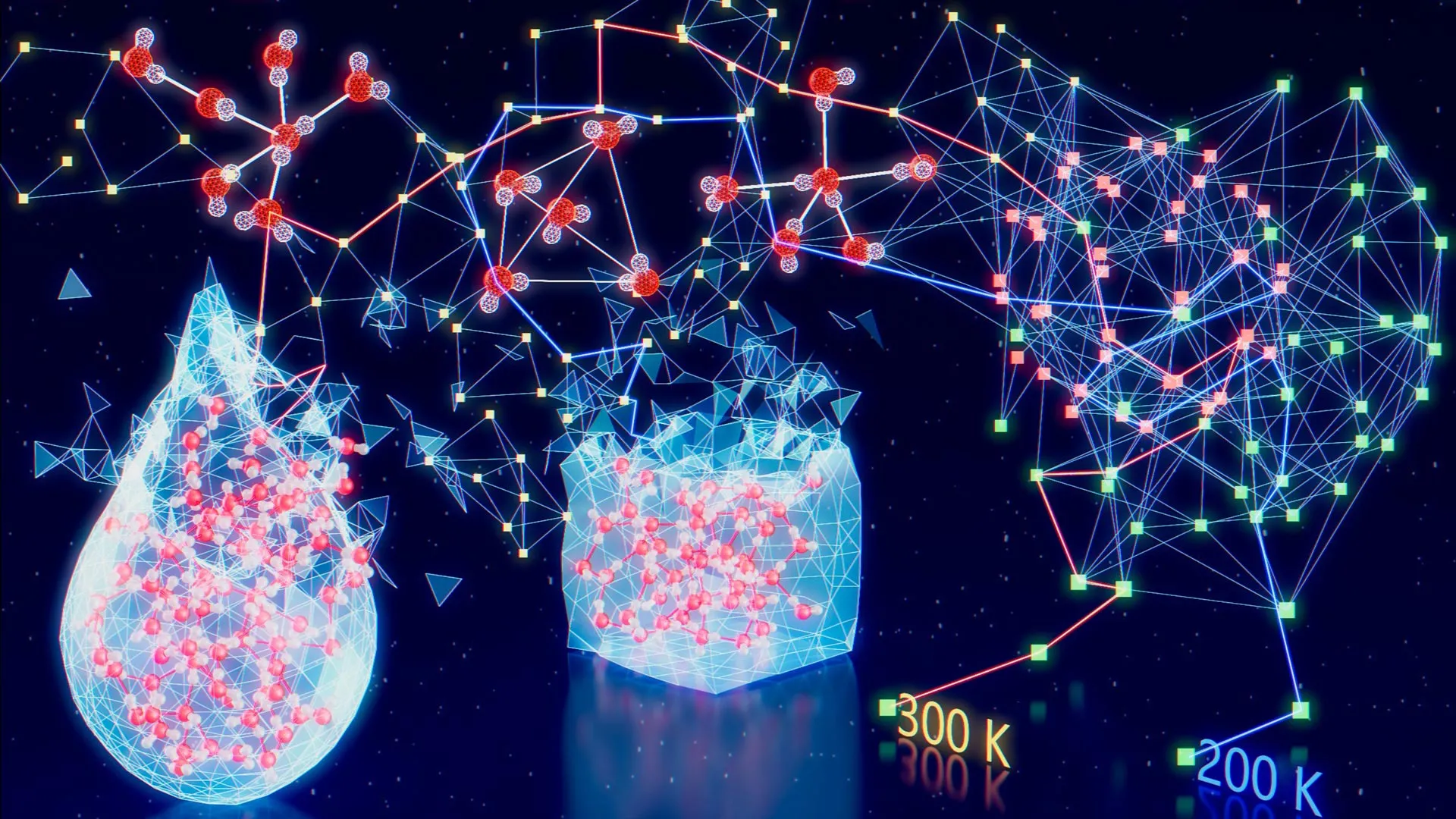
Now, researchers at the University of Osaka have turned to artificial intelligence (AI) to tackle that challenge. Their AI system provides a unified way to compare different methods of describing the structure of supercooled water, helping identify which ones capture the most important features. The research was published in Communications Chemistry.
Why Supercooled Water Behaves So Strangely
For liquid water to become ice, its molecules must arrange themselves into an orderly crystal lattice. That process begins at a nucleation site, a surface where ice crystals can start forming. Tiny impurities in the water or even microscopic scratches inside a container can provide those starting points.
If those nucleation sites are absent, water can remain liquid even after it has been cooled below its normal freezing point. This unusual state is known as supercooled water.
Water's unusual properties become even more pronounced under these conditions. Scientists believe these behaviors are linked to a balance between two competing forms of liquid water: a high density liquid (HDL) and a low density liquid (LDL). At the molecular level, water molecules are constantly forming and breaking networks of hydrogen bonds. As the temperature rises, the more compact HDL structures become increasingly dominant over the more open LDL arrangements.
Over the years, researchers have proposed many different ways to describe the local arrangement of water molecules, including measurements such as tetrahedral bond order and local density. Because these structural descriptors were developed independently, they use different scales, dimensions, and types of information. That has made it difficult to directly compare them and determine which are the most useful.
"Past studies have shown that using machine learning to classify and understand structural data is effective," explains corresponding author Kang Kim. "We specifically wanted to incorporate a neural network model into this study to evaluate how accurate the descriptors were at capturing key structural information, in a way that is like human cognition."
To train the AI, the researchers fed the neural network structural data generated from molecular dynamics simulations of supercooled water. Through repeated trial and error, the system learned to recognize meaningful patterns in the molecular structures.
"The network used what it had learned to compare how 16 descriptors differentiated between LDL and HDL structures at different temperatures," reports Nobuyuki Matubayasi, senior author. "In this way, we determined the most efficient descriptors."
The researchers say their framework could improve scientists' understanding of how microscopic structural changes are connected to the thermodynamic behavior of water. The findings may also help explain the origin of water's unusual properties while guiding the development of even better tools for studying its complex molecular structure.
Related Stories
 AI News
85% of Financial Firms Plan AI Budget Increases
7 seconds ago
 AI News
Automation and artificial intelligence: the new competitive advantage for data
45 seconds ago
 AI News
The epistemology of death: psychological autopsy, artificial intelligence, and forensic decision
50 seconds ago
 AI News
World Cup 2026: Superstar players, politics and hydration breaks among the standout themes of tournament so far
51 minutes ago
 AI News
Lionel Messi and Argentina are vulnerable ahead of World Cup matchup, claims Switzerland coach
51 minutes ago
 AI News
Trump says Iran truce is ‘over’ as US hits 170 targets over two nights
51 minutes ago
 AI News
Bangladesh relocates refugees after landslide kills at least 5 children
51 minutes ago
 AI News
US launches strikes on Iran for a second day after Trump says agreement to end the war is ‘over’
52 minutes ago