
Seoul to invest nearly US$1.2tn in chips, AI data centers
Seoul to invest nearly US$1.2tn in chips, AI data centers
South Korea plans to invest nearly US$1.2 trillion — equivalent to more than two-thirds of its GDP — in a new chip-building hub and artificial intelligence (AI) data centers over several years, as it seeks to profit from soaring demand while developing previously neglected regions.
The enormous cash injection comes as Asia’s fourth-largest economy rides high on a global AI boom — with South Korean memory makers emerging as a crucial cog in the fast-moving industry.
“Speed is the only path to survival. We must secure the core elements of artificial intelligence faster than any other nation,” South Korean President Lee Jae-myung said in Seoul at an event to unveil the public-private collaboration.
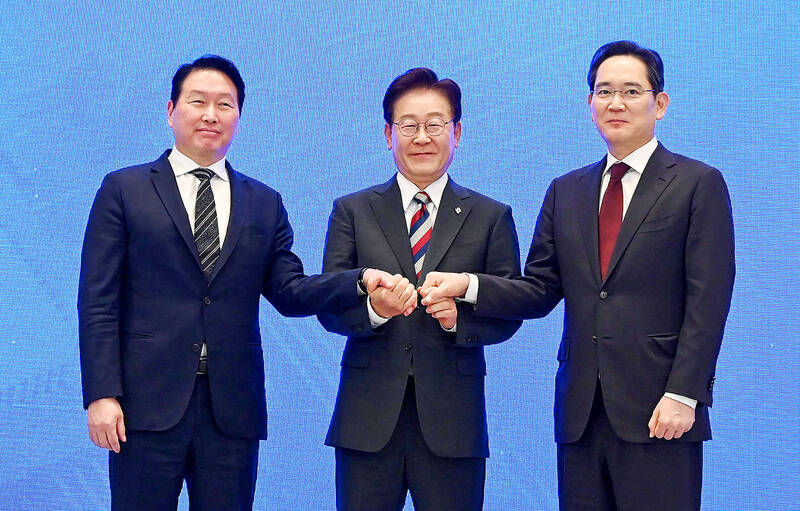
South Korean President Lee Jae-myung, center, Samsung Electronics chairman Lee Jae-yong, right, and SK Group chairman Chey Tae-won hold hands after a briefing announcing public-private collaboration projects at the presidential Blue House in Seoul yesterday.
Samsung Electronics Co and SK Hynix Inc are to make a record investment of 800 trillion won (around US$520 billion) in a new semiconductor fabrication hub in the country’s southwest, the government said.
The government also announced a separate investment of 1 quadrillion won (around US$650 billion) in AI data centers over the next 10 years.
The plans are in line with Lee’s agenda for industrial development in regions outside the capital, and South Korean Minister of Trade, Industry and Resources Kim Jung-kwan said the Samsung-SK Hynix project will comprise four fabrication plants.
“We will develop the southwestern region into a second semiconductor production hub,” he said.
Samsung Electronics and SK Hynix will each build two plants under the 800 trillion won project, according to Kim’s presentation slide.
“Permit approvals and construction timelines will be dramatically shortened to rapidly expand production capacity,” he said. “Through this, we will maintain an overwhelming market leadership and a decisive technological gap in the memory semiconductor sector.”
Shares of Samsung fell nearly 5 percent at close, while SK Hynix ended down 1.7 percent, extending Friday’s slide. While AI’s voracious demand for memory chips has pushed up the two companies’ shares, questions persist about the sustainability of profits as competition heats up and chipmakers ratchet up supply.
Meanwhile, South Korean Minister of Science and ICT Bae Kyung-hoon announced that the country will invest 550 trillion won in AI data centers by 2029.
“By 2035, an additional 10-gigawatt AI data center will be built, with a total investment exceeding 18.4 gigawatts and 1,000 trillion won,” Bae said.
The new investment is by far South Korea’s largest.
The southwestern region of Honam — a traditional liberal stronghold encompassing Gwangju and the Jeolla Provinces — has long lagged behind the more industrialized southeast.
However, without incentives for companies to voluntarily relocate, the massive investment could backfire, Sejong University business administration professor Kim Dae-jong warned. This could, in turn, hurt the nation’s semiconductor competitiveness.
“It is essential to minimize the financial burden, amounting to hundreds of trillions of won, as well as the time-related risks faced by companies,” he said.
Analysts say there are abundant renewable electricity resources in the southwest, making it possible for companies to meet their commitments to boosting green energy use.
But they caution that building an entirely new semiconductor manufacturing ecosystem away from the existing industrial base around Seoul would require significant time and investment.
“Establishing production lines from scratch could take more than five years,” Sangmyung University semiconductor engineering professor Lee Jong-hwan said. “The biggest challenge is that most skilled workers and suppliers remain concentrated around the Seoul metropolitan area.”
Related Stories
 AI News
Tech news: EY to bring tailored AI solutions via Integrated Solutions portfolio
28 minutes ago
 AI News
Apple unveils M5 Ultra and M6 chips with focus on artificial intelligence
29 minutes ago
 AI News
Immersed in artificial intelligence: "We have 10 Manhattan projects"
29 minutes ago
 AI News
Residents prepare to fight AI data centre approval
1 hour ago
 AI News
Quote of the day by tech pioneer Claude Shannon: 'I visualize a time when we will be to robots what dogs are to humans'
2 hours ago
 AI News
Anthropic is cutting Claude Code's current weekly limits by 17%
4 hours ago
 AI News
Many recent grads say AI is making it harder to get a job. Economists aren't so sure
6 hours ago
 AI News
California lawmakers reach deal in high
6 hours ago