
Seoul’s nuclear push, Toyota’s #2 status, India’s ‘cockroach’ politics
Seoul’s nuclear push, Toyota’s #2 status, India’s ‘cockroach’ politics – Asian Media Report
Korea’s threshold weapons-power talks, Softbank’s rise to Japan’s top spot, Gen Z’s youth slur revolt, Tokyo’s plan to shape regional power balance, China’s chip-making sanctions work-around and East Asia’s super-aged societies.
South Korea and the US have begun official talks on Seoul’s ambition to build nuclear-powered submarines and to win permission for civil uranium enrichment and spent-fuel reprocessing.
A senior-level working group is focusing on the implementation of security agreements reached at a summit meeting last November between Donald Trump and South Korean President Lee Jae Myung.
Under an agreement dating from 2015, known as the 123 Agreement, Seoul needs US approval to enrich uranium, even to civilian-use levels under 20 per cent. Approval has never been granted. Spent-fuel reprocessing for commercial purposes is banned.
The Korea Herald said Seoul saw enrichment and spent-fuel reprocessing as increasingly imperative for its nuclear reactor exports and its own energy security.
But Mason Richey, an international affairs expert based in Seoul, said in an analytical article these steps would move South Korea along the nuclear spectrum towards Japan’s status as a threshold nuclear power – able to build nuclear weapons in a relatively short time.
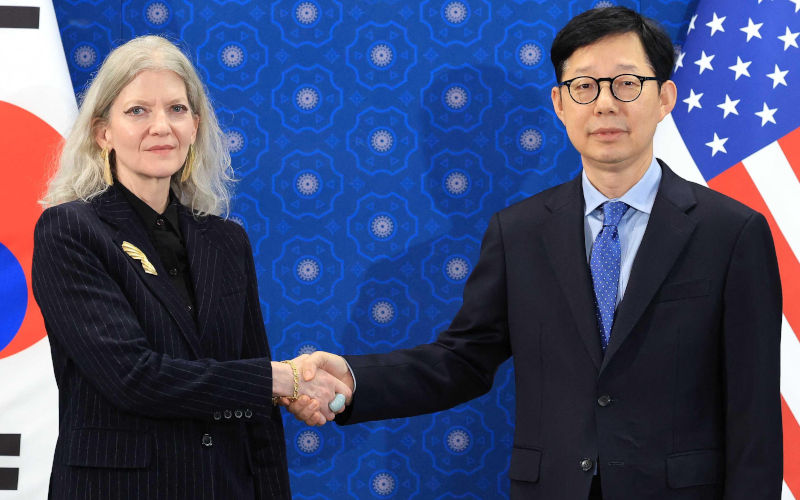
This week’s talks were led by Korea’s First Vice Foreign Minister, Park Yoon-joo, and US Under Secretary of State for Political Affairs, Allison Hooker.
Foreign Ministry spokesperson Park Il, said: “We will make every effort to ensure that both delegations meet as frequently as possible in order to make substantial progress.”
Seoul expected to build nuclear submarines in Korea and buy nuclear fuel from the US, The Korea Times said. It said discussions would also cover how international organisations could inspect nuclear materials used in submarines and how Korea would comply with international non-proliferation standards.
The paper said Seoul wanted to construct its first nuclear submarine by the mid-2030s and begin operations before the end of that decade.
Mason Richey, president of the Korean International Studies Association, said in his opinion piece Seoul wanted to design and build four 8,000-ton-displacement nuclear attack submarines, using low-enriched uranium in small, modular reactors.
It was a doable, if very expensive project, given South Korea’s shipbuilding expertise.
But the submarines were not needed to counter North Korea, which had a fleet of noisy, easily detectable, diesel-electric boats, he said. And South Korea was unlikely to use the submarines to attack China, given its economic interdependence with Beijing.
Richey said South Korea denied that its plans amounted to strategic nuclear hedging. “The concern is not what Seoul intends today,” he said. “It is Seoul’s capability.
“A South Korea with indigenous enrichment, reprocessing and nuclear-propelled submarines is a South Korea that has compressed the timeline to nuclear weapons, regardless of the political intentions of any particular administration.”
South Korea and the US planned to resume their talks as early as next month, The Korea Herald said. It quoted the Foreign Ministry as saying the two teams agreed to co-operate produce tangible results as quickly as possible.
AI boom pushes Toyota off top corporate rung
The AI stock market boom has produced a changing of the guard: Toyota is no longer Japan’s most valuable company. It has been pushed aside by Softbank.
Shares in the technology group rose 14 per cent in Tokyo trading on Monday, taking its market capitalisation past Toyota’s for the first time in more than 25 years. Softbank last achieved that feat in 2000, at the peak of the dot-com bubble, but held its lead only briefly, The Japan Times said.
The AI rally had boosted Softbank shares by more than 90 per cent this year, the paper said. Its market value was now more than 48 trillion yen (about A$420.76 billion). Toyota’s shares had fallen more than 10 per cent this year and the company’s market value stood at 46 trillion yen (about A$403.14 billion).
The change showed how the fortunes of the two corporate titans had diverged. Geopolitical headwinds weighed on the auto sector while AI euphoria surged.
Nikkei Asia, the online business and politics magazine, said Softbank’s stellar earnings and a huge bet on Open AI, the ChatGPT developer, were behind its rapid rise.
The company made a net profit of 1.82 trillion yen (about A$16 billion) in the first three months of this year, Nikkei said. It had been increasing its stake in Open AI, investing US$10 billion (A$14 billion) in April and committing to inject another US$20 billion (A$28 billion). This would take its total investment to about US$65 billion (A$91 billion).
Softbank was not the only company to grow exponentially in market value. Memory chip maker Kioxia and semi-conductor equipment manufacturer Tokyo Electron were also among the top 10 companies on the Tokyo exchange. Kioxia shares had soared by more than 3,500 per cent over the past year.
East Asian stocks, powered by AI companies, had boomed this year, Nikkei Asia said. On Monday, Tokyo’s Nikkei Stock Average had passed the 67,000 mark, in intraday trading, for the first time. It finished at a closing high point of 66,9394.33.
The Nikkei was up almost 30 per cent this year. South Korea’s KOSPI had jumped by more than 100 per cent and Taiwan’s Taiex had risen by more than 50 per cent.
All three had repeatedly hit new record highs.
Cockroaches to unite, form political movement
India has a new political phenomenon, described by its founder as a satirical outfit. He says he hopes to turn it into a movement, building on its social media popularity. The test will come this weekend when the founder seeks police permission to hold a protest rally in New Delhi.
The phenomenon is a Gen Z social media wonder, with more than 22 million Instagram followers. It also has a strange name: the Cockroach Janta (People) Party, a play on the name of Narendra Modi’s Bharatiya Janata Party.
The party burst onto social media last month after the Indian Supreme Court’s chief justice, Suriya Kant, said parasites were attacking the system. He likened youngsters who did not have jobs to cockroaches.
“There are youngsters like cockroaches, who don’t get any employment or have any place in the profession,” he said.
Al Jazeera said his remarks drew considerable ire, mainly from Gen Z internet users, who battled large-sale unemployment, inflation and bitter religious divides under Modi’s Hindu nationalist government.
A 30-year-old man called Abhijeet Dipke posted on X what is said to have been a joke: “What if all cockroaches come together?” He was flooded with social media responses.
Dipke told Al Jazeera, in an interview from Chicago, that people in power thought citizens were cockroaches and parasites. “They should know that cockroaches breed in rotten places. That’s what India is today.”
He told The Hindu newspaper the party would use all constitutional means to make sure people’s voices were heard. He hoped to create a lasting movement out of the viral popularity of the online outfit.
“CJP will remain a movement born out of satire and powered by the support of young people,” he said.
In a video posted on social media, Dipke said he would return to India on 6 June and stage a peaceful protest.
A commentary in The Indian Express, written by activist Yogendra Yadav, said CJP was not a party or a movement. It was a moment – a stack of emotions. It gave a glimpse of the kind of energy that could reclaim the republic from authoritarian rule.
Turning the cockroach into an meme to take on the system was a textbook example of how humour and unpredictable play were keys to non-violent resistance, he said.
US foreign policy dilemma: the capability-commitments gap
The US made it clear from the start of Donald Trump’s second term that it would recast American foreign policy. The latest expression of the shift came from Defence Secretary Pete Hegseth at the recent Shangri-La Dialogue in Singapore.
“We need partners, not protectorates,” he said. “We seek alliances built on shared responsibility, not dependency. This is the maturation of our alliances in a new era.”
Richard Haass, president emeritus of the Council on Foreign Relations, said this line of thought reflected the view that America’s security partners had not carried their weight.
But the US had a larger motive, he said in an article distributed by Project Syndicate and published by The Korea Herald. It wanted to narrow the gap between America’s military capabilities and its commitments.
“This gap would become readily apparent if more than one contingency arose simultaneously, which is more than a hypothetical possibility,” he said. “But the Iran war has already brought [the gap] into sharp relief.
“America’s traditional partners have begun to rethink their own national security strategies. They are right to do so.”
International law professor Park Jung-won made a similar point, in a commentary in The Korea Times, about Trump’s failure to resolve the central issues of the Iran war – the Strait of Hormuz and Iran’s nuclear ambitions. But he expressed it more bluntly.
Trump, he said, was a product of a deeper problem – the accumulated fatigue of a hegemonic power increasingly uncertain about the burdens and costs of maintaining the international order it had built and once defended.
Indian foreign affairs expert C. Raja Mohan said much of Asia had complained about Trump’s Asia policy and had muttered about America’s likely abandonment of the region. But there was an exception.
“Tokyo is not wringing its hands,” he said. “It is acting to defend itself and help others secure themselves against Chinese expansionism and US volatility.”
For decades Japan’s defence industry was inward-looking and official policy constrained military co-operation with foreign powers, Mohan said in an opinion piece in The Indian Express newspaper. But now Japan argued that preserving peace in Asia required participation shaping the regional balance of power.
Mohan, a contributing editor at the paper, said Tokyo’s new military doctrine was not being driven by nostalgia for its imperial past but by anxiety about the future balance of power in Asia.
“Japan is trying to reconcile two strategic imperatives,” he said. “The first is preserving the American alliance, which has been the foundation of its security.
“The second is reducing excessive dependence on the United States by strengthening regional security partnerships and creating Asian defence-industrial networks.
“The imperatives for India are similar.”
Huawei’s sanction-beating chip-design innovation
For decades, the guiding principle of the computer chip industry has been Moore’s Law – the dictum that chip performance improves as more transistors are crammed into the same chip area.
But Huawei, the Chinese IT giant, has developed a new approach as it works to bypass US sanctions that ban the country from importing leading chip-manufacturing technology.
Huawei aimed to improve performance by reducing the time it takes for data and signals to move through circuits, chips and computing systems, a Nikkei Asia story said.
The company introduced what it called a new law – the Tau Scaling Law– to reflect its innovatory approach. Huawei also called it Her’s Law, in recognition of the key role played by He Tingbo, the company’s semiconductor chief. (The family name He is pronounced like “her”). The new approach came from a change of mindset, He said – imagining Huawei facing the constraints of Moore’s Law 10 years earlier than other chip companies.
Huawei introduced a new chip design method called LogicFolding, the story said.
This technology vertically stacked digital, analogue and memory circuits to improve performance, chip density and power efficiency.
The breakthrough was seen as a boost for China’s local chip manufacturers. The country’s top chipmaker (and Huawei partner) Semiconductor Manufacturing International Corp, saw its share price on the Shanghai exchange close almost 20 per cent higher on the day of the announcement. It continued rising the next day.
A story in Hong Kong’s South China Morning Post said Huawei’s strategy was born of necessity, because of the US restrictions. Huawei’s framework could be a critical point for China’s chip industry, it said.
SCMP said Huawei had not eliminated China’s need for advanced manufacturing equipment but it had changed the narrative.
“For years the geopolitical question has been binary,” the story said. “Can China build its own advanced lithography machines? Huawei’s answer is to change the question entirely. How much juice can we squeeze out of the limited manufacturing capacity we have?
“Analysts at Bernstein Research compared the potential impact of the Tau Law to the rise of DeepSeek in the AI space – a demonstration of extreme efficiency under tight constraints.”
Baby drought reflects pressure on young adults
Japan, South Korea, Taiwan, Singapore and Hong Kong are all super-aged societies, where the proportion of adults aged 65 or more has passed 20 per cent.
Across East Asia, the total fertility rate has fallen below one birth per woman, well below the population replacement level of 2.1 births. In Hong Kong, the total fertility rate is 0.73.
“Low fertility plagues high-income societies,” says an Oped in the South China Morning Post. “Across East Asia, societies are becoming richer, healthier and more educated, yet fewer people feel able or willing to have families and raise children.”
The article was written by social scientists Wei-Jun Jean Yeung, of the National University of Singapore, and Paul Yip, of the University of Hong Kong.
They say population changes are reshaping families, labour markets, caregiving systems, healthcare demand and fiscal sustainability.
But the challenge should not be framed narrowly as one of merely raising the number of births.
“Low fertility rates reflect the growing pressures young adults face,” Yeung and Yip write. “Skyrocketing housing and living costs, long working hours, persistent gender inequalities, intense competition at work and school, technological disruption and growing uncertainty about the future.
“Sustainable population policies must ultimately strengthen human well-being and expand life opportunities.”
The pairing of low fertility and human development is central to the discussion, they say. Family trends are not merely demographic outcomes. They reflect how people experience work, relationships, care-giving, inequality and hope for the future.
“There is no silver bullet for such a complex problem,” Yeung and Yip say. “The impact of short-term cash allowances remains limited. As societies have fewer children, human development across all stages of life becomes even more critical.”
Note: Japan released its latest birth figures this week, showing the 10th straight year of decline. But the drop in births last year was lower than in the recent past, The Japan Times reported – 2.2 per cent compared to about 5 per cent in recent years. The number of births last year among women between the ages of 30 and 34 rose slightly. The paper noted that in 2024 there had been a rise in the number of marriages involving women aged 25 to 34.
The views expressed in this article may or may not reflect those of Pearls and Irritations.
Related Stories
 India
India
Starlink, Ambani’s venture should get equal treatment, let consumers decide: Shashi Tharoor
2 days ago
 India
India
Lawrence Bishnoi’s rise: Student politics, first murder and a sprawling crime network | India News
2 days ago
 India
India
India’s finance minister says market liquidity makes it easier for investors to exit
2 days ago
 India
India
India news: CJP alleges 'deliberate' delay in leaders' release
2 days ago
 India
India
Indian Diaspora Holds Pro-Modi Counter
2 days ago
 India
India
Clashes Erupt in London as Diaspora Divided Over India's Election Chief and Electoral Roll Controversy
2 days ago
 India
India
London: Indian diaspora rallies in support of PM Modi, criticises CJP protesters
2 days ago
 India
India
Cabinet Approves Go
2 days ago