
Separatists dominating Alberta referendum conversation online: report

Separatists dominating Alberta referendum conversation online: report
Pro-independence influencers receive roughly 8 times as much engagement as separation critics
On the morning of Alberta Day this year, also known as the first of September, one of the most influential separatist social media accounts in the province sprung into action to mark the occasion.
The anonymous account known as Rise of Alberta, which has amassed almost 100,000 followers on X with a consistent flow of independence content, began the day with a dramatically backlit Alberta flag to celebrate the province’s future as a “free and independent country.”
Then came a clip of Premier Danielle Smith talking about the referendum, a shot of a celebratory Alberta Day drone show against a dark sky, and, finally, a link to a site where you could buy a “classic, handcrafted” Alberta flag blanket that comes in a variety of sizes and starts at $75. (They are made, the site notes, in the U.S.)
According to a new analysis from the Centre for Media, Technology and Democracy's Media Ecosystem Observatory, co-led by McGill University and the University of Toronto, the account is the most influential player in the raging online debate about Alberta independence that is dominated by a loose network of grassroots citizens, passionate advocates and anonymous social media accounts. Some of whom are also selling home decor.
“I think this is, in many ways, what modern political campaigns look like,” says Chris Ross, a senior analyst with the Observatory, pointing to the increasingly blurred lines between social media influencing, commerce and regular old politics.
“The general public needs to wrap our heads around this and think, ‘OK, this is becoming more normal, so how should we think about this?’” Ross added.
“And should we be giving it more scrutiny?”
Unlike in, say, Quebec, there is no elected party campaigning for sovereignty in Alberta, which has left the campaign for independence largely in the hands of a leaderless group of individuals with a wide range of beliefs and allegiances.
Online, the study suggests this has manifested as a passionate network of influencers, memes and online spaces devoted to the cause.
The analysis, released Thursday, paints a picture of an online conversation dominated by the separatists, in contrast to real world polling which suggests that support for independence has remained consistent at roughly a quarter of the population.
Among those with the biggest sway identified in the report, the pro-independence influencers outnumber their critics almost two to one, and receive roughly eight times as many likes, comments and shares.
In order to capture the online conversation, researchers collected all the posts on five social media platforms — Instagram, X, YouTube, TikTok and Bluesky — that included the word “Alberta,” plus related terms such as “referendum,” “sovereignty,” and “separatist.” (Facebook was not included because the site does not allow the search of specific terms in the same way.)
They then screened-out the accounts of politicians and media organizations, as well as those that fell below a certain threshold for engagement.
The result was 114 political influencers that were responsible for roughly half of the total social media engagement on this topic since the beginning of 2025. The report names the 40 most significant accounts, defined as those with more than 50,000 engagements on the posts collected as part of the study.
“The independence movement is, obviously, not a fan of Canada’s federal institutions, so I think modern technology allows for this guerrilla-style campaign strategy that really does end up in front of people’s eyes on their feeds,” Ross said.
The account driving the most engagement was Rise Of Alberta, whose posts on X have received over two million engagements over the last year and a half. (There was no response to the requests for comment that CBC News sent to the Rise Of Alberta accounts on X and Facebook.)
The top seven accounts are all similarly pro-independence, and include the personal accounts of notable figures in the movement, such as Keith Wilson, head of the Alberta Transition Council, and Jeffrey Rath, spokesperson for the Alberta Prosperity Society.
But the list also includes an account called Tablesalt, which has recently posted about everything from tariffs to home invasions to criticism of Jason Kenney, while misteristersunshinebaby, which describes itself as “born in Canada before it became the 51st state,” is ninth.
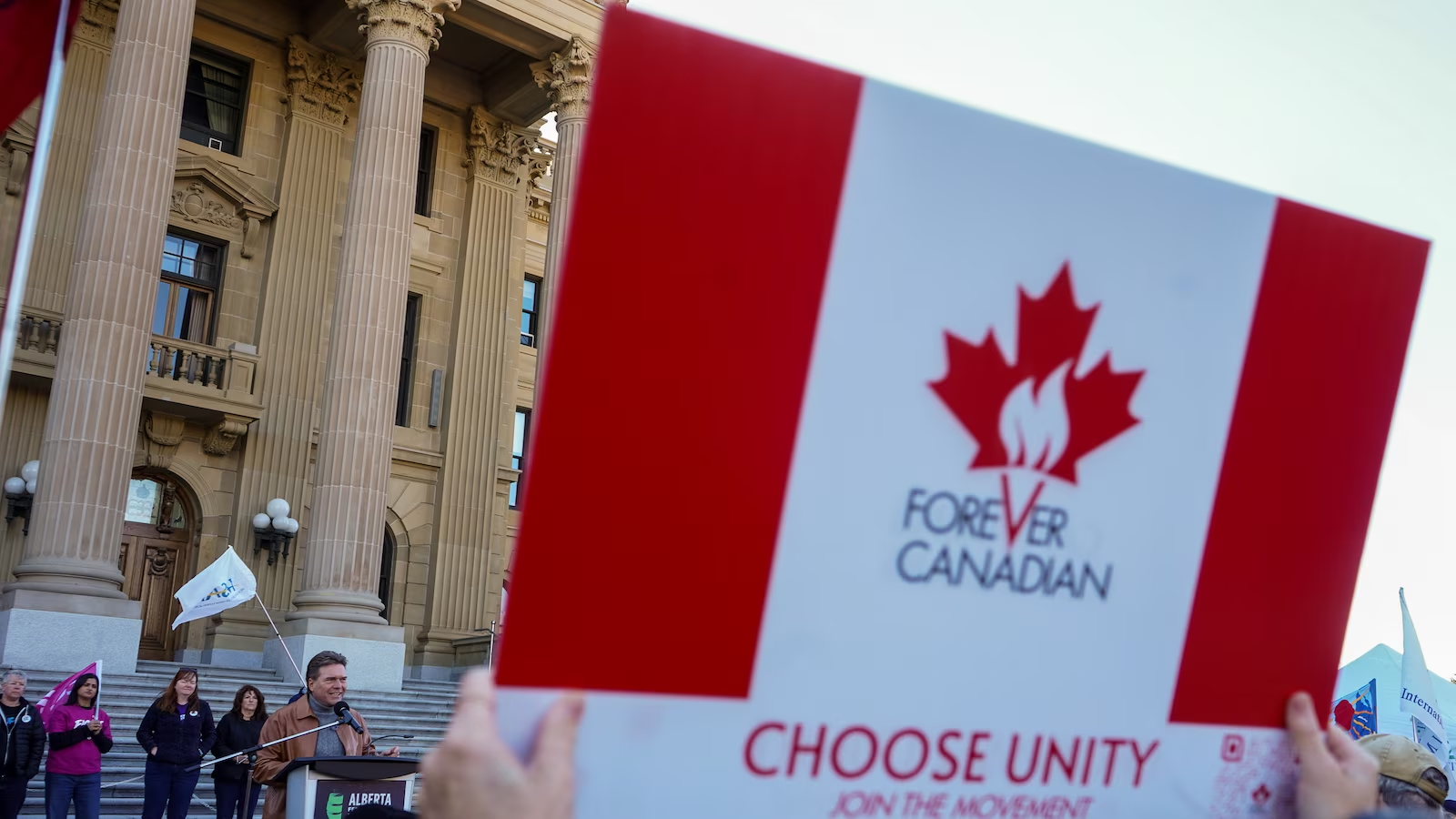
The most influential federalist account belongs to Thomas Lukaszuk, the founder of the Forever Canadian petition, which ranks eighth, with just over 181,000 interactions since the beginning of 2025. The account of former premier Jason Kenney, who has become a very public defender of confederation, ranks 32nd.
Chatter about Alberta separation of any kind is an outsize driver of online engagement, Ross noted. “There is just something about the spectacle of a province potentially leaving Canada that is naturally very interesting,” he said. “It’s like rubbernecking at a car accident.”
But the separatists have emotion on their side, he noted, as they appeal to the anger and fear that many of their followers feel about Alberta’s relationship with Ottawa.
Social media influencers have become a major source of political information more broadly in Canada, Ross points out, and some users have also come to prefer the more conversational tone of the separatist camp, compared to the missives from mainstream government or political institutions, who tend to lean federalist.
“There’s something deep in the human brain that likes seeing these off-the-cuff takes more,” he said.
Another big part of the pro-separatists’ success is that they didn’t have to build their network from scratch, says Jean-Christophe Boucher, an associate professor of political science at the University of Calgary.
The independence influencers “piggyback on a network that was built, at least since COVID,” says Boucher, who was not involved in the writing of the report but has worked in monitoring online influence campaigns.
Some of the influencers on the list were also active during the trucker convoy in Ottawa and during the contested ostrich cull in British Columbia, he says, both of which were magnets for activists concerned about what they saw as government overreach.
“That capacity to already have an audience, to have people excited and engaged on these issues is a huge benefit for them,” Boucher said. “Whereas the federalist camp has to build everything from scratch.”
While the data isn’t clear on whether online posts have the ability to influence what people believe, Boucher argues that the dominance of separatist content online has the potential to affect mobilization and voter turnout.
“It gives the pro-separatist camp the perception, a false perception, that they’re mobilized,” Boucher said. “The odds that they will go vote will increase… because they think they’re winning.”
Alex Boyd is a senior reporter based in Calgary, interested in politics, provincial affairs and misinformation. She is a former national and investigative reporter for the Toronto Star. Reach her at alex.boyd@cbc.ca.
Related Stories
 Canada
Albertans head to polls in historic referendum on whether they want to stay in Canada
1 week ago
 Canada
In the news today: four soldiers killed, Alberta referendum, AI privacy fears
1 week ago
 Canada
How a grass fire at a Canadian military base killed four soldiers
1 week ago
 Canada
How will household electricity rebate reduction, temporary winter pricing change impact Ontarians?
1 week ago
 Canada
Residents told to boil tap water due to bacteria
1 week ago
 Canada
Oil
1 week ago
 Canada
Albertans vote on path to independence as Carney fights to keep Canada united
1 week ago
 Canada
Two of 4 soldiers killed in fast
1 week ago