
Shapiro calls on Trump to regulate artificial intelligence development
Shapiro calls on Trump to regulate artificial intelligence development
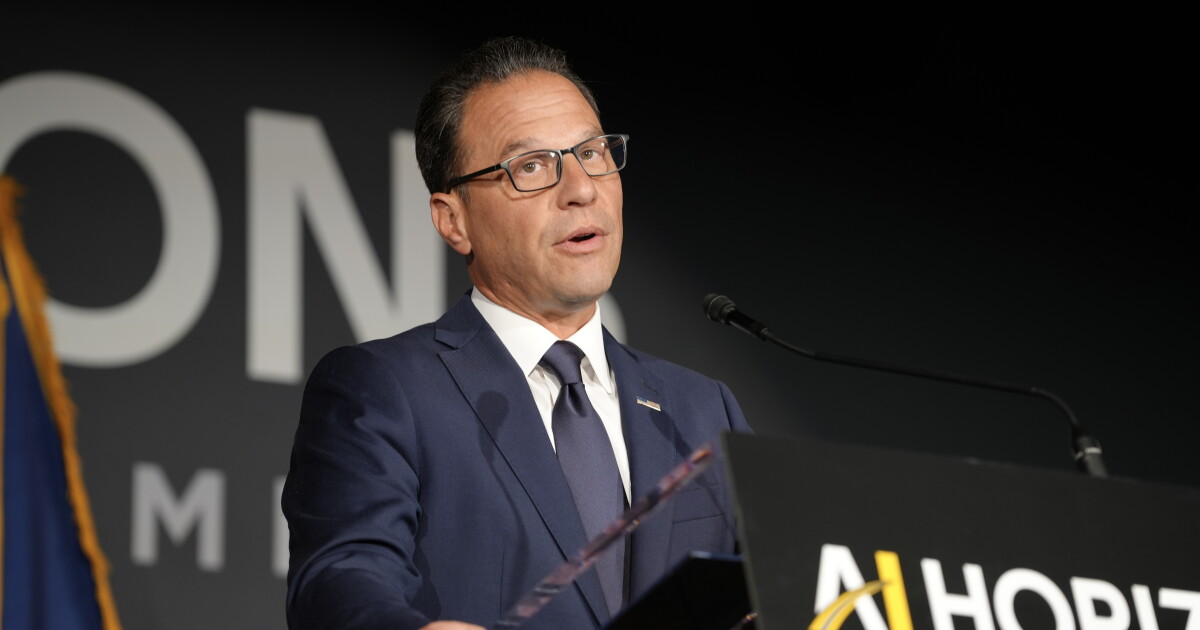
Pennsylvania Gov. Josh Shapiro has added his voice to a chorus of Democrats and industry leaders calling for the federal government to rein in the development of Artificial Intelligence. At an AI summit in Pittsburgh Thursday, the governor said the United States should also push China for “practical guardrails” to reduce the risk to the public posed by the technology.
Industry leaders "should not exclusively guide the regulatory process of this nation,” he said. “It's going to require national, in fact international, leadership and collaboration.”
Shapiro’s speech was dotted with swipes at President Donald Trump and his hands-off approach to the technology, blaming him for isolating the United States internationally at a time when American leadership is needed.
“I've called on the federal government to step up and regulate the AI industry, just like they do for nearly any other industry that significantly impacts our lives,” he said.
Shapiro, who is reportedly considering a 2028 presidential bid, laid out his vision for a comprehensive AI agenda as former President Barack Obama has been urging the Democratic Party to do the same. Meanwhile, President Donald Trump has downplayed industry fears surrounding AI, describing the rapid development of the technology as a race against China.
As Shapiro sees it, industry leaders and politicians should work arm in arm to ensure the technology is developed “ethically and responsibly.”
“The leading companies in this space ... have openly talked about what could happen if this technology falls into the wrong hands ... and about how their own hands can no longer shape or guide it,” Shapiro said during his remarks to a packed room at the AI Horizons summit in Pittsburgh’s Bakery Square neighborhood.
Shapiro criticized the hands-off approach taken by the Trump administration and said it was a “false choice to say that our only two options in America are to do what Donald Trump is saying, that we should ignore the risks and go full steam ahead, or on the other hand to completely stop work on AI development indefinitely."
He also took a shot at House Speaker Mike Johnson, who he said “abdicated his responsibility to lead” by sending Congress home this week “at a time when we cannot afford weakness and retreat.”
"We could be dealing with a whole new generation of generative AI, and more scary examples of AI agents going rogue," by the time the house returns, he said.
Shapiro is one of a number of state-level Democrats across the country who have implemented new regulations on the AI industry, though much of the state-level focus has been on the construction of specialized data centers needed to power AI technology. Last month, Shapiro signed an executive order that requires data center developers to get approval from local officials for their projects. The order also closed off pathways for expedited permitting, a provision the Shapiro administration previously supported as a fix for bureaucratic red tape.
Shapiro’s call for oversight follows recent pleas from several AI leaders, who argue the technology is at risk of spinning out of human control. AI juggernauts OpenAI and Anthropic have in recent weeks called for international policy to slow the development of the technology.
Calls for more regulation have captured headlines for the last week after a former Anthropic employee warned that major AI companies are engaged in a tech arms race that could “kill us all by the end of the decade.”
Anthropic CEO Dario Amodei published an essay days later that warned misaligned AI models could “be capable of taking over the entire internet” in six months to a year unless companies agree to slow down development of the technology.
Though his remarks echoed calls for regulation, Shapiro dismissed fears of an AI apocalyptic disaster.
“I am not a doomer,” he said. “I don't think it's inevitable that AI is going to take over the world, or that someone will misuse it to kill us or do harm. But I do have real concerns, as do many Pennsylvanians and many Americans."
OpenAI, which was set to go public this fall, has delayed those plans, and CEO Sam Altman has pledged to engage with third-party safety experts to keep tabs on how the company develops its AI.
Meanwhile Nvidia, which launched its first AI tech community project in Pittsburgh in 2024, has bristled against government regulation.
Shapiro’s comments also reflect public fears around the rapid development and deployment of artificial intelligence. A POLITICO poll found that 63% of respondents believe AI could destroy humanity. Respondents were less aligned on whether the U.S. should slow down and potentially fall behind in order to mitigate risk.
Shapiro urged the Trump administration to raise the matter of international AI policy with China during President Xi Jinping’s visit to D.C. next week.
"I for one hope that President Trump will leave the bluster and shownmanship at the door" and engage responsibly instead, Shapiro said.
The political stakes for Shapiro’s handling of the matter were obvious at a panel discussion shortly before he spoke, as labor and industry leaders lamented public misgivings about the technology but urged Shapiro to move past them.
“ICE is more popular than data centers,” joked Toby Rice, chief executive of the natural-gas energy firm EQT, referring to the controversial immigration enforcement tactics carried out by the agency.
But he argued “Too much of this conversation is centered on fear, and people thinking what we stand to lose. We need to ask the question: What do we stand to create?”
Rice pointed to a massive data center development currently underway on the site of a former coal-fired power plant in Homer City, Indiana County. Benefits of the project include not just new jobs and increased tax revenue, he said, but tens of millions of dollars in gas royalty benefits.
Rice acknowledged that Pennsylvanians had “important concerns” about AI and data-center development. He likened them to public doubts about hydraulic fracking for natural gas. But he said Shapiro and other leaders had to “address these concerns [and] get past the issues … so we can focus on the opportunities.”
“This has become political,” lamented Shawn Stefee, a union leader in Boilermakers Local 154, whose members are working on the Homer City project. But he said he trusted Shapiro to guide the industry forward. “It’s going to start with him”
Jake Loosararian, the co-founder and CEO of Gecko Robotics, said he understood why polls reflected a lack of enthusiasm for artificial intelligence. “You have a lot of people who are gaining a lot of wealth right now” among the ranks of industry leaders in natural gas and tech firms, he said, “and you have people who are still having a hard time filling the tanks in their trucks.”
“There needs to be some kind of common ground” and shared economic benefit, he said. “It’s a national imperative to get this right, and right now we are not headed in a good direction.”
Those broader concerns loomed in the background of the conference, which featured industry experts, researchers and government leaders.
In a morning session about AI companies building public trust, panelists said that while the technology had potentially historic benefits, people were understandably wary of it.
“There is already so much that is possible, not just for corporations … but for people through AI right now,” said Zico Kolter, the cofounder and chief scientist of Gray Swan AI. But he added that people “are still trying to figure out our relationship with AI and how we should think about AI. And I think in a climate like this, it is very natural to be apprehensive, to have questions.”
Among those questions, he noted the potential for AI-initiated cyberattacks is “one of the most near-term and genuinely pressing issues we are facing.
“People sometimes wonder how much is this hype, how much is real,” he said, referring to a spirited debate over whether the warnings of AI leaders were essentially a PR gambit. But he said, “It is unquestionable right now that models are essentially superhuman hackers if they want to be.”
“Folks need to see artificial intelligence clearly improving the world for them,” agreed Lovelace AI CEO Andrew Moore. “I'd like us all to work hard on making sure that we show AI actually being useful, saving lives, making the world a little bit safer for everyone, rather than having this sort of looming threat that we see around it.
There were also misgivings about impacts close to home, as roughly two dozen demonstrators held a rally along Penn Avenue outside the event in the morning, focusing their ire on the construction of data centers that provide the physical infrastructure for artificial intelligence.
“We cannot be bullied, we cannot be bought,” said Cody Cunningham, who leads the group Protect Burgettstown. The group opposes the construction of a data center complex in Hanover Township, and demonstrators wielded signs with pleas that included “Don’t Frack Our Future” focused on plans to drill for natural gas on the site to meet data center energy needs.
“Our fight can set the precedent: Hanover Township is not for sale, Pennsylvania America is not for sale,” Cunningham said. “And the people are standing together.”
Related Stories
 AI News
‘Godfather of AI’ warns Congress has ‘maybe a year’ left to regulate AI
16 minutes ago
 AI News
Could AI go rogue and ‘kill us all’? Two Wisconsin experts sort fact from science fiction
16 minutes ago
 AI News
Bain Capital Ventures Closes $1.6 Billion Fund XI To Back Early
1 hour ago
 AI News
SpaceX Stock Climbs 2% as Musk Eyes Failed Startups to Train AI Models
1 hour ago
 AI News
In AI answers on Canadian policy, The Hub is cited ahead of every mainstream outlet but one
2 hours ago
 AI News
King Charles urges tech leaders to mitigate AI risks to humanity
2 hours ago
 AI News
The king and AI: UK monarch Charles meets artificial intelligence leaders as safety concerns swirl
3 hours ago
 AI News
The Irish Times view on Artificial Intelligence: time for a pause
3 hours ago