
Silicon Valley Pushes to Build Physical AI Robots
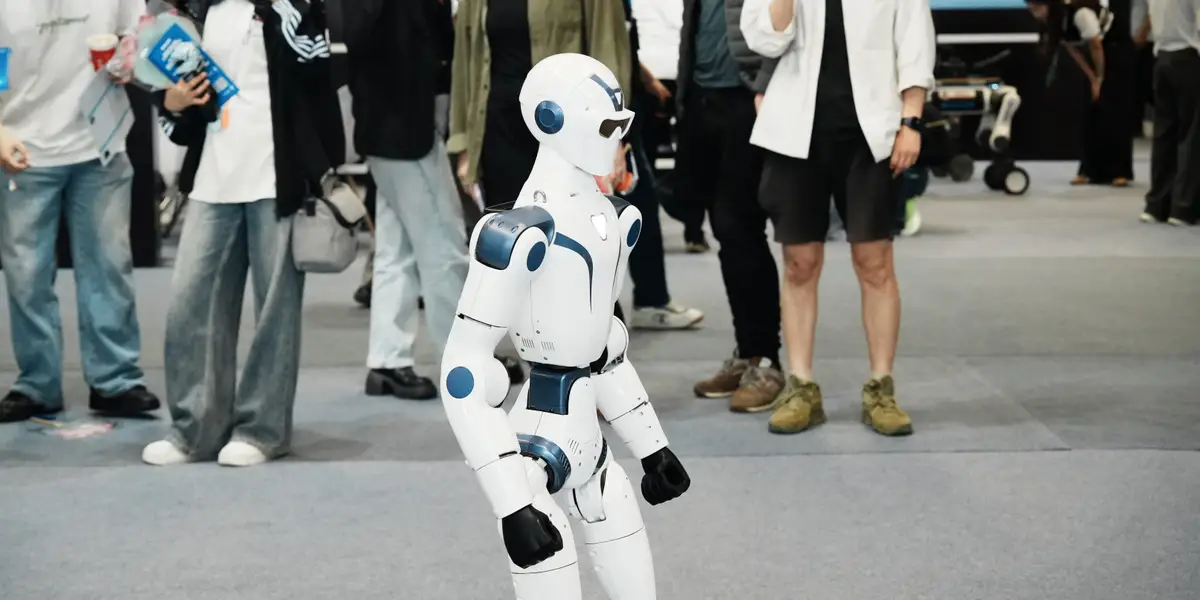
Business Insider reports that Silicon Valley is shifting from conversational AI toward robotics, with major players and startups racing to give AI a body. At Nvidia GTC Taipei, Business Insider reports Nvidia unveiled a standard humanoid robot blueprint for academic researchers, expected to be available in late 2026. Business Insider reports OpenAI CEO Sam Altman said, "In the short term, we are focused on robots to support skilled workers to build our future infrastructure; in the long term, we imagine everyone having a personal robot doing anything they need." Business Insider frames robotics as an "arms race" involving Nvidia, OpenAI, Meta, Tesla, and startups such as Figure AI, which Business Insider reports was most recently valued at $39 billion and signed a commercial agreement with Catalyst Brands for distribution deployments.
Business Insider reports Silicon Valley is shifting from building conversational AI toward physical robotics. Business Insider reports that at Nvidia GTC Taipei, Nvidia presented a standard humanoid robot blueprint aimed at academic researchers, with availability expected in late 2026. Business Insider reports OpenAI CEO Sam Altman said, "In the short term, we are focused on robots to support skilled workers to build our future infrastructure; in the long term, we imagine everyone having a personal robot doing anything they need." Business Insider reports the story frames robotics as a competitive area involving Nvidia, OpenAI, Meta, Tesla, and a wave of startups. Business Insider reports Figure AI was most recently valued at $39 billion and has a commercial agreement with Catalyst Brands to deploy humanoids in distribution and logistics.
Industry-pattern observations: The shift from purely digital models to embodied systems increases emphasis on integrated stacks: perception (multi-modal sensors), real-time control, simulation-to-real transfer, and edge-compatible compute. Companies building humanoids typically combine high-bandwidth sensing, low-latency actuation, and specialized inference hardware; these components raise system engineering and safety requirements beyond those of cloud-first LLM deployments.
Public reporting places this move in a broader trend where major AI platform providers and chipmakers seek to capturevalue along both software and hardware supply chains. A standard humanoid blueprint from a major vendor can lower entry barriers for academic labs and startups, accelerating experimentation but also concentrating attention on integration, validation, and regulatory-readiness for real-world operation.
Observers should track three indicators:
The story documents major AI platforms publicly committing attention and resources to robotics, which materially affects practitioner priorities around integration, simulation, and hardware. That makes it notable for ML/robotics engineers but not a frontier-model breakthrough.
Practice interview problems based on real data
1,500+ SQL & Python problems across 15 industry datasets — the exact type of data you work with.
Related Stories
 AI News
'A wave of AI attacks on critical infrastructure is coming', tech giants warn
2 minutes ago
 AI News
Xero Adds AI, Google Targets Law Firms And Claude Beats ChatGPT: 5 Small Business Tech Stories
2 minutes ago
 AI News
LTM inaugurates global delivery and AI competency center in Kolkata
1 hour ago
 AI News
Scura, Wigfield, Heyer, Cammarota & Gonzalez Highlights Responsible Use of Artificial Intelligence in NJ Legal Practice
2 hours ago
 AI News
Google AI Week gives Killeen businesses hands
2 hours ago
 AI News
Artificial Intelligence Stocks To Consider
2 hours ago
 AI News
AI’s worst disasters will arrive unannounced | Letters
3 hours ago
 AI News
Anthropic Holds Talks With AI Chip Startup MatX To Accelerate Chip Development
4 hours ago