
Sobeys' parent Empire agrees to end property controls. Here's how it's a win for consumers
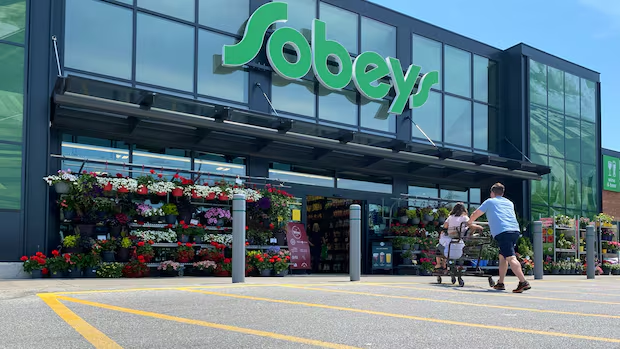
Sobeys' parent Empire agrees to end property controls after battle with Competition Bureau
Deal means Empire Co. Ltd. will no longer be permitted to restrict competition through land titles
Canada's Competition Bureau has reached an agreement with Sobey's parent company to have the grocery giant strictly limit or stop using property controls after the agency found the practice to be anti-competitive.
Property controls are clauses written into the land title that can prevent rival grocery stores from opening new stores nearby (exclusivity clauses), or can ban food products from being sold at nearby pet stores, dollar stores, gyms or other retailers and restrict what future leaseholders can sell on the land (restrictive covenants).
Empire Company Limited — which owns Sobeys, Farm Boy, Safeway, Freshco, IGA and others — has been under pressure from the consumer watchdog for months to get rid of their property controls after it found the practice to be anti-competitive.
"This all started with an investigation that we started in 2024 about the use of property controls by Loblaw and Sobeys and their impact in the grocery sector," said Anthony Durocher, acting senior deputy commissioner of the Competition Bureau.
"Loblaw has made commitments to curb its use," he told CBC News. "Now we have an agreement with Sobey's as well."
Win for consumers, economist says
The investigation into the Canadian grocery giants' use of property controls came off the back of federal committee hearings held in 2023 that were meant to get to the bottom of rising grocery prices.
"Sobeys, in a way, has been the hardest nut to crack," said economist Jim Stanford, who testified at those hearings. "They denied that these things were wrong and initially pledged to continue doing it."
How grocery giants control who can sell food in your neighbourhood
Competition Bureau looking deeper into how Sobeys can control who sells food in your area
The new deal is a win for the bureau — and for consumers, he said.
"I think this is a recognition that these practices are wrong — economically wrong and morally wrong — and the Competition Bureau is taking them seriously."
Land title documents obtained by the CBC's Marketplace earlier this year found stores within a radius of up to five kilometres from a grocery giant were restricted from selling perishable food items, like "fresh or frozen food, including meats, fruits, vegetables, fish, poultry, bakery, pre-packaged bread, delicatessen, bulk food or dairy products."
One reason why you might be paying more for groceries
Some restrictions also prevented nearby retailers, such as dollar stores, from offering steep discounts on big national brands like Kraft, Coca-Cola and Evian.
A spokesperson for Sobey's parent company, Empire, told CBC News in a statement that the company is "pleased to have resolved the matter of property controls with the Competition Bureau," adding that they continue to invest in their network of stores across Canada.
Canada's got a grocery competition problem. Are local food hubs the answer?
Empire Company Limited is the second-largest grocery network in Canada after George Weston Limited, which owns Loblaws, No Frills, Superstore, Zehrs, Dominion, Fortinos, Freshmart and others.
Loblaws committed to cease enforcing its own restrictive covenants and to limit its exclusivity clauses in 2025, after the Competition Bureau's initial probe. The watchdog says it continues to monitor that commitment.
'Exclusivity clauses' still permitted
While the new agreement legally requires Empire to refrain from using new or existing restrictive covenants, it does allow "limited" use of exclusivity clauses.
This means that while the company can no longer restrict what other businesses can sell, they can still prevent direct competitors from opening locations on a shared development.
"There are some cases where it's justified in specific circumstances," said Durocher, pointing to Competition Bureau's public guidance for retailers.
The guidance says a "limited" exclusivity clause can be pro-competitive in a scenario where "no retailer would otherwise make the necessary investments to become a key tenant in a new shopping plaza." It further states that in such a case, no retailers of a particular type would risk opening up in the shopping plaza without the exclusivity clause, "and so the clause increased competition."
The bureau is prepared to make case-by-case judgements in these instances, Durocher said, having identified 19 such scenarios on land occupied by Empire-owned grocery stores in the course of their investigation.
The federal government granted the Competition Bureau increased authority to enforce their property control rules earlier this year.
Ultimately, Durocher said, this makes it easier for grocers, butchers and bakeries to open up and to compete. "More competition means lower prices, more choice, more innovation," he said.
Competition Bureau to examine Canada's food supply chain
Ottawa has struggled to increase grocery competition. Will the new food strategy help?
Durocher said he intends to pursue similar, legally binding deals with other grocers, while simultaneously moving forward with the consumer watchdog's formal examination of the industry's barriers to competition launched in June.
This includes investigations into production and processing, transportation and distribution, and retail pricing across Canada's food supply chain.
As the examination continues, the Competition Bureau might be somewhat "hamstrung" by their limited powers, said Stanford, adding he would like to see more done to "stop these companies from getting so big in the first place."
"I'm encouraged by this, but I don't know if it means a whole new era of cracking down on food oligopolies or not," he said. "That remains to be seen."
Katie Pedersen is an investigative journalist for CBC Marketplace.
Related Stories
 Lifestyle
Food inspections hampered by staff shortages
1 day ago
 Lifestyle
Mother bear that wandered into B.C. store killed by conservation officers
1 day ago
 Lifestyle
Man shot by ICE agent in Texas treated for paralysis in left side, lawyer says
1 day ago
 Lifestyle
Canada leaving billions on the table by not processing more crops at home, new agri
2 days ago
 Lifestyle
Hundreds flee homes in Far North Cameroon after armed group raid kills 15
2 days ago
 Lifestyle
Haiti: Over 250,000 children trapped in the grip of hunger
2 days ago
 Lifestyle
Restaurant 'feels helpless' over dine and dashers
2 days ago
 Lifestyle
Unloved brands offloaded by Big Food are a tasty snack for startups, PE firms
3 days ago