
Some Russians are turning on Putin as drones hit Moscow. Does it matter?
Some Russians are turning on Putin as drones hit Moscow. Does it matter?
'Not only are they not winning, but the war is coming closer,' says Pulitzer-prize winner Anne Applebaum
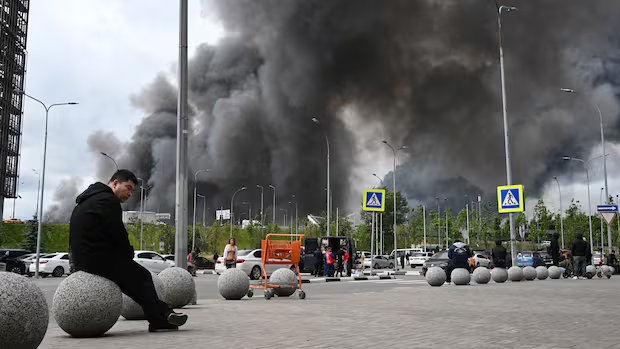
Last week, Moscow residents looked up at black smoke hanging over the city as Ukrainian drones buzzed overhead.
It was Ukraine's largest drone attack on the Russian capital since Russia launched its full-scale invasion in 2022. Hundreds of flights were delayed or cancelled, while a major oil refinery on the city's outskirts was repeatedly struck and set ablaze.
"If Ukraine is going to burn, your Moscow will burn too," Ukrainian President Volodymyr Zelenskyy said.
The latest wave of strikes has brought the war much closer to home for many Russians, disrupting daily life and eroding their sense of safety.
Analysts say the attacks may deepen domestic anxieties as the war drags on. But whether that discontent will loosen Russian President Vladimir Putin's grip on power — or provoke him into escalating further — remains unclear.
Muscovites beginning to understand that 'war is coming closer,' says Pulitzer Prize-winning historian
Historian Anne Applebaum told CBC it was the first time Muscovites had been subjected to "real drone campaigns" since the war began.
"They finally see the war, and they're beginning to understand that it's not that … not only are they not winning, but the war is coming closer," said Applebaum, who won a Pulitzer Prize in 2004 for her book, Gulag: A History.
Applebaum said the attacks would not immediately end the conflict but could contribute to "a pretty strong shift in the mood of the business elite, the political elite" and others who still influence Putin's thinking.
Her latest book, Autocracy, Inc., examines how dictators work together to undermine democracies.
Even though the strikes blackened the skies and damaged buildings, footage of the attacks did not air on the country's evening newscasts. Nor were warnings issued to the city's residents.
"I can't say anything about an alert. No sirens, nothing at all," one Moscow resident told independent Russian media outlet SOTAvision. "Of course, I hope this is under control, but it obviously causes anxiety."
Power and paranoia: War arrives on Putin’s doorstep
Some prominent Kremlin allies have also denounced Russians who share images of Ukrainian attacks.
Vladimir Solovyov, a leading Russian propagandist who hosts programs on the state-owned television channel Rossiya 1, called those who post such videos traitors.
"This passionate desire to photograph and post everything — is it some kind of an itch in the ass or what?" Solovyov said on his radio show.
Applebaum, a staff writer for The Atlantic who continues to cover the Russia-Ukraine war, said it is unclear how widely such images circulate inside Russia. But she said they remain significant.
"They're pretty clear proof also that Russians are not safe," she said, "that they haven't defeated Ukraine, that the war is still going, that they're paying a high price for it."
Moscow is not the only Russian city to have been hit by recent Ukrainian strikes.
On Monday, Ukraine's military said it struck an electronics plant in Voronzeh, Russia, that produces missile parts, including components for the Iskander tactical missile system.
On Wednesday, drones knocked out power in Russian-held Crimea while also targeting energy infrastructure in central and southern Russia. Fuel restrictions have already been imposed on the Crimean Peninsula as a result.
In communities affected by the strikes, some Russian civilians have described an ongoing feeling of panic and anxiety.
"We are not protected and we don't know anything, and every day we go to bed with fear," one resident of Tuapse, a town on the northeastern shore of the Black Sea that has been hit repeatedly by drones, told SOTAvision.
"Such are our authorities. They don't give a damn about us," the woman said.
Even state-run or Kremlin-linked polls reportedly showed Putin's approval ratings steadily declining throughout March and April. The numbers later rose again after one poll temporarily stopped publishing its results and changed its methodology.
Pro-war figures criticize leadership
Some Russian nationalist figures who have otherwise supported the war are now criticizing how Putin has managed it.
"We've been fighting for five years, but the army isn't reviving," said Pavel Gubarev, a former leader of pro-Russian separatists in Ukraine's Donbas region, in an interview this April. "And what's happening on the front makes you think this isn't a war at all, but human slaughter."
Ukrainian journalist Eugene Slavnyi cautioned against interpreting such rhetoric as evidence of changing attitudes toward the war itself.
"They might be against Putin, but they're still supporting the war," said Slavni, editor-in-chief of UNITED24 Media, the largest English-language Ukrainian media platform.
"This is what you need to understand, that it's not only Putin's war. This is, unfortunately, the war of Russian people against Ukrainian people."
Exiled opposition activist and businessman Mikhail Khodorkovsky told CBC that declining support for the war would worry Putin.
"If Russian society stops supporting Putin, his only support will be the secret services, and he will become dependent on them," Khodorkovsky said. "He does not want this."
But Khodorkovsky, once the richest man in Russia, said it is unlikely that the country's oligarchs will turn against the 73-year-old president.
"The West does not understand the system of power in Russia," he said. "Those so-called Russian oligarchs are actually just tools of Putin's political machine, not independent actors."
If widespread protests were to erupt, Putin might initially prefer to arrest a small number of dissidents "to get people to fall into line," according to Michael Kimmage, author of Collisions: The Origins of the War in Ukraine and the New Global Instability.
But Kimmage said the authoritarian leader would not hesitate to use force against his own people.
"I don't think that there would be shyness about large-scale executions or just the use of mass violence," he said.
Putin could try to create a 'civilian catastrophe' in Ukraine, says history professor
Managing both domestic discontent and a prolonged war will become increasingly difficult for Putin, said Kimmage, founding director of the Kennan Institute, a Washington D.C.-based centre that conducts research on countries of the former Soviet Union.
"In a way, Putin has made his life miserable — his personal political life miserable — because of this miserable war."
New documentary Putin's Journey explores Russian leader's rise to power
Kimmage said there is also a risk that Putin could become increasingly desperate and dangerous, escalating beyond the ruthlessness Russia has already displayed against Ukrainian cities and civilians.
"He can always go after things like the water supply, the electricity supply — which he's been doing — but you can up the ante there and really try to create a civilian catastrophe [in] Ukraine," said Kimmage, a professor of history at the Catholic University of America.
Putin is already wanted by the International Criminal Court for alleged war crimes involving the unlawful trafficking of Ukrainian children into Russia.
Applebaum said Putin is "clearly not winning the war," but cautioned that mounting pressure could lead to greater aggression rather than compromise.
"Maybe he has a greater desire to show how powerful he is. We don't know."
With files from Alex Shprintsen, Terence McKenna and Anastasiya Ivanova
Related Stories
 World
World
Mistrial declared in Lindsay Clancy child killings case after jury deadlocks
11 minutes ago
 World
World
Niger coup attempt: Is Russia proving better at protecting friends than fighting enemies in West Africa?
11 minutes ago
 World
World
Indiana Fever Get Good Caitlin Clark News After FIBA World Cup Debut
1 hour ago
 World
World
UN General Assembly endorses a new world map that shows more accurately Africa's size
3 hours ago
 World
World
Why are European countries moving their gold out of North America?
3 hours ago
 World
World
Friend holds out hope for Canadian runner missing on Matterhorn
3 hours ago
 World
World
Teen footballer comes third in world championships
4 hours ago
 World
World
Viewpoint: Fusion’s lessons from fission, as commercial deployments approach - world
6 hours ago