
Space Startup Pixxel With Ties to N. America Secures $100M Series C
Los Angeles- and Bangalore-based Pixxel said it has closed a $100 million Series C round, the biggest fundraise yet for an Indian spacetech startup, as the Google-backed company pushes beyond hyperspectral imaging into a wider Earth-observation business that includes analytics software, sovereign systems and satellite manufacturing.
Temasek and Seraphim co-led the financing, with 360 ONE Asset, IMM Investment, Canada’s Radical Ventures, with offices in San Francisco and New York, and growX Ventures also participating, taking Pixxel’s total funding to $195 million.
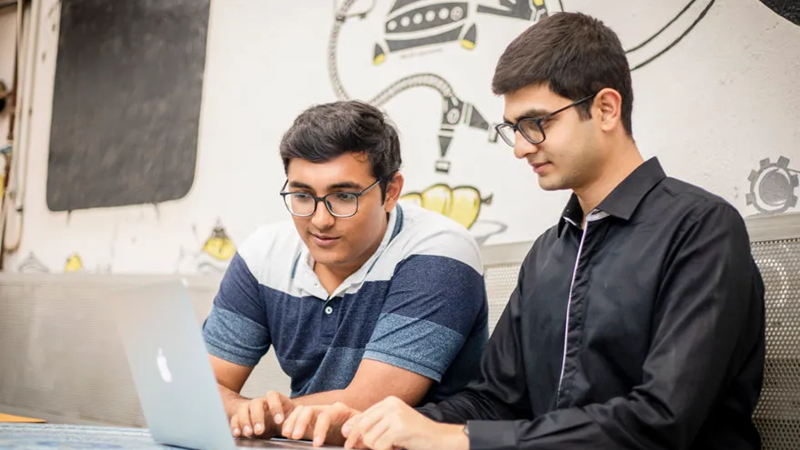
Founded by the duo of Awais Ahmed and Kshitij Khandelwal, Pixxel is one of the many space startups that have emerged in India since the country privatized space development six years ago. The two met at the Birla Institute of Technology, where Ahmed earned a bachelors degree in Math and Khandelwal in electrical and electronics engineering. The company’s chief science officer, based in Los Angeles, is Eiji Yafuso, previously the CEO of Lux Solis and a former chief technology officer of PV Labs, which makes airborne visible and infrared mapping and surveillance technology.
Pixxel operates its American legal entity, Pixxel Space Technologies Inc., out of El Segundo, Calif. It serves as the hub for its North American commercial operations, satellite constellation development, and its dedicated federal arm, Pixxel Federal, which manages contracts with U.S. government entities like the National Reconnaissance Office (NRO).
The funding deal also appears to put Pixxel at the top of India’s private space fundraising table. The Economic Times reported Skyroot Aerospace has raised $155 million so far, while The Times of India put Skyroot at about $160 million after its May 2026 round.
Pixxel did not disclose a valuation on Sept. 7, but Mint, a business daily, had reported in July that Temasek was leading discussions around a $100 million raise at a $350 million to $400 million valuation. Seraphim CEO Mark Boggett told Mint the company is well placed around “AI-powered Earth observation” and rising demand for sovereign capabilities.
What investors are betting on is a broader stack, not just a satellite feed. Pixxel said the new capital will fund its Honeybee hyperspectral constellation, high-resolution optical satellites, Aurora intelligence software and Gigapixxel production capacity in India and the U.S. Founder and CEO Awais Ahmed said the company began by trying to build a “health monitor for the planet.” In comments reported by The Times of India, Ahmed said more Firefly satellites would launch first, followed by Honeybees that would keep 5-meter hyperspectral resolution while extending into short-wave infrared. Pixxel’s statement added that the first Honeybee launch is expected in 2027 and that it is also adding synthetic aperture radar and ultra-high-resolution optical imaging.
The company enters this round with more operational traction than a typical satellite startup. Pixxel says it has deployed six Firefly satellites and launched Aurora; Mint and YourStory also reported contracts with NASA and the U.S. National Reconnaissance Office, multiple iDEX wins from India’s defense ministry, and plans for an orbital data-center demonstration satellite. It has also been selected to lead India’s first public-private Earth-observation constellation under IN-SPACe. A separate Times of India report said that 12-satellite project will be built by a consortium led by Pixxel with Dhruva Space, PierSight Space and SatSure, with investment of more than Rs 1,200 crore and a target to be operational by 2029.
The timing matters almost as much as the size. India Today said Pixxel is one of the startups that emerged after India opened more of the space sector to private players. YourStory, citing government data, reported private investment in Indian spacetech had reached $618.5 million by March 2026, with about 440 registered space startups; Tracxn put total external funding at about $871 million across 241 rounds by July. For founders and investors alike, Pixxel’s raise is a sign that capital is now following companies that want to control more of the value chain, from sensors in orbit to software that turns raw imagery into decisions.
[Noah Wire Services helped in the writing of this article.]
Related Stories
 Business
Robot factories and hypersonic missiles: JPMorgan Chase’s first $5 billion of defense investments
4 days ago
 Business
Police say a car has hit an Australian lawmaker, critically injuring her; the driver was arrested
4 days ago
 Business
Boomi acquires Israeli startup Elementary for $43 million
4 days ago
 Business
Mega chicken farm expansion plan withdrawn
4 days ago
 Business
Data Breach at Hankyu Hanshin Department Store Common ID System Affects Nearly All 1.26 Million Members
4 days ago
 Business
Global Startup EXPO and Nippon Startup Awards 2026: METI Showcases Japan's Deep
4 days ago
 Business
FANCL and Attenir Suffer Data Breach Affecting 780,000 Customers, Exposing Addresses, Names, Phone Numbers
5 days ago
 Business
DeepSeek Quietly Ships V4.1-Flash
5 days ago