
“Startup Organization AX Depends on the CEO”… Plan Alliance CEO Moon Kyung
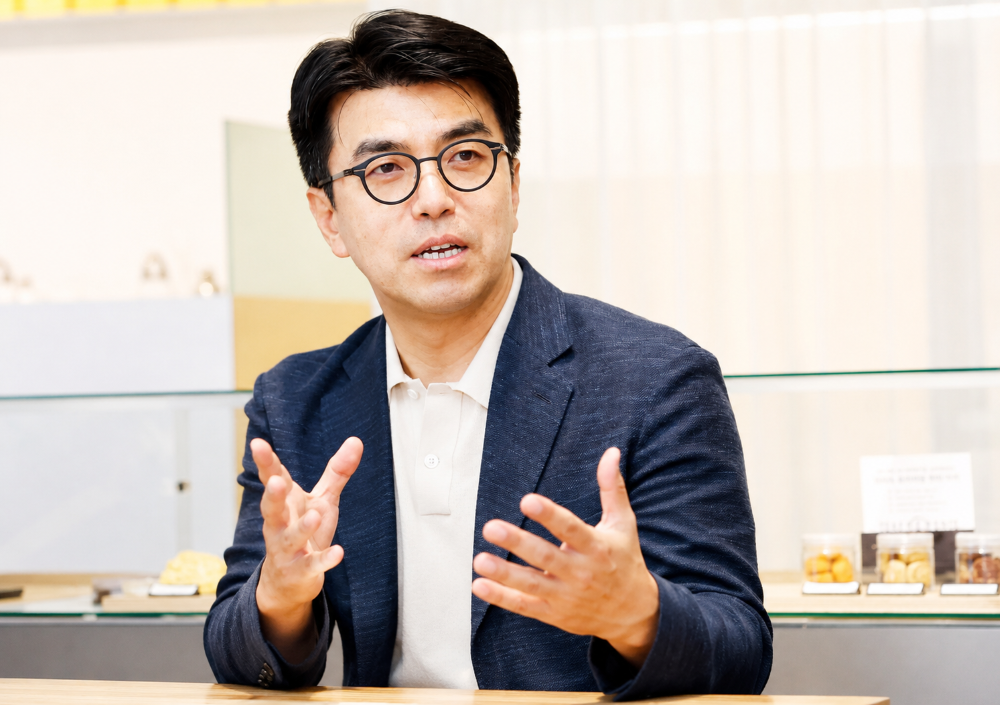
“One day, after spending a long time lecturing on AI outside, I returned to find that my company was still operating in the familiar way. That’s when I realized that I needed to find the answer before anyone else.”
Moon Kyung-ho, CEO of Plan Alliance, is considered the most pioneering figure in the industry, leading 'digital transformation' and 'practical application of AI.' CEO Moon has been integrating AI into business operations since the early days of ChatGPT and is actively working as an AX expert shifting the industry paradigm.
In the days before AI was commercialized, CEO Moon, who was at the forefront of trends, recognized AI faster than others. The realization that "failure to adapt leads to obsolescence" turned into a sense of desperation. Starting that night, he began self-studying to apply AI to practical work. He devoted himself to the task regardless of weekdays or weekends, mastering the latest AI technologies ahead of anyone else.
The problem was the organization. While CEO Moon utilized various AI agents such as GPT, Claude, and Cursor, and even gave external lectures on practical applications, the actual understanding and usage rate of AI among internal employees was significantly low. A substantial gap had opened up between the CEO's own speed and efficiency and the organization's speed and efficiency.
Faced with this gap, CEO Moon viewed the problem as lying with himself, not with the employees. With the belief that he had to find the answer himself, CEO Moon plunged into AX in his own way. He did not recruit external experts. He did not invest a massive budget in company-wide training, nor did he form a task force through a separate organizational restructuring. It took approximately two years to bridge this gap.
Compared to 2023, Plan Alliance has streamlined its workforce by more than 30%. In just two years, productivity per person has improved by nearly 1.5 times, while the number of clients handled has actually increased by approximately 33%. This is a change brought about by productivity innovation through AX, which has allowed the company to expand its size without increasing its workforce.
Change extends beyond mere efficiency; the scope of the business itself is expanding. Plan Alliance is introducing business services for the brand communication organizations of large and mid-sized enterprises in a manner rarely seen in the existing industry—services that did not previously exist. This approach involves directly building and providing AI-powered tools such as media management tools, real-time issue detection systems, and negative issue sensors for community platforms. In essence, it goes beyond mere management outsourcing to create the very "business infrastructure" for brand organizations.
CEO Moon Kyung-ho reveals the secret to AX's success as follows: “There is no need to change the entire organization. The trust and empathy shown by just one employee is enough.”
Most organizations choose company-wide training as the solution for AI transformation. This approach involves distributing tools to all employees, training them on how to use them, and encouraging their utilization. In fact, many companies are driving AI adoption through this approach.
However, CEO Moon chose the exact opposite path. His method can be summarized in three steps: the CEO sets an example by utilizing AI in practical operations first, focuses on a single key figure rather than the entire organization, and waits for that change to naturally spread throughout the group.
The CEO wants to quickly spread good tools throughout the organization, but employees are often overwhelmed by their immediate workload and find it burdensome to learn new technologies. He did not try to forcibly bridge this gap. Instead of persuasion, he focused first on understanding the employees' reality and determined that change should begin with voluntary participation rather than coercion.
CEO Moon led the transition to AI by setting an example himself rather than through 'coercion.' First, he established a free AI study group within the organization and allowed anyone to participate freely. He kept the door open so that employees would naturally seek it out when their curiosity arose. He focused on creating an atmosphere where people participated out of their own interest, rather than forcing them to learn.
At the same time, he consistently shared his own process of studying and utilizing AI with his employees. He did not stop at merely recommending it verbally but showed actual results. He personally developed practical brand management tools using 'loop engineering,' which allows AI to repeatedly verify and modify itself after setting goals, and shared them with his staff. In essence, he directly implemented tasks that would have previously been outsourced.
When the CEO first mastered AI and created tools that could be utilized in practical work, employees began to gain confidence, thinking, “I can do this too.” “It is most important for both the CEO and executives to be diligent and demonstrate action first without coercion,” CEO Moon said. He added that when a leader proves themselves through action, the organization naturally follows suit.
The real key lay here. Instead of trying to persuade the entire organization at once, CEO Moon focused on a single key figure. He sought out a curious employee who was not afraid of trial and error and possessed many ideas for new content, rather than one considered competent or cautious.
Whenever this employee brought in unpolished results, they refined the work together by exchanging feedback. He described this process as "exchanging back and forth like playing table tennis." Rather than waiting for a high-quality outcome, he guided them to repeat a cycle of rapid experimentation and revision, and this intensive feedback brought about change faster than expected.
At some point, other team members began seeking out the employee to ask how to use AI. It was the moment when a culture of learning from and referencing colleagues naturally formed, rather than the CEO unilaterally teaching. Changes that top-down education had failed to create began to spread spontaneously within the organization.
“Now, that colleague is doing better than me. As work efficiency changed significantly with the use of AI, other team members started to follow suit. That is how AI naturally began to spread rapidly within the company.”
Investment focused on one person eventually spread to the capabilities of the entire organization. The success formula CEO Moon speaks of always starts with 'one person'.
We are living in an era where legacy conglomerates are pouring massive budgets into company-wide AI training. However, startups, which struggle to secure training budgets, dedicated personnel, and sufficient time, require a different approach. To startup CEOs facing this battle, CEO Moon delivers the following message.
“Don’t think you need an expert; the CEO must start first.”
CEO Moon believes that ultimately, it is one person, rather than budget or manpower, who creates change. As a first-generation brand communication expert in Korea celebrating his 26th year, he himself did not have ample resources when launching AX. He took the initiative and focused on a single employee who saw potential in him. That small change eventually spread throughout the entire organization.
The 94% renewal rate, based on the philosophy of "staying with a partner for at least five years," also stems from the same philosophy. It is the result of consistently investing time in each person and relationship to build trust, rather than trying to achieve large results all at once.
Two years ago, on his way back from a lecture, he pondered the reality that his employees were unable to keep up with AI. Now, his question has changed. It is not about how many employees use AI, but about how effectively he can drive change in even a single person to the very end. He believes that for startups lacking both budget and manpower, the answer begins right there. And he has proven that possibility firsthand within his own organization.
The Startup Ecosystem Reporter Corps is jointly operated by KAIA and Venture Square and records various stories from the startup scene.
Related Stories
 AI News
Bill Gross bets AI can help mass
1 day ago
 AI News
Nigeria records 93% rise in AI micro
1 day ago
 AI News
The Italian gelato maker using AI to invent new flavours
1 day ago
 AI News
Closing the Gap Between Agentic CX Pilots and Production
1 day ago
 AI News
New Brunswick data centre debate highlights cross
1 day ago
 AI News
How to Structure an AI Agent Referral Fee Agreement Between Startups
1 day ago
 AI News
No, AI didn’t delete a Swedish reality TV series
1 day ago
 AI News
There is no AI in Armageddon. Artificial intelligence is a tool, not an apocalypse
1 day ago