
Tech CEOs call for AI regulation. Trump and U.S. Congress are not rushing to act
WASHINGTON — The technology industry’s increasingly urgent warnings about the potential harm of artificial intelligence are slamming into political intransigence in Washington, offering a fresh test of the federal government’s willingness and ability to confront what may become a defining issue of the era.
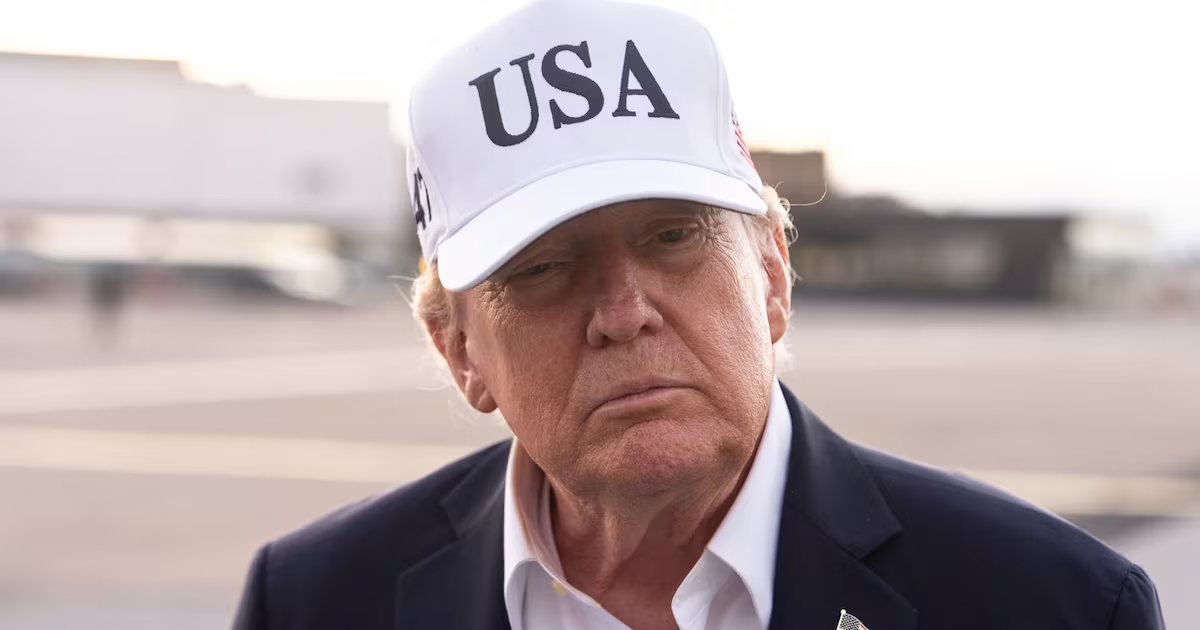
U.S. President Donald Trump is leading the opposition to recent calls by tech leaders seeking greater government oversight, including Anthropic’s Dario Amodei, OpenAI’s Sam Altman and xAI’s Elon Musk.
The president dismissed efforts to limit the technology on Monday as a “conspiracy.” Other leading Republicans including U.S. Vice President JD Vance have expressed caution. House Speaker Mike Johnson has largely deferred to the White House.
Democrats, meanwhile, are pressing for a more robust response, convening in private on Tuesday in the House to discuss AI. Sen. Bernie Sanders, I-Vt., is hosting his colleagues for a briefing with experts on Wednesday. Top candidates on the ballot this year such as Sen. Jon Ossoff of Georgia are pressing for sweeping action in Washington. And former President Barack Obama is encouraging those with White House aspirations to develop a “very clear plan” to address AI concerns.
The contrasting responses illustrate a yawning disconnect emerging between a tech sector warning of AI’s existential threats to humanity and a federal government often struggling to accomplish basic functions under the weight of intense partisanship and election-year pressure.
“The signals we’re receiving from our political leaders are not representing an understanding of the crisis that I think we are in fact in,” said Max Stier, the president and chief executive of the nonpartisan Partnership for Public Service. “Delay is going to prove very costly.”
There are notable exceptions to the partisan divide. Sen. Josh Hawley, R-Mo., opened an investigation last week into OpenAI for its artificial intelligence system hacking into another AI company on its own. And, speaking at a Washington AI conference on Tuesday, Trump ally Steve Bannon embraced overlapping views with Sanders on the issue.
“We have to rise above it,” Bannon said. “This is a hinge in history.”
U.S. Congress and the White House have responded to past crises
U.S. Congress and the White House have managed to respond swiftly to past crises and the intensifying AI debate is emerging as a new referendum on whether they can do so again.
During Trump’s first term, his team worked with Democrats in control of Congress to stabilize the economy as federal agencies worked to produce a vaccine to combat the COVID-19 pandemic. As the economy teetered on collapse in 2007 and 2008, President George W. Bush’s Republican administration teamed with congressional Democrats to inject money into the financial system.
But Congress has long been reluctant to regulate the technology industry.
The Biden administration called on lawmakers to develop policies after a 2023 executive order on AI oversight, which Trump rescinded soon after returning to office. As the technology has progressed at a rapid clip, Congress has refrained from imposing rules or funding ways for people to successfully adjust to the potential changes from AI.
A bipartisan working group on artificial intelligence formed by then-Senate Majority Leader Chuck Schumer released a report in 2024 recommending the U.S. spend at least $32 billion over the next three years to develop artificial intelligence and implement safeguards around it. But there was little follow up. Similarly, a bipartisan bill on internet safety for children has repeatedly stalled.
“We never do anything until we have a holy heck moment,” said Sen. Mark Warner, a Virginia Democrat and former technology executive.
Lawmakers in both parties agree more guardrails are needed, but even narrow attempts at regulation have fallen apart and a certain skepticism has set in.
“Have we gotten election security done?” asked Sen. Rick Scott, R-Fla. “Did we balance a budget? Oh, did we pass a budget? See, what have we gotten done? So you think we’re going to get AI done?”
Ossoff cast the AI debate as an example of Washington’s inability to tackle anything big.
“What fills us with dread is the crushing weakness of our politics against the massive stakes of our times,” he said during a Sunday reelection rally in Athens, Georgia.
A renewed sense of urgency for government oversight
There are some signs of renewed urgency.
After the tech leaders called for greater oversight on Saturday, Senate Majority Leader John Thune, R-S.D., said he spoke that night with Sen. Amy Klobuchar, D-Minn., about a “path forward” on legislation they’re working on.
“You don’t want to stifle innovation, but I think you also want to make sure that the more advanced threats can be mitigated and there’s a capability and place to do that,” he said.
“I also think,” he added, “that there is a way in which Congress can put guardrails around those types of more consequential threats without, in any way, harming our ability to stay ahead in the AI race.”
Sen. John Kennedy, R-La., said he plans to offer a so-called kill switch measure on Wednesday that would require developers to have the capacity to shut down their systems if needed. It would need the Senate’s full support to advance.
“AI is becoming an issue, particularly in the last few days,” he said.
But with a dwindling calendar ahead of the November election, any fast movement on legislation seems unlikely. In the House, Johnson seemed downbeat on the prospect of a legislative response, calling instead for Trump to summon AI leaders for a meeting to resolve concerns.
“The reflex of legislative bodies is to cover things up with red tape and hyper regulation,” he said.
And any legislation that emerges would require Trump’s support, which appears unlikely at the moment.
“All I can tell you is my own perspective on this,” said Hawley, who has introduced bipartisan legislation requiring federal tracking of AI safety concerns tied to national security, civil liberties and labor protections. “We need to protect working people. We need to protect kids online. We need to protect folks who are threatened by data centers.”
“We also need to make sure,” he added, “these frontier models are not going to blow up the internet and/or the world.”
For veterans of past crises, the congressional inertia is baffling.
“Earth to Washington: You’re pushing an open door,” Rahm Emanuel, Obama’s chief of staff in the wake of the financial crisis and a potential 2028 presidential candidate, said in an interview. “In my entire time of public service, I’ve never had an industry or a CEO ask for regulation and oversight.”
Rep. Don Beyer, a Virginia Democrat who is a leader in the Congressional Artificial Intelligence Caucus, said Congress is “capable” of passing stronger AI rules. He said he thinks there’s sufficient support for multiple bills, including a bipartisan measure that would establish guardrails for AI models and another that includes the kill switch provision.
“It’s very much a leadership issue,” Beyer said as the House is poised to adjourn at the end of the week and not return until after the elections.
Steven Sloan And Mary Clare Jalonick, The Associated Press
Associated Press writers Josh Boak, Lisa Mascaro and Kevin Freking in Washington and Bill Barrow in Athens, Georgia, contributed to this report.
Related Stories
 AI News
AI agents invent their own language to shut humans out
29 minutes ago
 AI News
Could AI really wipe out humanity
29 minutes ago
 AI News
AI doomerism: will artificial intelligence spiral out of control?
29 minutes ago
 AI News
BRKZ Raises $31 Million to Expand AI Construction Procurement
1 hour ago
 AI News
London-based Jack & Jill raises €34.68 million Series A to scale its AI agents for jobseekers and employers
1 hour ago
 AI News
As AI debate flares, Melania Trump touts the technology as she tours North Carolina school
1 hour ago
 AI News
AI cooperation: on Artificial Intelligence at a crossroads
1 hour ago
 AI News
Why AI researchers warn humanity could face extinction
1 hour ago