
Texas universities are offering AI degrees. Is it the answer for a changing workforce?
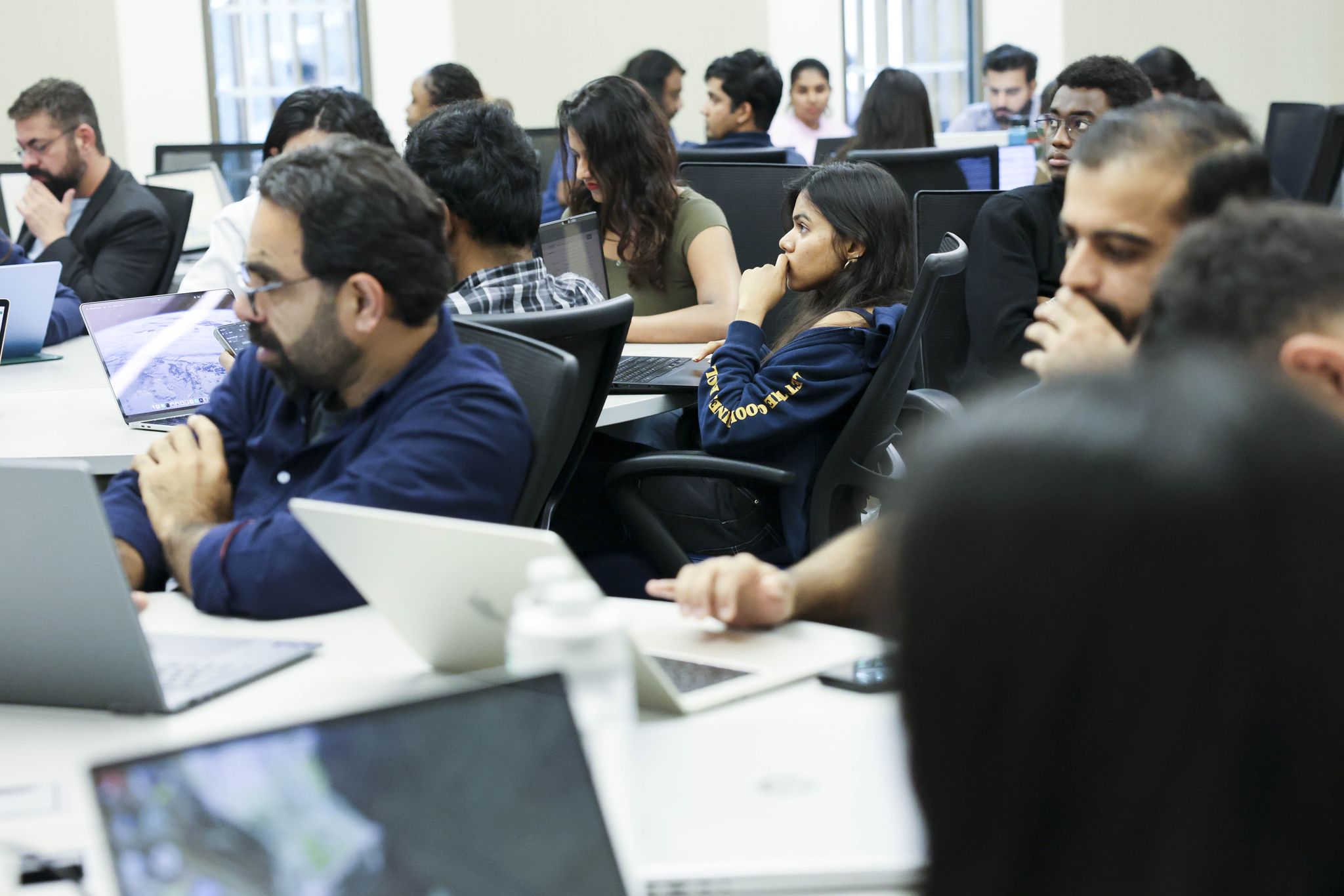
During the last week of the spring semester a few dozen graduate students, in a mix of sweatshirts and business attire, chatted softly around tables as they awaited the start of their Agentic AI class, a new course in the University of Texas at Dallas’ M.S. in Business Analytics and Artificial Intelligence program. They were led by an affable Brazilian professor named Antonio Paes, who briefly scanned the classroom and selected one group to present their final project.
“Yes, you go. I saw you debating about it,” Paes announced, provoking laughs.
Article continues below this ad
The three soft-spoken young men took the front of the classroom and — after some brief technical difficulties — began running the sophisticated AI modeling system they had created over the past week. As AI-generated code scrolled on a large projector, they explained that their program, called Chain pilot, was designed to help businesses adjust to real-world supply chain shocks by continuously monitoring inventory and pricing. It was designed to sometimes automatically implement solutions, saving human managers critical time; in a more unique twist, it also incorporates multiple AI agents, including a “skeptic” agent and an “advocate” agent, that are intentionally pitted against each other to help humans select the optimum solution to bigger problems. Later, another small group presented their customizable AI-powered travel planner. Another, the final group, explained how its AI model crawled the internet to identify competitors’ pricing history and offer detailed recommendations.
“Really good. I think all of the applications have real use,” Paes told the class. “For this last project,” he added, “you can take this to any small or midsize company and try to sell that, because that can totally be used right now.”
But the burgeoning AI whizzes will still likely be entering a tough job market — particularly for new graduates — as many companies slow new hiring in part because of uncertainty over AI. Texas universities, including D-FW’s major institutions, are trying to stay a step ahead by offering what would have been a head scratcher only a few years ago: AI bachelor’s and master’s degree programs, which are often paired with more traditional disciplines such as business or engineering and are designed to provide graduates with not only a basic AI fluency but a level of expertise that’s intended to benefit a wide range of workplaces.
“Think about it this way,” said Gaurav Shekhar, an associate dean and associate professor at UT Dallas’ Naveen Jindal School of Management who helped implement UTD’s AI programs. “Finance is a domain. Marketing is a domain. But AI is not really a domain.”
The country’s first undergraduate AI degree launched in 2018 — about four years before the public launch of ChatGPT would kick off a global AI frenzy — at Carnegie Mellon University, the Pittsburgh research university that decades earlier had also played a key role in developing the technology.
“We want to be the first to offer an AI undergraduate degree program,” Reid Simmons, the new program’s director, said in a statement at the time. “I’m sure we won’t be the last. AI is here to stay.”
Simmons was right. As of last year, according to one higher education company’s count, more than 300 universities across the U.S. offered bachelor’s or master’s AI programs. More keep coming. Over just the past few months, the University of Tulsa, Southern Illinois University Carbondale and Michigan Tech have all announced new bachelor’s in AI or applied AI. Syracuse announced a new bachelor’s in Integrative AI, and the University of Mary Washington debuted what it called Virginia’s first master’s in AI in Business.
Texas now counts more than 20 AI master’s and bachelor’s degree programs, the most of any state, according to the count by Degree Prospects, including a bachelor’s at UTEP and, beginning this fall, a bachelor’s through the University of North Texas’ College of Engineering. That program was unveiled even as the Denton university decided to cut 12 degree programs in fields including linguistics and gender studies because of a $45 million budget deficit.
The new AI program is meant “to prepare students to thrive in a ridiculously evolving world,” UNT economics professor and then provost Michael McPherson, who proposed the program, said during a February board meeting. “It sort of makes all of our heads spin, but it also addresses, I think, a growing and critical need in our society.”
Other Texas universities, including Texas A&M, offer AI minors and certificate programs but not full degree programs. That could change, said ‘Jon Jasperson, an associate dean at Texas A&M’s Mays Business School, which last fall counted nearly 1,500 students across its AI in Business programs.
“Whether it’s, ‘We take one of our existing degrees and reimagine it and refocus it,” Jasperson said. “Or whether we say, ‘Let’s create a completely new program.’ ”
Through its Naveen Jindal School of Management, UTD launched a business analytics master’s program in 2014 and an undergraduate program in 2022. In 2024, it renamed both programs to include AI. But the tech-heavy university had already been teaching AI-related courses for years — the rebrand, Shekhar said, was more about updating the name to reflect the programs’ offerings than tapping into a buzzy academic trend.
“They started renaming a lot of programs around the country — they just started calling them AI or something,” Shekhar added. “It was more of a marketing need for a lot of people, but for us at UT Dallas — literally the only thing that changed was the name.”
The four-year undergraduate program offers various concentrations, such as Marketing Analytics and AI or Finance and Risk Analytics, and requires AI-related coursework as well as core business classes. The two-year master’s program offers data science and accounting analytics tracks and more niche courses such as Applied Machine Learning and Robotic Process Automation. This spring, the undergraduate program counted 50 graduates, and the master’s program counted 289.
One of the biggest hits was Paes’ new Agentic AI class, where 50 students — a full enrollment — used their advanced skills with AI tools like Claude and ChatGPT to develop projects that aimed to solve problems ranging from UTD parking issues to the scourge of medical billing errors in the American healthcare industry.
“We built an agent that tracks it, which tells you line by line in a layman’s language what is wrong in the bill, and it creates a PDF, which you can send to the hospital and you can dispute a charge,” explained Radhey Mutha, a student in her late 20s. A financial analyst, Mutha added, would charge hundreds to get the same process started. “And our agent does it for free.”
A knock on the door — but not an invitation to the party
Texas AI students — whether they just graduated with a master’s or are still a couple years from a bachelor’s — will most likely encounter a highly uncertain, rapidly changing job market. That’s largely because even as the U.S. and Texas economies have maintained relatively low unemployment, both have also been stuck for years now in a “low-hire, low-fire” trend — a phenomenon driven in part by companies’ decisions to pause hiring amid so much AI upheaval.
Meanwhile some of the largest tech firms, including Meta, have implemented widespread layoffs as they spend billions on AI. In Texas, where job growth was nearly flat last year and will likely remain at least slightly below the state’s traditional pace this year, one recent survey showed that 10% of companies already say AI is decreasing their need for human workers.
Young job hunters have been most impacted.
“Even for highly educated young workers, obtaining employment has become harder as firms scale back expansion and replacement of vacancies,” William Rodgers III and Alice Kassens, two researchers at the Federal Reserve Bank of St. Louis, wrote last month.
The AI degree graduates — who are positioning themselves not just as enthusiasts of the technology but savvy implementers — hope they’ll stand out. That’s more likely to happen through their ability to show their real-world applications of the technology than the two trendy letters on their diploma, several career experts and companies told The Dallas Morning News.
“In our technology and operations [division], which is where a majority of our workforce is, that can carry weight,” Jennifer Chandler, the Dallas president of Bank of America, said of high-level AI credentials.
But in a world where nearly every college graduate is now fluent in AI, what really matters, Chandler added, was candidates’ proven experience. “Where have you demonstrated you have used that expertise to save time for a company, to create an efficiency?”
At Ericsson, a global tech company with its North America headquarters in North Texas, less than 1% of U.S. hires since 2024 hold a bachelor’s that explicitly names “artificial intelligence,” according to a company representative. But candidates with what the company considers “AI-related degrees” — such as computer science, IT and data science — have accounted for a growing share of U.S. hires and span more than 275 roles. More than half of those have come through the company’s operations in D-FW.
“I would never say in front of anybody that AI in a title doesn’t matter, because it’s the first knock on the door,” said Rosario Saud, head of talent and development for Ericsson Americas. “It’s not going to get you invited to the party.”
What goes further, Saud added, is the story candidates can tell in their resumes and in interviews about past AI projects or initiatives — she pointed to one UTD graduate whom Ericsson recently hired, for an HR-related role, in part because he had won a Google AI competition for a project related to water consumption.
“That was something that actually struck us when we saw the CV,” said Saud. “I was like, ‘That’s the perfect example of an individual that is applying AI in something.’ ”
‘What do you do with it? ’
Universities are also striving to remain attuned to shifting corporate workplace needs. Every semester, hundreds of companies, from industries ranging from healthcare to financial services, visit UTD’s Jindal School of Management, Shekhar said, and many are deeply involved in various student projects. AI is a constant topic.
“Every industry is disrupted with AI,” he said, “in a good way or not so good way as well … the best thing for [companies] to do is just to engage with academia, because students, believe it or not, are some of the most genius thinkers.”
Those thinkers are also highly motivated. After Paes’ Agentic AI class wrapped up, the professor delivered a brief speech: The corporate world may be going through “a gigantic reset,” and competition is high, he told the students. But technological disruption has also created opportunities — and the students now have the ability to apply their AI skills to immediately benefit startups or other companies.
“So coding is no longer a problem. Building something is no longer a problem, at least for you guys,” Paes continued. “The problem is: ‘What do you do with it? What kind of innovation [do] you bring?”
The group happily gathered for a class photo, and several students were eager to speak with a reporter for The News. One graduating student, Danielle Beagle, a former English major and military mechanic, had enrolled in the master’s program to help advance in her current accounts payable role. Through Paes’ class she created an AI agent that dramatically streamlined the invoice processing she was already doing. “I was able to basically take three weeks of my previous job and cut it down to 38 seconds,” she said.
Another student, an Australian named Muhammad Farid, had enrolled because he felt his stable career in the U.S. as a business analyst was no longer stable because of AI. He was expecting to make an immediate impact on a summer internship with Slick City, the North Texas-based indoor amusement park company. “I can bring in my inventory management and inventory accounting know-how from my previous position,” he said. “And I can also bring in agentic AI.”
Others hoped to forge an entirely new path.
“I want to completely diverge from finding a job, working 9-5,” said Nhan Le, a 20-something former corporate worker originally from Vietnam. Instead, Le said, she hopes to use AI and her finance background to find work in fintech for a startup — or possibly create her own.
Related Stories
 AI News
Bill Gross bets AI can help mass
1 day ago
 AI News
Nigeria records 93% rise in AI micro
1 day ago
 AI News
The Italian gelato maker using AI to invent new flavours
1 day ago
 AI News
Closing the Gap Between Agentic CX Pilots and Production
1 day ago
 AI News
New Brunswick data centre debate highlights cross
1 day ago
 AI News
How to Structure an AI Agent Referral Fee Agreement Between Startups
1 day ago
 AI News
No, AI didn’t delete a Swedish reality TV series
1 day ago
 AI News
There is no AI in Armageddon. Artificial intelligence is a tool, not an apocalypse
1 day ago