
Thai futsal levels the field for players with disabilities
Thai futsal levels the field for players with disabilities
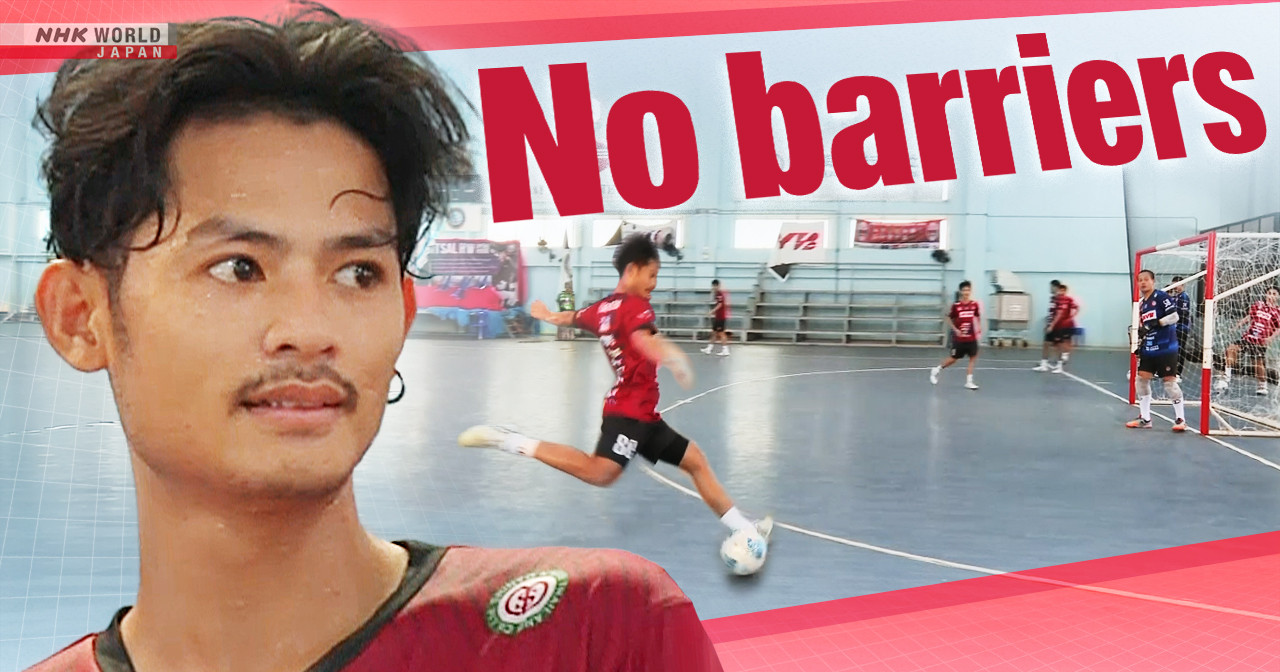
A raised hand calls for the ball. Two index fingers pressed together mean "mark your opponent." At YFA Sriracha FC, deaf and hearing players have developed a shared language and used it to reach the highest level of Thai futsal.
The professional club was founded by Japanese footballer Aihara Yutaka, who was born without part of his left arm. Its 21-member squad includes four deaf players, all competing on equal terms.
Futsal is played on a smaller court than soccer, with fewer players and a quick-passing style. It is hugely popular in Thailand.
At YFA Sriracha, deaf and hearing players train, compete and often live together in a team dormitory. During games, they coordinate through eye contact, body positioning and quick visual cues.
These simple ideas have turned a bold experiment into a competitive professional team.
Difficult start on foreign soil
Aihara, 47, grew up in Kanagawa Prefecture, southwest of Tokyo. Inspired by his older brother, he began playing soccer in the second grade. He eventually captained his elementary school team, which placed third in a prefectural tournament and advanced to a regional competition.
Aihara says the absence of his left hand never felt like a disability. His ambition was to become a professional player. But he didn't think he was good enough to make it in Japan, so he moved to Thailand at 23 after being told he would be introduced to a professional club there — an introduction which never happened.
Unsure what to do next, he began playing street soccer on a court outside his accommodation. Word soon spread about a talented Japanese player, and a professional offer eventually followed.
The signing bonus was just 3,000 baht — worth less than 10,000 yen at the time. Aihara still keeps the money as a memento.
"I couldn't become a J.League player, but I wanted to make a living from soccer," he says. "When I signed that contract, I felt an enormous sense of relief. For the first time, I could support myself through the sport."
After about a year in Thailand, he moved on to play professionally in Bangladesh, Uganda and Mongolia. He hoped his unusual career would one day help him in his dream to open a soccer academy for children. It also reinforced a belief that would shape his future: a disability should never prevent someone from pursuing a dream.
Aihara later returned to Thailand and began coaching at a school for deaf children. The thank-you letters he received from them contained messages such as "I love soccer" and "I want to become a professional player," and these words inspired Aihara.
"I was the one telling them they could become professionals, so I felt responsible for giving them somewhere to pursue that dream," Aihara says. "My role was to put them on the same starting line as everyone else. What happened after that would depend on their own efforts."
In 2019, he founded YFA Sriracha FC to give them a genuine route into the professional world.
The club adopted a guiding principle: to give dreams and hope to children with disabilities. Aihara then began the long task of finding sponsors willing to support this vision.
For Jakkarin Maithinklang, now 26 and leader of the club's deaf players, that opportunity was life-changing.
He grew up in a poor farming village in northeastern Thailand and attended a local elementary school. At the time, nobody realized he had a hearing impairment, but Jakkarin says he couldn't easily follow conversations or express himself, and found himself excluded by classmates.
"I was left alone when the other children talked in groups," Jakkarin says. "It made me feel like I was stupid."
Eventually his hearing loss was identified and he transferred to a school for deaf children about an hour from his home. There, he discovered futsal — and the sport transformed him.
He became more confident, competed in tournaments and earned a place on Thailand's national deaf futsal team while still in high school.
After graduation, Jakkarin entered university but had to drop out almost immediately due to financial difficulties.
He later worked at rubber plantations and other jobs, but his disability limited his opportunities. The wages were low and insufficient to support his family. Although he longed to become a professional futsal player, his priority was finding a job to earn income rather than trying to pursue his dream.
Then his coach introduced him to Aihara, opening a path into professional futsal that had seemed closed. At YFA Sriracha, he could finally turn his talent into a livelihood and support his family.
"Because I cannot hear, I pay especially close attention to my coaches' advice and work hard in training every day," Jakkarin says. "Becoming a professional player gave me the determination to train hard and save for my future. Mr. Aihara made it possible for me to work and live alongside anyone."
YFA Sriracha's approach has also produced results on the court. It won the second division championship in 2023 and started competing in the first division in 2024.
But the following year proved difficult. Its head coach left to lead Thailand's women's national futsal team, while injuries sidelined several key players. The club was relegated in 2025.
Aihara responded decisively. He replaced one-third of the squad and appointed a new coach with experience at one of Thailand's elite clubs.
Before preseason training, he wrote to the players and urged them to think about why — and for whom — they play.
"In the real world, there is no separate society for people with disabilities," Aihara says. "People with and without disabilities have to work together. That is why I want to see how brightly these players can shine in the mainstream."
Seeing the team's success on the same stage as hearing players, he says, can give children with disabilities the confidence to imagine a future that might otherwise seem closed to them.
Aihara rejects the idea that inclusion should be treated as exceptional.
"Disability is not something special," he says. He even dislikes the word "diversity," because he believes it describes something that should simply be normal.
That conviction has led him to a paradoxical measure of success: he hopes that one day YFA Sriracha FC will no longer be needed.
"If children with disabilities can join bigger clubs without having to come through us, and if everyone shares that mindset, then this team can disappear," he says.
Related Stories
 World
World
Words for a divided world: Nagasaki's peace declaration
56 minutes ago
 World
World
US plans to sanction another bank in effort to clamp down on Iran transactions, Bessent tells AP
56 minutes ago
 World
World
US strikes Iranian rocket launchers on the Strait of Hormuz in first military action in weeks
56 minutes ago
 World
World
PokémonXP and the 2026 Pokémon World Championships Closing Ceremonies Recap
56 minutes ago
 World
World
Curaçao takes home 2nd LLWS title behind offensive breakout
1 hour ago
 World
World
‘The house got carried 100 metres away’: some Nepal flood victims had minutes of notice. Others had seconds
1 hour ago
 World
World
Headteacher saves 900 children from deadly flash flood in Nepal
1 hour ago
 World
World
Shooting at rave leaves 1 dead, 5 injured in Switzerland
1 hour ago