
The Alberta NDP won Calgary’s byelection. But next election, the map could look very different
The Alberta NDP won Calgary’s byelection. But next election, the map could look very different
Alberta’s boundaries commission delivered two maps earlier this year
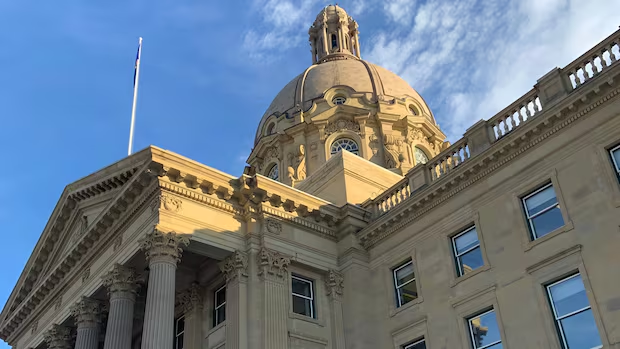
Earlier this week, the Alberta NDP flipped a conservative stronghold riding with a win in Calgary-Shaw, a byelection that's been viewed as a potential bellwether ahead of the next provincial election.
But the boundaries that make up Calgary-Shaw today could look very different come next election, and one recently-proposed map that uses hybrid urban-rural ridings could potentially make it more difficult for the NDP to repeat Monday's feat.
Redrawing Alberta’s voting lines is typically a routine affair. Every eight to 10 years, a commission forms with the goal to consult and deliver a plan setting out potential provincial voting boundaries.
But this year’s iteration of the commission played out very differently. For the first time, two competing maps were delivered by the majority and minority members of the commission.
Justice Dallas Miller, the commission chair, suggested adopting the majority report or expanding the legislature from 89 to 91 seats.
Instead of adopting the majority’s proposals, Premier Danielle Smith’s government adopted Miller's latter suggestion, and appointed a panel to redraw the boundaries. Smith has said she’s focused on preserving rural representation, while the Opposition has levied charges of U.S.-style “gerrymandering” at the government.
CBC News previously conducted what’s known as a transposition of votes. The exercise seeks to estimate how a previous general election would've looked had it been held with the new boundaries.
Calgary-Shaw provides an up-to-date case study, illustrating how proposed changes to Alberta's electoral map could affect election results.
The NDP's Kyle Campbell won Calgary-Shaw in Monday's byelection with about 46.6 per cent of the vote, just ahead of the UCP's Mike Derry, who received roughly 43 per cent of the vote.
The black line in the maps below represent Calgary's city limits.
Under the map delivered by the commission's majority report, Calgary-Shaw would shrink with a small panhandle of territory in its northwest absorbed by Calgary-Lougheed.
When Monday's byelection and the 2023 Alberta election results are factored onto the majority map, the result indicates Calgary-Shaw voters would have still elected an NDP representative, but with a slightly tighter margin of victory.
But with the minority map, there's no riding called Calgary-Shaw at all.
Instead, Calgary-Shaw would be divided into four ridings. About half of it would go to a new riding called Calgary-South, and most of the rest of the area would be absorbed by Calgary-De Winton, a rural-urban riding that also includes parts of the current Highwood and Banff-Kananaskis electoral districts. The rest of the area would be split up into Calgary-Fish Creek and Calgary-Lougheed.
When Monday's byelection and the 2023 Alberta election results are transposed onto the minority map, all four ridings gaining territory from Calgary-Shaw would see a UCP margin of victory between eight and 17 points.
While transpositions of votes are routine exercises when ridings are redistributed in Canada, it's important to note their findings don't mean the next election will deliver these results.
As well, these are not the final maps Albertans will be grouped into. Those still have yet to be unveiled.
Criteria guiding electoral map shakeups
The biggest public concern when electoral maps are redrawn is to avoid U.S.-style gerrymandering, said University of Alberta political scientist Jared Wesley.
“The main principle at stake when you are redrawing electoral boundaries is to ensure that voters get their representatives and that governments don’t get to pick their voters," said Wesley, who previously served as chair of a commission to redraw local ward boundaries in Edmonton.
“This is not an exercise in pulling out a Sharpie marker and redrawing boundaries because they make the most sense politically."
Redrawing ridings usually comes down to population size and ensuring they’re not drawn too large or too small to preserve a one-person, one-vote principle, said Wesley. He added that ridings should also preserve communities that are more effectively represented by one MLA rather than divided into different electoral districts.
“Most times, when boundary commissions get together, they’re really tinkering around the edges for that very reason — to preserve historic communities of interest," said Wesley.
“That’s what the worry about the minority report is: that it’s a far more aggressive rewrite than we’re used to in Canadian boundaries.”
UCP MLA Brandon Lunty, the chair of the MLA committee overseeing the work, said the panel it appointed was directed to consider the majority report map and Miller’s recommendation to grow the legislature to 91 seats.
“Albertans deserve effective representation as our province continues to grow, and we believe this approach ensures that representation is fully considered and consistent with the Canadian Charter of Rights and Freedoms,” said Lunty via email.
Kathleen Ganley, an NDP MLA who's also on the committee, said she's troubled by the UCP's process to redraw ridings, including its decision to invite a pollster to help the panel.
She noted a pollster's only focus is voting intent, which shouldn't be a consideration for a new electoral map; instead it should be focused on properly representing communities of common interest.
“It shouldn’t be about politics. It shouldn’t be about who wins or loses,” said Ganley.
“That common interest situation is the debate that we have been having around this boundary commission, because people want the ability to have their voice heard.”
University of Calgary political scientist Melanee Thomas said she's unsurprised to see the majority report's map delivers a similar result in Calgary-Shaw to Monday's byelection, but she's struck to see the swing in results for the area on the minority map.
If Calgary-Shaw is divided into four ridings, Thomas said it's important to ask where exactly the boundaries would be drawn.
“If somebody lives in the neighbourhood or knows the community well, would they draw the line there, because it makes sense?" said Thomas. "And if the answer is no, then the argument for communities of interest becomes suspect."
The panel is expected to submit its report on new electoral boundaries by Oct. 22.
With files from Naël Shiab and Meg Banks
Related Stories
 Canada
Carney set to attend the United Nations General Assembly in New York next week
1 hour ago
 Canada
2 missing Alberta children found safe in rural B.C.: Alberta RCMP
2 hours ago
 Canada
Auger-Aliassime, Draxl put Canada ahead 2
2 hours ago
 Canada
Canadian Medical Association updates code of ethics and professionalism
2 hours ago
 Canada
Trump says his son’s wedding party being bankrolled by a Russian oligarch is ‘totally allowed’
2 hours ago
 Canada
Cuba energy grid suffers nationwide collapse
2 hours ago
 Canada
Canada one win away from Olympic men's volleyball berth with win over Mexico
3 hours ago
 Canada
This invasive species has just been found in Canada for the 1st time
3 hours ago