
The battle that made Canada bleed: Operation Medusa, 20 years later
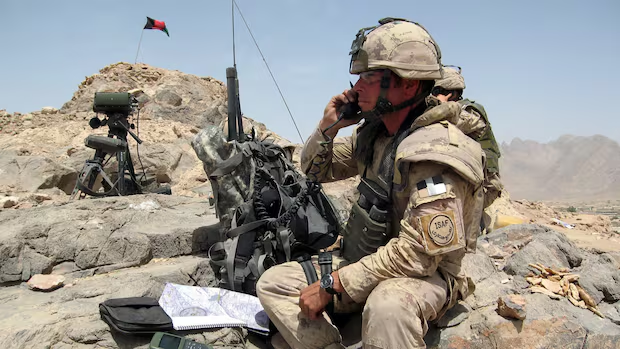
The battle that made Canada bleed: Operation Medusa, 20 years later
Over 1,000 Canadians took part in battle that was military's largest since Korean War
As Canadian troops crossed the Arghandab River, the first indication to former corporal Bruce Moncur that something was amiss came with the sight of a green pen flare shooting across the sky.
"I remember looking at it thinking, well, that's weird," said Moncur, who realized that since NATO troops in Afghanistan fired red flares, green must have belonged to the Taliban.
"That was an indication that we had walked far enough into the trap."
The Taliban had waited until he and his section of troops had dismounted from the protection of their armoured vehicles before springing their three-sided ambush.
Moncur recalls every detail of that day 20 years ago with a stark, blinding clarity.
It was the opening phase of Operation Medusa, a savage, close-quarters battle in the vineyards and dusty villages of Kandahar.
'I'll never forget': Canadian veteran recalls opening phases of Operation Medusa
The battle began on Sept. 2, 2006, with an artillery and air bombardment.
A day later, Moncur's unit set off to cross the river.
The Canadians ran into a deeply entrenched enemy that was firing machine guns, rocket-propelled grenades and small arms.
The battle was different in the sense the Taliban force had chosen, unusually, to stand and fight.
More than 2,000 NATO troops, including over 1,000 Canadians, took part, alongside Afghan forces and American, British, Dutch and Danish elements.
It would be the biggest battle Canadians had fought since Korea and their largest conventional operation of the Afghan war.
Canadian veterans on the legacy of Afghanistan war
Moncur's unit, Charles Company, 1st Battalion Royal Canadian Regiment (1RCR), had been drawn into the insurgent ambush after crossing the river as they were pushing toward their objective, a little white school house the Taliban had occupied.
The firefight lasted five hours. Four Canadian soldiers were killed: Warrant Officer Frank Mellish, Warrant Officer Richard Nolan, Sgt. Shane Stachnik and Pte. William Cushley. An additional 16 troops were wounded before the order was given to retreat.
"In that firefight, I was all over the battlefield. Some vehicles were stuck and left behind, and we had to try to salvage them," Moncur said. "One soldier was left behind. We obviously don't leave anyone behind. So, we had to go and rescue his body."
In an interview given to reporters at the time, the commander of Bravo Company 1 RCR said the depth and strength of the Taliban force, which were later estimated at a total of 1,000 insurgents, was not something the Canadians expected.
Rebalancing or retreat? Canada's peacekeeping legacy fades away
5 years after Taliban seized control, Afghan refugee reflects on new life in Saskatoon
"Truthfully, I was surprised by the resistance they put up," the commander, Maj. Geoff Abthorpe, said. "We came at them with what I perceived to be a pretty heavy fist."
"I think closer to about 400 Taliban fighters and men that had fought all their lives versus 80 Canadians that had … this is their first time at combat, first time in a real firefight," said Moncur.
In the late summer of 2006 prior to the battle, hundreds of insurgents had massed in the Panjwai and Zhari districts, roughly 30 kilometres west of Kandahar city, the provincial capital.
They had dug trenches, fortified compounds, planted mines and improvised explosive devices and established defensive positions around the nearby village of Pashmul.
The timing was deliberate. NATO had only recently taken responsibility for southern Afghanistan from the U.S.-led coalition, and the Taliban appeared determined to test whether the alliance had the stomach for a serious fight.
Sean Maloney, a historian at the Royal Military College of Canada, said all throughout the spring and summer of 2006 Canadian troops had been fighting running battles with the Taliban.
The ones that decided to fight in Pashmul were different. They were better trained, more co-ordinated and better equipped.
There has been a long running debate in Canadian and U.S. military circles about whether Pakistan's notorious intelligence service had contributed — in some way — to the sophistication of the insurgents who fought NATO forces.
"They're definitely a major factor in this," said Maloney.
A U.S. military study of insurgent tactics, written long after the battle in 2018, also pointed to potential Pakistani involvement, including the redirection of foreign fighters to bolster the ranks of local Taliban.
The report noted how the insurgents mounted planned ambushes and counterattacks and, when NATO firepower became overwhelming, conducted what the study calls a "disciplined retreat."
Several weeks after the operation, Pakistani journalist and noted Taliban expert Ahmed Rashid wrote a piece quoting NATO commanders, who believed the battle had exposed the Taliban’s support structure in Pakistan to an "extraordinary degree."
After the failed river crossing on the second day of the battle, disaster struck Moncur's unit again.
An American A-10 mistakenly strafed Canadian positions, killing Pte. Mark Graham and wounding more than 30 others, including Moncur, who suffered a major head injury.
"I'm sitting there eating, and my fire team partner comes to sit next to me,' said Moncur, who compared the sensation of being strafed to being electrocuted. "I just remember being tossed in the air like a rag doll…. I remember feeling like my body was being, like I touched a socket or something."
He tumbled down a rocky slope before losing consciousness. When Moncur came to, he knew his head was bleeding.
"If you've ever washed your face in a basin and just filled up and splashed yourself with water, that's how much blood ended up filling in my hands," Moncur said.
He crawled to a nearby medic, who was also wounded, before passing out again.
Canada's top soldier expresses pride in 'who we are,' after Hegseth targets cadets in post
Five years after Kabul fell, the reckoning over Afghanistan is far from over
"I basically made peace with this. That was going to be the final moments of my life," Moncur said.
He was rushed to the military hospital at Kandahar Airfield before being evacuated to a U.S. military trauma centre in Germany, where he faced a long, painful road to recovery.
Following the friendly fire attack, Charles Company was effectively removed from the battle.
Canadian Afghan war veteran describes being wounded by friendly fire
The commanders — Brig.-Gen. David Fraser and Lt.-Col. Omer Lavoie — shifted the axis of the main attack to the north.
The battered remnants of Charles Company remained in the south, helping convince the Taliban another river assault was coming, while Canadian forces pushed down from Highway 1.
The operation lasted another two weeks and ended with hundreds of insurgents killed.
Maloney said it was a pivotal moment in the war. The intention of the Taliban, at the time, was to eventually push into Kandahar city.
The decisive defeat forced them to switch back to hit-and-run tactics of improvised explosives and ambushes.
It was also an important political moment.
"That's when the Afghans realized, yeah, we're going to fight," Maloney said. "And as one of them walked up to our people and said — in shock — you're willing to bleed for us."
Senior reporter, defence and security
Murray Brewster is the senior defence writer for CBC News, based in Ottawa. He has covered the Canadian military and foreign policy from Parliament Hill for over a decade. Among other assignments, he spent a total of 15 months on the ground covering the Afghan war for The Canadian Press. Prior to that, he covered defence issues and politics for CP in Nova Scotia for 11 years and was bureau chief for Standard Broadcast News in Ottawa.
Related Stories
 Canada
Albertans head to polls in historic referendum on whether they want to stay in Canada
1 day ago
 Canada
In the news today: four soldiers killed, Alberta referendum, AI privacy fears
1 day ago
 Canada
How a grass fire at a Canadian military base killed four soldiers
1 day ago
 Canada
How will household electricity rebate reduction, temporary winter pricing change impact Ontarians?
1 day ago
 Canada
Residents told to boil tap water due to bacteria
1 day ago
 Canada
Oil
1 day ago
 Canada
Albertans vote on path to independence as Carney fights to keep Canada united
1 day ago
 Canada
Two of 4 soldiers killed in fast
1 day ago