
The Gen Z Effect: How Young India Is Rewriting Politics

For the past few weeks, Indian politics has revolved around Gen Z. Their remarkable protests culminated in the resignation of Union Education Minister Dharmendra Pradhan—an outcome that would have seemed almost unthinkable in Modi’s India.
This may well mark the beginning of a new chapter in Indian politics. More importantly, it signals the emergence of Gen Z as a powerful political force capable of reshaping the national conversation.
However, it would be a mistake to view this movement solely through the lens of the Cockroach Janatha Party (CJP). While it is undeniable that CJP has been at the forefront of the agitation, it was by no means the only force involved. Several other student organizations, most notably AISA, also played significant roles. More importantly, the overwhelming majority of participants did not appear to belong to any particular organization. They were, above all, members of Gen Z—young Indians united not by partisan affiliation, but by a shared sense of purpose and a willingness to make their voices heard.
Again, it would be inaccurate to bracket the protesters as Gen Z alone. Many of those who participated in the agitation were clearly in their thirties. This distinction is important because the 18–35 age group accounts for roughly 28% of India’s electorate. It is this broader demographic, rather than Gen Z in the strict sense, that deserves closer attention when analysing the political significance of this movement.
Another remarkable feature of this movement was the spontaneous emergence of solidarity protests across India. This was particularly evident in Mumbai, Bengaluru, Bihar, West Bengal, Jharkhand, and Kerala. In many of these places, the immediate grievances differed from those raised at Jantar Mantar, yet the spirit of solidarity with the movement was unmistakable.
The ripple effects extended even further. In one instance, Gen Alpha schoolchildren organized a demonstration demanding better facilities in their school. Elsewhere, the E20 Janatha Party emerged to campaign against the mandatory introduction of E20 petrol. Together, these developments suggest that the movement inspired a wider culture of civic assertion, encouraging diverse groups to organize and voice their own concerns.
The immediate trigger for the protests was the NEET question paper leak. However, to any close observer, it was evident that this was merely the final straw. The mood at the protest site was unmistakably anti-BJP and anti-RSS, and more specifically, critical of Prime Minister Narendra Modi and Home Minister Amit Shah.
Slogans such as “Modi tere tanashahi nahi chalegi, nahi chalegi” (“Modi, your dictatorship will not be tolerated”) drew enthusiastic responses from the crowds. From an analytical standpoint, however, the most significant slogan was “Jab jab Modi darta hai, Hindu-Muslim karta hai” (“Whenever Modi feels threatened, he resorts to Hindu-Muslim polarization”). It was among the most widely chanted slogans at Jantar Mantar, suggesting a strong aversion to the Sangh’s divisive communal politics.
Perhaps the most astonishing aspect of this movement is that a significant number of the protesters appear to come from staunch BJP-supporting households. In other words, many of them are the children of committed Modi supporters. How a generation raised on a steady diet of the Sangh’s communal rhetoric—reinforced by sections of the media and, often, by their own families—has come to reject the Sangh is a fascinating political phenomenon.
Even more striking is the apparent reversal of influence within families. Rather than parents pulling their children back into their ideological fold, the opposite seems to be happening. Many young people appear to be persuading their parents to reconsider long-held political beliefs. If this trend continues, it could pose a far greater long-term challenge for the BJP than the protests themselves.
Another significant aspect of this agitation was the way it broke the politics of fear. The Modi government has been guilty of silencing dissent through coercive methods, including the use of investigative agencies such as the Enforcement Directorate (ED) against opposition leaders and others. As a result, many public figures—including celebrities and business leaders—were reluctant to voice criticism.
This movement has altered that atmosphere. Many prominent personalities found the confidence to speak out, expressing support for the students’ agitation. While some adopted a measured and balanced position, many others openly backed the protesters, suggesting that the movement has begun to erode the climate of fear that has characterized recent years.
The anger of many young people towards the present regime is real, deep, and politically significant. Its ramifications are likely to be felt for years to come. Yet a sober assessment of the political landscape suggests that Modi and the BJP remain well ahead in the race for power in 2029.
Nevertheless, this movement has given the opposition something it had been lacking for a long time—a glimmer of hope. It has demonstrated that the BJP is not politically invincible and that sustained public mobilization can alter the political discourse.
It was heartening to see CJP respond positively to Rahul Gandhi’s call for Amit Shah to resign, taking responsibility for the brutal crackdown on the students. However, a cohesive relationship between the opposition parties and the leadership of this movement has yet to take shape. Equally concerning was the fact that opposition parties continued to squabble among themselves even as students sustained the agitation.
The opposition must move beyond these internal divisions. It should extend a hand of welcome to the agitators and create space for Gen Z both within its organizational structures and beyond them. In the years ahead, the opposition will have to confront not only the BJP but also a biased Election Commission. Instances of electoral fraud on a massive scale have become a recurring feature of Indian politics. The technological sophistication of Gen Z could prove invaluable in monitoring the electoral process and mitigating the effects of electoral fraud. Ultimately, success in 2029 may depend, to a significant extent, on how effectively the opposition accommodates the aspirations of Gen Z and how fully it integrates young people into its political struggle.
Get the latest CounterCurrents updates delivered straight to your inbox.
Shakeel Mohammed P A is a social activist based in Kochi. Email : [email protected]
Related Stories
 India
India
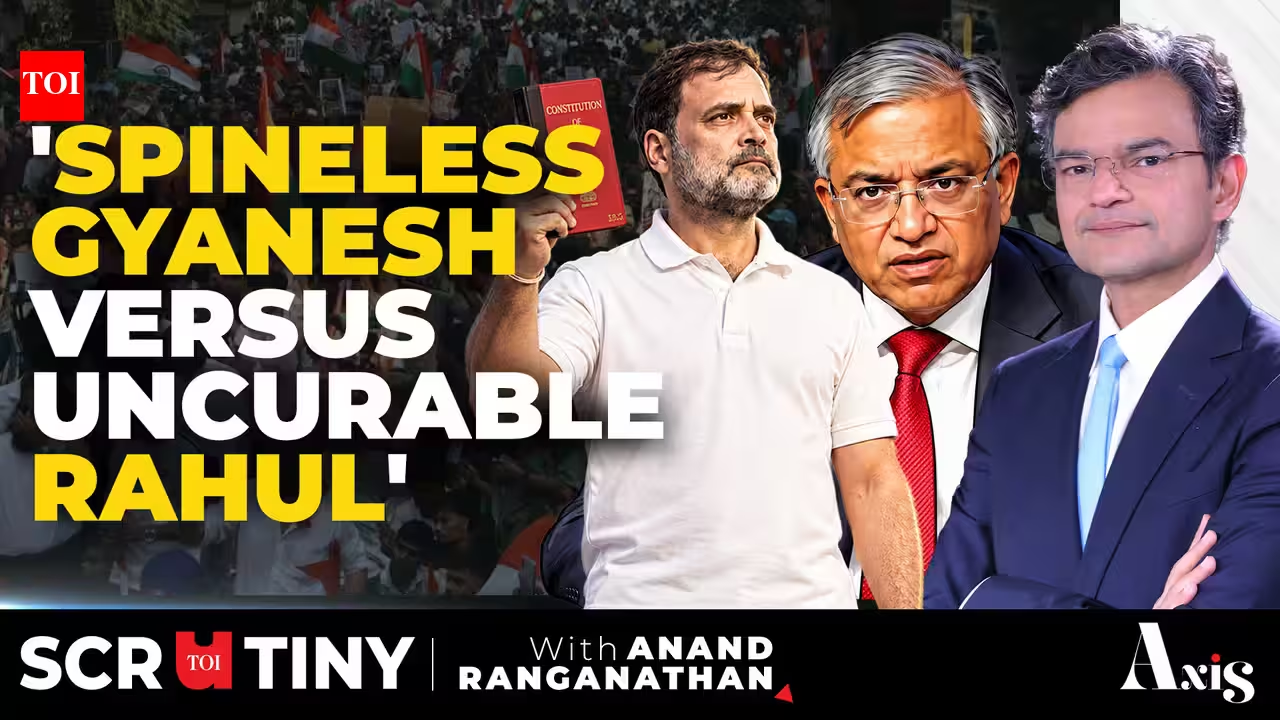
'Spineless': Anand’s Scathing Attack on Election Commission, Disses Rahul’s SIR Protest Politics
52 minutes ago
 India
India
Top 6 New
1 hour ago
 India
India
Congress doesn’t believe in hatred politics, wants to uphold Punjabiat, says Pargat Singh
2 hours ago
 India
India
Is Elon Musk battling Indian oligarchs or Asia’s security state?
2 hours ago
 India
India
INDIA bloc leaders to meet President Murmu tonight on their demand for Gyanesh Kumar’s resignation
4 hours ago
 India
India
Rahul Gandhi, 'foreign collaborators' want to create anarchy in India: BJP
5 hours ago
 India
India
Starlink: Why Elon Musk is taking on Mukesh Ambani and Jio over satellite internet
6 hours ago
 India
India
Election Results Tamil Nadu: Vijay's TVK trailing behind AIADMK after three round of counting in Dharapura
7 hours ago