
The one word you won’t find in the NSW Budget: startups
For decades, stamp duty on rising property prices has been a golden goose and get out of jail card to improve the NSW Budget’s bottom line.
Property – not unlike gambling – has been kind to those in charge of state and federal purse strings for many years. But with Covid-era costs lingering like BNPL repayments, the RBA board treating inflation like a wayward schoolboy in need of caning and governments around the country dealing with a dramatic shift in voter sentiment without the buckets of money they normally sling at people to cheer things up, we live in interesting times.
The NSW Budget’s own prediction is that it will take until the second half of 2027 before the RBA cuts interest rates.
The party is over, with the federal budget trying to dampen investor demand, and house prices flatlining or falling, along with auction clearance rates.
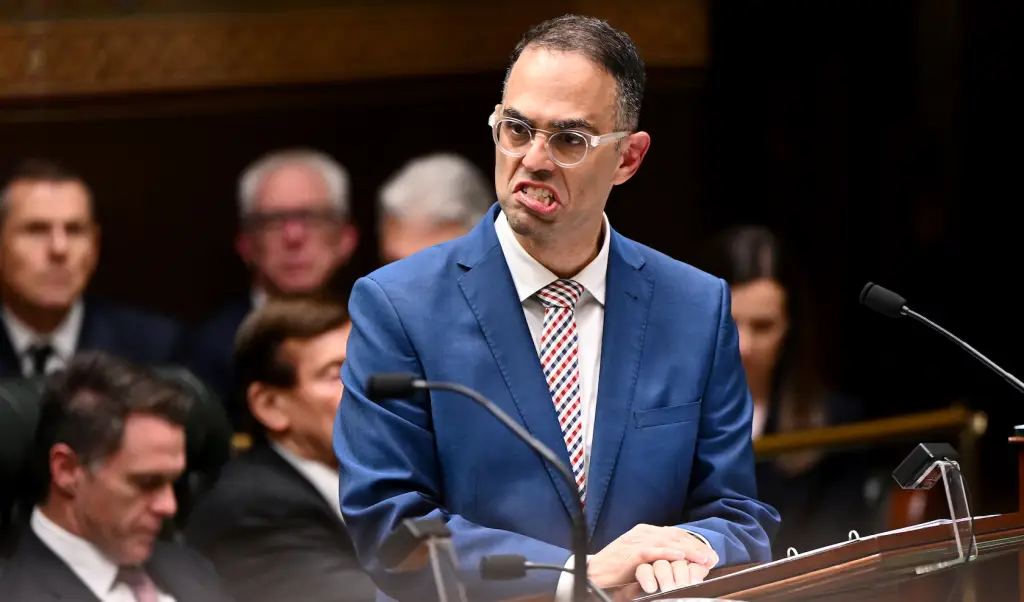
NSW treasurer Daniel Mookhey delivered the 2026/27 state budget on Tuesday. He even teased a surplus in FY28, just after voters decide if Labor will get a second term. There’s a $2.3 billion deficit in FY27, followed by a $1.1bn surplus in FY28. But the economic scenario modelling in Budget Paper No. 1, reveals those predictions sit on shifting sands.
Right now, Mookhey has a problem. The NSW budget papers show stamp duty revenues from property falling by $5.3 billion over the next four years – including a $2bn drop to $12.6bn in FY27. Land tax also drops $3bn.
“A weaker outlook for the property market following a material shift in the cash rate since the 2025-26 half-yearly review has placed significant downward pressure on property prices and transaction volumes. As a result, transfer duty and land tax have been revised down by $8.4 billion over the four years to 2029-30,” it says in Budget Paper No 1.
State debt in FY27 will hit $193.8bn, 20.5% of NSW GDP, then rise to $219.4bn in 3 years.
For perspective for ordinary mortals not used to a life with so many zeros, the $9bn interest bill for servicing that debt works out just over $1000 per NSW citizen.
Mookhey’s rays of sunshine in the years ahead, delivering 1% growth in FY27 before it rises to 2%, come courtesy data centres and energy project investments.
“In fact, private investment is now the leading source of economic growth in NSW,” he said.
“No other state can say the same – much of that investment is being driven by the renewable energy transition.”
That’s why NSW policy settings are doing all they can to fast-track both sectors, alongside measures that cheer up the cheap seats down the back of voter land.
Commuters spending a fortune on Sydney’s outrageously expensive toll roads will have the weekly cap reduced from $60 to $50 in FY27, while Opal fares will be frozen at 2025 prices for a year. There’s also $100 off registering your car.
So what’s in for business and tech-startup sector. Well it’s modest and this is a government with much to be modest about.
The first thing to note is business is handing over over more payroll tax than even – $14.1 billion this year, then increasing 5.3% annually to FY30, to top $17.4bn. That’s nearly double the Budget’s forecast annual average spending growth of 2.7% over the next four years.
There’s a note on productivity in Budget Paper No. 1 worth highlighting.
“NSW labour productivity growth averaged 1.8% over the 1990s, but has gradually declined since then, averaging 0.8% over the past 20 years. This is consistent with trends across advanced economies and reflects a mix of factors, including a slowdown in the rate of capital deepening per worker, slower diffusion of technology between firms, a less dynamic business environment, tighter financial constraints, a decline in competitive pressures and a shift towards service industries with slower productivity growth,” it says.
“Important government initiatives to lift productivity growth include significant ongoing investment in infrastructure and the establishment of the Investment Delivery Authority, which promotes a more supportive investment environment. Further reforms include planning reforms to increase construction feasibility, reforms to workers’ compensation, which keep people engaged in the workforce and potential reform of the Emergency Services Levy, which could improve the efficiency of the State’s tax system.”
So that’s the government’s big thinking – “potential” reform of the tax paid on property and car insurance premiums to fund fire and emergency services.
But two things you won’t find mentioned anywhere in the budget are startups and Tech Central.
Having closed the Sydney Startup Hub, dragged its feet on its own Innovation and Productivity Council, walked away from SXSW Sydney, and TechStars Sydney, and support for a range of other initiatives for startups, a key driver of productivity growth, investment and employment, the NSW budget has nothing to say on initiatives for the tech sector.
The interpretive dance of April 2025’s Innovation Blueprint has no follow up in the budget. It’s just words – something the Minns government is blessed with an endless surplus of.
You only have to look at the “Innovation in NSW” on the Investment NSW site to realise the paucity of thinking by the government and NSW science, innovation and technology minister Anoulack Chanthivong.
After three years in power, Labor has abandoned the startup sector as a possible pathway for innovation and productivity growth.
But there was one piece of good news in the NSW Budget for business – $37 million for a replacement small business advisory program after the government quietly axed the popular Business Connect program last year.
That works out at 1.12% of the additional $3.3 billion businesses will pay the government in payroll taxes over the next four years. And just over double the $16 million in funding the government gifted US entpreneur Dana White last year to bring 3 UFC events to Sydney.
As the NSW government asks voters for a second term in March 2027, it’s worth noting that their money is not always where their mouth is, when it comes to business and startups.
Related Stories
 Technology
3 Texas Tech Softball Players Injured In Offseason Jet Ski Accident
3 hours ago
 Technology
Nigerian, Türkiye Strengthen Defence Partnership on Naval Shipbuilding, Technology Transfer
5 hours ago
 Technology
NSU Technology & Entrepreneurship Summit Sept. 30
8 hours ago
 Technology
Leaked DLSS 5 code lets modders test Nvidia’s AI graphics tech
12 hours ago
 Technology
Dual
13 hours ago
 Technology
AWS, Google, NVIDA, Workday & Running Robots: Top Tech News
14 hours ago
 Technology
Newcleo
15 hours ago
 Technology
Snyk was worth $8.5 billion. The price of its employees' stock has collapsed.
16 hours ago