
The politics of leverage
The Great Game: The problem is that in real life, it never quite works that way. Trump knows it and so does Modi
TWO pieces of news this week, from Washington DC and Punjab, have unerringly put their finger on the meaning of the word, leverage — not quite Shylock and Antonio in The Merchant of Venice, but close.
The first bit of news from Trump’s DC revolves around the Lindsey O. Graham Sanctioning Russia and Iran Act, 2026, which threatens countries like India with up to 100 per cent tariffs, if they continue to do business with Russia.
If Trump had read his Shakespeare, he would know by now not to do this. Modi has just come off a big summit in which both Vladimir Putin and Xi Jinping, two out of three of the world’s most powerful leaders, have participated. The newspapers are full of how Russia has supplied 51 per cent of India’s oil imports since the US-Israel war against Iran over the last six months. The Army Chief has been in Russia most of this week, negotiating new arms deals.
What kind of leverage does Trump think he can have with Modi if he signs the Russia and Iran Act? Does he think India will withdraw from fright — a bit like Antonio, whimpering and snivelling, before Portia marches up and turns the tables on Shylock — and call off its multi-faceted ties with Moscow?
And then there’s the BJP here in Punjab, seeking to expand its influence, another word for leverage, hoping the people of this border state will reward it with their affection in the coming Assembly polls.
With six months left to go, every political party is also aiming at the same thing. The ruling AAP has promised to increase dearness allowance for state employees. The Congress is trying to unify its fragmented state unit. Shiromani Akali Dal’s Sukhbir Badal is travelling across the districts, trying to revive his party, so he can have better leverage in any future conversations with a potential ally, the BJP.
The larger question looms large. Is Punjab playing chess these days or is it gambling for its future. If it’s the former, who are the pawns in this larger great game? If the latter, who holds the cards?
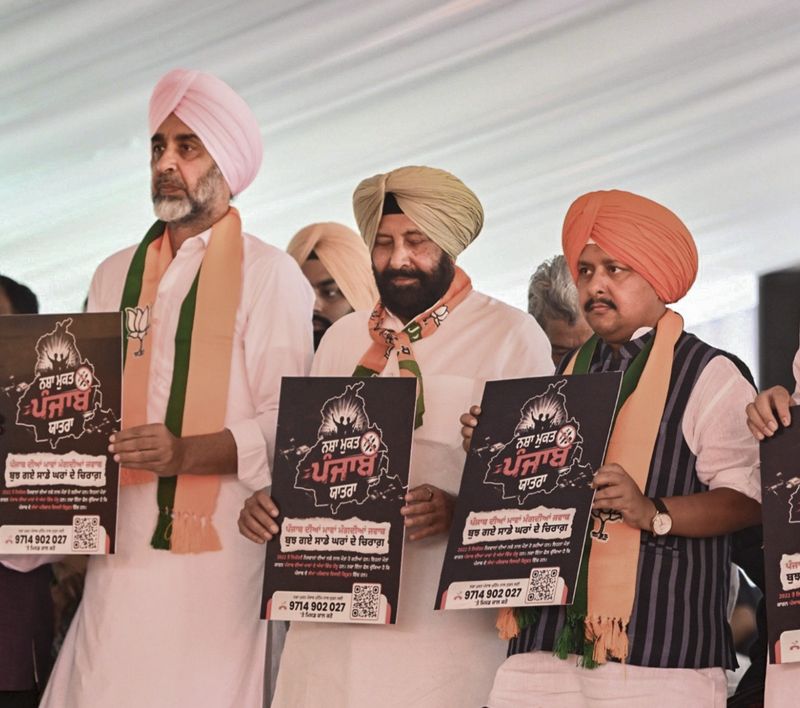
So what’s been significant this week is the manner in which the BJP is unveiling its Punjab campaign. Party president Nitin Nabin showed up in Pathankot wearing a turban and brandishing a sword, launching the party’s anti-drugs yatra with a few words in Punjabi; incidentally, both Nabin and state party president Kewal Dhillon spoke from prepared texts.
The location of the launch — in Pathankot, at the Ekta Sthal, the site which memorialises Syama Prasad Mookerjee, the founder of the Jana Sangh, and his journey from this city to Jammu back in May 1953, to break J&K’s permit system — was no less significant.
Mookerjee remains a towering figure in the BJP pantheon. The party is commemorating his 125th birth anniversary this year. His slogan, “ek desh mein do vidhan, do pradhan aur do nishan nahin chalega!” (the same nation can’t have two Constitutions, two Prime Ministers and two flags), against Article 370, which gave special status to J&K, has resounded across the decades. When the Article was abolished in 2019, the BJP fulfilled one of the three ideological vows it has maintained since the party was launched in 1980. (The other two are the building of the Ram temple in Ayodhya and the implementation of a Uniform Civil Code — Uttarakhand has already done it, while Gujarat, Assam and Madhya Pradesh are on course; all are BJP-ruled states.)
Nabin’s message in Pathankot was crystal clear. The BJP will woo Punjab, but not at the cost of its own ideology.
The question is, how this will unfold in the coming months. Will the BJP ally with the Akali Dal to fight the election together, or not. Both sides are keenly aware that an alliance could work to their mutual benefit — BJP candidates may be able to gain entry into Punjab’s villages, largely dominated by Sikhs, where they have been shown black flags until now; and the Akali Dal may have access to the BJP’s Hindu voters in the urban areas.
At least, this is the theory, as the battle for Punjab is launched this week. And then there’s Amritpal Singh, the radical MP from Khadoor Sahib who has been behind bars for the last three years in a Dibrugarh jail, and whose political outfit, Waris Punjab De, has been showing up on the graph of every political party these last few months.
The problem is that in real life, leverage never quite works that way. Trump knows it and PM Modi knows it — his experiences as a younger pracharak in the 1980s across Punjab and Haryana have given him an understanding of the people of this border state few others in the BJP have. Modi knows that for an alliance between the BJP and the Akali Dal to work requires more than just the slice-and-dice of caste (Jat Sikh, Dalit Sikh, Punjabi Khatri, for example) or religion (gurdwara, temple, dera); that this tiny state with only 13 MPs and a Muslim population verging on the insignificant is still capable of turning the national mood topsy-turvy; that it took someone like RSS chief Mohan Bhagwat to admit in Ludhiana in February that the “RSS considers Sikhism a separate and distinct religion.”
Certainly, Trump knows there’s something about Punjab — otherwise the tasteless US Department of Homeland Security advertisement targeting a bearded South Asian man (“get off our roads, Mr Singh”) wouldn’t have been withdrawn so quickly. The US President now has nine days to decide whether to sign off on the Russia Act that also targets India. Certainly, he should know that Indians love to disagree with each other till the cows in the paddy fields of Punjab eat their fill and come home — and argue about who to vote for and why in the coming Assembly elections — but when it comes to questions of foreign policy, from Nehru to Vajpayee, Manmohan Singh and Modi, Indians from across the country will rally around their government in Delhi.
Related Stories
 India
India
Spotify launches Haryanvi 101 as listening in the language doubles in a year
2 hours ago
 India
India
‘But why now?’ Mamata questions arrest of Congress’ Nandigram bypoll candidate, calls it ‘BJP's vendetta politics’ | India News
4 hours ago
 India
India
Marathi film 'Gondhal' is India's pick for Oscars 2027
4 hours ago
 India
India
Indian Diaspora Wishes Prime Minister Modi On His Birthday With Billboard @Times Square
5 hours ago
Big setback for Mamata Banerjee: ECI freezes Party symbol, allocates fresh for different factions
9 hours ago
 India
India
Photos of a boat race on India’s Kulsi River
11 hours ago
 India
India
From historical solidarity to strategic trade: The India
12 hours ago
 India
India
India's hospital boom is improving access but pricing millions out of critical care
15 hours ago