
The story of Canada’s 'only union
The story of Canada’s 'only union-built town'
N.L.’s Port Union was created to end the exploitation of fishermen by the merchant class
You might have heard of “union towns” — blue-collar cities like Chicago, Ill., and Scranton, Pa., where labour unions exercised enormous political power.
But perhaps nowhere has a better claim to be a “union town” than a small community on Newfoundland and Labrador’s Bonavista Peninsula.
Port Union wasn’t just run by unions, it was founded by one. Parks Canada and the Government of Newfoundland and Labrador call it Canada’s only union-built town.
The community was the brainchild of union organizer William F. Coaker.
The fifth of seven children, Coaker was forced to leave school at age 11 to help support his family. As a fish handler on the St. John’s harbourfront, he had a firsthand view of exploitative labour practices and instigated his first strike when he was just 13-years-old.
After learning the merchants he was working for were paying their young employees less than rival firms, he convinced all the boys to stop work until they received a raise.
Coaker represented their grievance to management, and they blockaded the entrances to the merchants’ premises to keep out scabs. Under pressure to offload the ships arriving in the harbour at the end of the fishing season, the company conceded two days later and raised the boys’ pay by a third.
Over the following years, Coaker travelled around the island and took on a variety of jobs, from store manager to telegraph operator to farmer.
His interest in labour rights only grew as he saw the way rural fishing families were mistreated by the merchant class.
Working under the “truck system,” they lived in a near-constant state of debt. Merchants ran the local stores where families bought clothing, dry goods, fishing supplies and other essentials on credit in the winter and spring. In the fall, they paid back what they owed with their catch of salt cod.
The problem was, the merchants not only set the local price of cod, concealing its true value on the international market, they also rarely disclosed the price of the goods families were buying upfront. When they settled accounts in the fall, the merchants could manipulate the prices to keep the fishers in debt and keep the firms from having to pay out any cash.
Coaker’s solution was unionization. Through collective action, fishers could fight for fair treatment.
In 1908, he founded the Fishermen’s Protective Union (FPU). Its goal was to improve quality of life for outport Newfoundlanders through education, policy and self-representation.
The union published a newspaper, the Fisherman’s Advocate, which printed weekly reports of foreign fish prices to help fishermen negotiate fair pay. It established its own trading company to import fishing gear at cost and export members’ cod directly to international markets, paying them in cash instead of credit.
The FPU advocated for a minimum wage, free public schools, and old age pensions. In 1913, its political arm — the Union Party — successfully elected eight members to the House of Assembly, including Coaker.
Seeking a headquarters for the union and unable to find something suitable in St. John’s, in 1915 Coaker bought an unoccupied 80-acre stretch of coastline on the southern shore of Trinity Bay.
The site had several features to recommend it. It was in a prime inshore fishing area where many FPU members lived, its harbour was ice-free from April to February with room enough to shelter a hundred boats, there was a nearby river ripe for hydro-electric development, and, most importantly, it could be acquired for just $400.
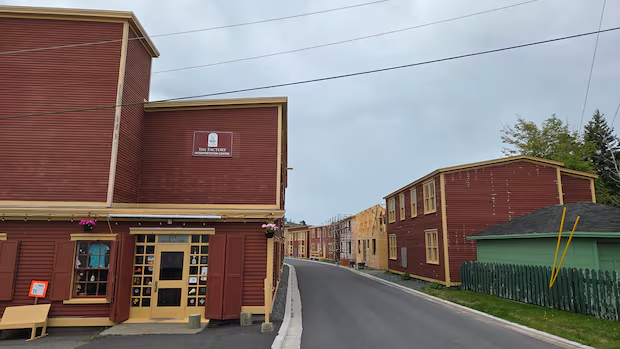
Construction crews broke ground in May 1916. Along the curve of the shoreline they built the commercial properties: a salt fish plant and general store, the factory building with its woodworking shop and printing press for the Fishermen’s Advocate, a forge and a shipyard.
Rising up the hillside that flanks the harbour, they installed rows of neat red duplexes to house the staff and managers of the FPU companies.
Union members moved in from outports along the northeast coast, and, by 1926, Port Union was a thriving community with its own hotel, bakery, post office, church, and railway station.
The union’s ethos wasn’t to provide the bare minimum to keep body and soul together. They believed working-class rural fish harvesters were as deserving of comforts and conveniences as wealthy urban merchants.
The town had its own soft drink plant and movie theatre, amenities unheard of in most outports at the time, and the factory boasted an elevator, possibly the only one outside of St. John’s. The houses had indoor plumbing, municipal sewer services and electricity provided by the town’s new hydro-electric plant on the Catalina River.
The town remained relatively prosperous until the cod moratorium of 1992, when the local fish plant was closed and a third of the population left.
Because of its unique history, Port Union has been designated a National Historic District, and some of its buildings have been converted to historic sites, museums and a community art space.
The Fishermen’s Protective Union may have been swept away by the tides of time, but its legacy lives on.
The union movement broke the cycle of debt that once kept fishing families in grinding poverty. The social policies FPU promoted, like free public education and minimum wages, have become fundamental to our democracy.
As for Port Union, it embodied a dream many are still fighting for to this day: a world where all people reap the benefits of their own hard work.
Download our free CBC News app to sign up for push alerts for CBC Newfoundland and Labrador. Sign up for our daily headlines newsletter here. Click here to visit our landing page.
Ainsley Hawthorn, PhD, is a cultural historian and author who lives in St. John’s.
Related Stories
 Canada
Dutch elm disease ravaged Canadian cities. Can we help trees protect themselves?
35 minutes ago
 Canada
Ontario Liberal leadership race enters new phase
35 minutes ago
 Canada
Meet the weaver making death more sustainable
35 minutes ago
 Canada
Frechette holds mid-campaign cabinet meeting ahead of counter
1 hour ago
 Canada
Why more than 150 years later, Hamilton's Nine Hour Movement still matters
1 hour ago
 Canada
Stephen Fuhr was mocked for opposing the purchase of F
1 hour ago
 Canada
'It’s going to be painful': Trade watchers warn of tit-for
1 hour ago
 Canada
Free support for secondary school place sign
2 hours ago