
The Sussex man who 'changed the world'
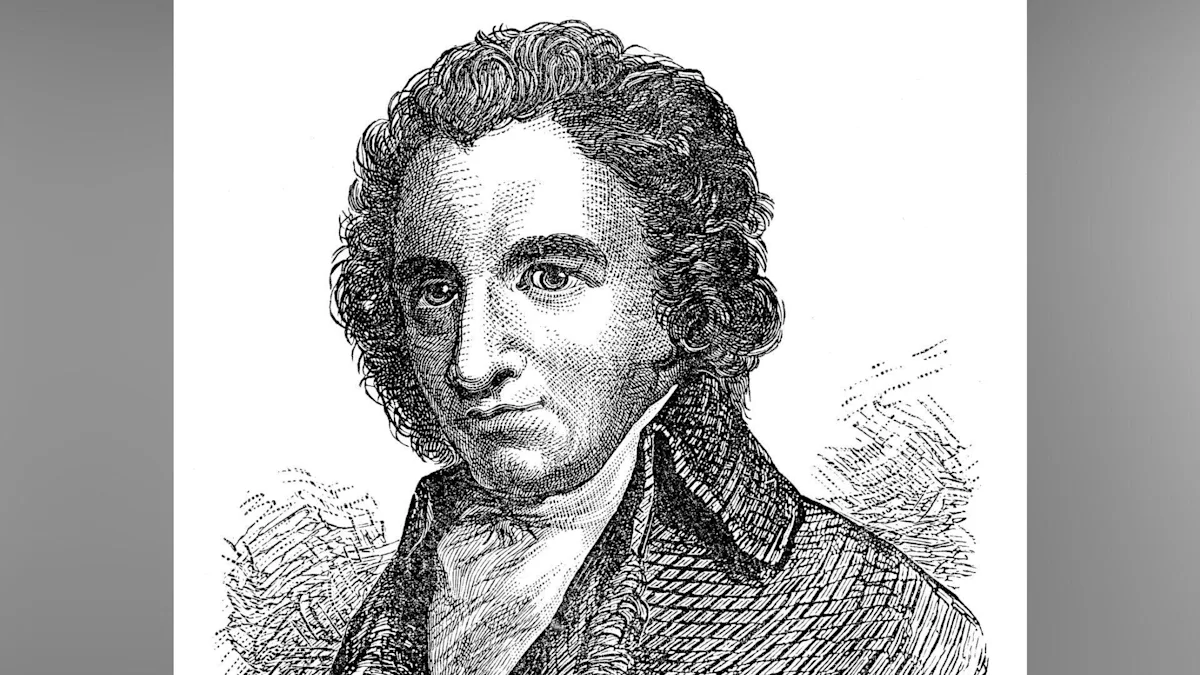
Many British people may never have heard of Thomas Paine, one of the Founding Fathers who helped create the US.
Even fewer will know that he lived for six years in Lewes, East Sussex.
Paine wrote Common Sense that helped inspire the 1776 US Declaration of Independence from Britain, according to historian Leanne O'Boyle.
The 40-page pamphlet – which sold out almost immediately – "set off a bomb" in the colonies, she explained.
"Up till that point most American colonists were loyal to the King."
Paine argued all people were created equal and monarchy was an "inherent tyranny", she said.
He "destroyed the status quo", added O'Boyle.
Marking how the English-born revolutionary's views helped change the world, Lewes is celebrating the 250th year of US Independence on Saturday.
The event's centrepiece will be a "democracy procession" through the East Sussex town led by Paine's Bones – an 8ft (2.4m) walking skeleton - alongside banners, musicians, costumes and performers, organisers say.
"This festival is about championing hope and the idea that communities have the power to imagine and build a better future together," adds O'Boyle.
Paine had come to Lewes to work as an excise officer.
This job was "quite funny" for a man who would go on to call for the abolition of the monarchy, because he was raising money for the King, O'Boyle said.
Before he arrived in 1768, Lewes was already a place of "radicalism and rebellion", she said.
The town had "a dissenting population of different religious groups and politically active, intelligent, cosmopolitan [people]."
Paine immediately plugged into the town, attending every council meeting, she continued.
She says: "This to me is the action of a man who wants to get involved in his local community and make a difference."
Paine honed his arguing skills at the Lewes' Headstrong Club, where he was a frequent debate winner, O'Boyle said.
She said this influenced Common Sense, which was written to be read out loud, in simple language with short, snappy sentences - which meant it spread like wildfire in the rebellious US.
The Headstrong Club was relaunched in 1987 on the 250th anniversary of Paine's birth.
Paine had participated in a fair pay case for excise officers - one of the first examples of national unionised action anywhere in the world, O'Boyle said.
Paine was also separating from his landlord's daughter Elizabeth, who he had married in Lewes.
"It is unclear whether this is a man whose life is falling apart or he's deliberately unpicking his life," continued O'Boyle.
But she added Paine kept "putting one foot in front of the other."
"This is also a story of human resilience".
Possibly while he was living in Lewes, Paine was introduced to the US independence figure Benjamin Franklin, who wrote him a letter of introduction for America.
He left Lewes for the US in 1774, having been fired from the excise service – ostensibly for being absent from his post, O'Boyle said.
"It is an exciting time - everything he goes on to do next changes the world forever".
Richard Powell, chairman of the Lewes' Headstrong Club, said the American Founding Father's spirit is still very much alive in Lewes.
"Any 'citizen of the world' is welcome at our monthly meetings," he told the BBC, quoting one of Paine's famous phrases
"We get viewpoints right across the spectrum, and some of them do occasionally cause pain – no pun intended."
Follow BBC Sussex on Facebook, X, and Instagram. Send your story ideas to southeasttoday@bbc.co.uk or WhatsApp us on 08081 002250.
The seaside town that was a fascist hotbed
Related Stories
 AI News
PREVIEW | Paraguay vs France: team news, lineups, predictions (World Cup 04/07)
22 minutes ago
 AI News
Arias sends Colombia into World Cup last-16 with 1
22 minutes ago
 AI News
World Cup 2026: Ranking the 8 Round of 16 matchups from best to worst
22 minutes ago
 AI News
Salah awaits Messi as Egypt beat Australia on penalties at World Cup
22 minutes ago
 AI News
Ram Mandir Trust member accuses administrator of playing politics
22 minutes ago
 AI News
Controversy Intensifies: INDIA Bloc Raises Election Commission Concerns in Letter to Chief Justice
23 minutes ago
 AI News
Yorkshire news quiz of the week
23 minutes ago
 AI News
South weekly quiz: What moon appeared this week?
23 minutes ago