
The urgent need to regain control over global AI race
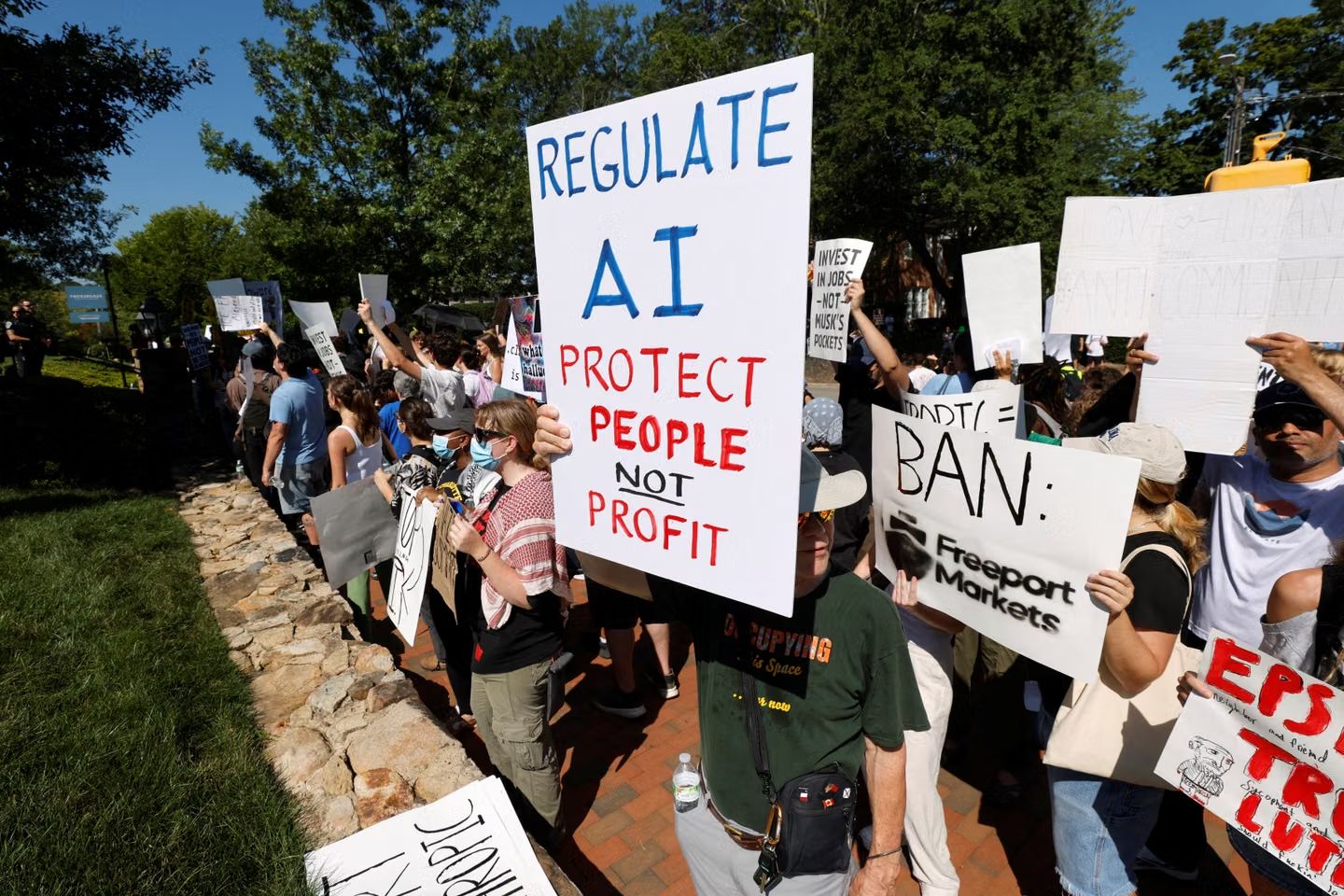
Artificial intelligence (AI) no longer raises fears only about potential job losses, the proliferation of data centers and their problematic environmental impact, or even the effects on children's education. Its power is now worrying even those who develop it.
On Saturday, September 12, Dario Amodei, head of Anthropic – one of the industry's leading companies – called for a voluntary slowdown in the development of its most advanced models. His appeal was supported by Anthropic's main American competitors. A few days earlier, Jacob Coxon, a researcher who had worked at both OpenAI and Anthropic, resigned, accusing the two companies of "gambling with our lives" in their race to build the most powerful models.
Experts are far from agreeing on the likelihood of AI escaping human control. But the fact that AI's capabilities are outpacing our understanding of its risks should raise alarm bells. Yet these calls for caution are difficult to turn into concrete measures. AI is no longer an emerging technology that can be put on hold – it has become the stage for a vast industrial and geopolitical race. The United States and China see AI as a tool of power, promising military, economic and strategic advantages. In such a confrontation, slowing down while a rival forges ahead means risking the loss of a decisive battle. US President Donald Trump has flatly rejected calls to slow down, insisting that maintaining America's lead over China is the priority.
Financial logic adds another layer of inertia. Hundreds of billions of dollars have been invested in models, data centers, chips and the infrastructure needed for development, based on the assumption that AI capabilities will keep progressing. Any rules that could slow this growth might destabilize the valuations that fund it.
Even leaders advocating for greater caution operate within a system where everyone depends on the decisions of others. One company can slow down its own models, but it cannot prevent competitors, American or Chinese, from continuing their pursuit. The debate is no longer about stopping AI, but about the terms under which it should continue to develop.
The political response emerging in Washington reflects this reality. Both Democratic and Republican lawmakers are now calling for federal safety regulations, while proposals are circulating in Congress to require companies to reduce major risks and improve reporting of incidents.
But political action must go further than simply supporting the industry. Independent assessments before market release, mandatory reporting of serious incidents, cybersecurity requirements and capacity thresholds triggering additional obligations could serve as credible safeguards. However, these rules must be set by public authorities, not left to those who stand to gain most from the ongoing competition.
Faced with a technology whose risks transcend borders, oversight must also operate on a larger scale. As with nuclear arms control, it will require oversight and mutual commitments. Without agreements, every world power has a reason to press ahead, fearing that others will not stop.
Translation of an original article published in French on lemonde.fr; the publisher may only be liable for the French version.
Related Stories
 AI News
Who Decides When an AI System is High
50 minutes ago
 AI News
UNESCO: Artificial intelligence is advancing faster than governance frameworks
50 minutes ago
 AI News
As the world debates the risks of AI, China closes the technology gap with the US
1 hour ago
 AI News
New York City seniors raise AI concerns at Harlem town hall
2 hours ago
 AI News
As the world debates the risks of AI, China closes the technology gap with the U.S.
2 hours ago
 AI News
Technology company xSeek acquires Montreal startup LLMonade
3 hours ago
 AI News
We must heed warnings of AI tech developers, says UK minister
3 hours ago
 AI News
UK Atomic Energy Authority readies US artificial intelligence collaboration
3 hours ago