
The U.S.
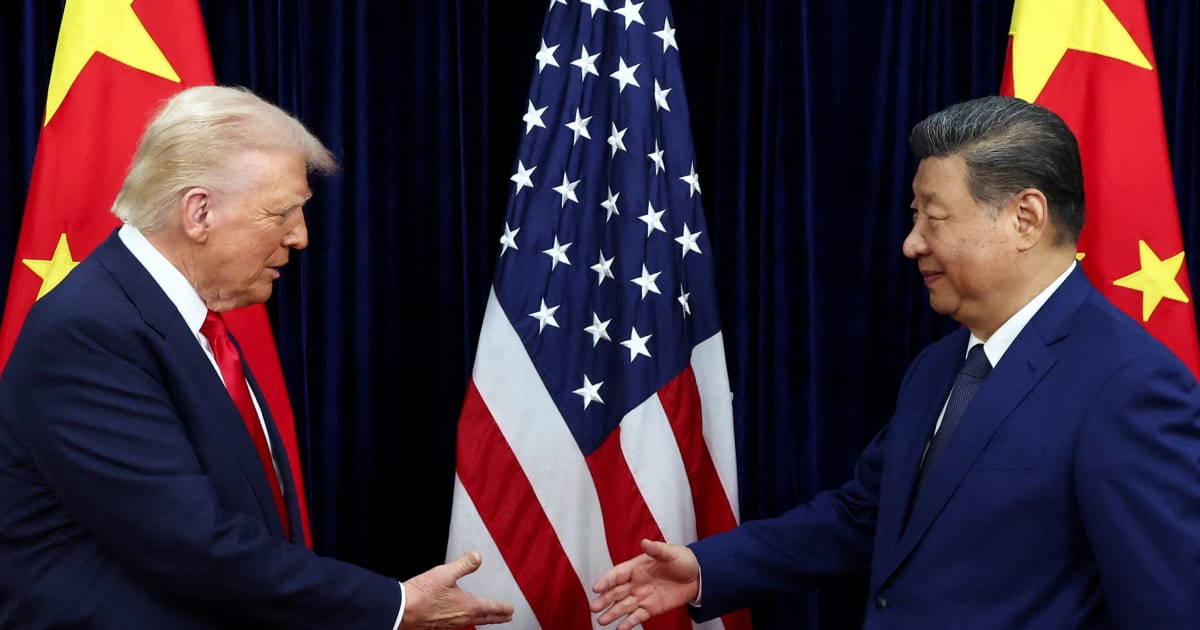
Chinese President Xi Jinping and U.S. President Donald J. Trump are scheduled to meet again in Washington in September when Xi arrives for a reciprocal state visit. When the two leaders met in Beijing in May, China placed the relationship with Taiwan front and center in their discussions.
Before Trump had left the Great Hall of the People, where bilateral talks were taking place, Chinese state media reported that Xi had warned of a conflict over any mishandling of “the Taiwan question,” describing it as “the most important issue in China-U.S. relations.”
Artificial intelligence (AI) will likely be at the top of the agenda when Trump and Xi meet next week. Ahead of Xi’s scheduled visit, the United States and China are expected to hold their first official bilateral dialogue on AI as a follow-up to an agreement in May over the importance of safety measures.
But whether policymakers in the United States realize it yet, they will find it increasingly difficult to separate the competition with China over global AI dominance from the Taiwan Strait issue.
Competition over Artificial Intelligence
The United States and China’s race over AI is changing the importance of Taiwan less for Beijing than it is for Washington. Long before advanced large-language models began to make headlines, China saw Taiwan as integral to the project of the so-called “great rejuvenation of the Chinese nation.” Xi has tied his personal legacy to ensuring Taiwan falls under the rule of the Chinese Communist Party during his lifetime. Beijing’s interest in unification with Taiwan exists independent of and notwithstanding any rational economic benefit that the island can bring.
Moreover, there are signs that China already assumes it will have to build its domestic AI industry without the help of Taiwan’s chipmaking capabilities. Chinese regulators are already weighing tighter controls over the development of homegrown AI technologies. These include a proposal to prevent local companies, such as Huawei, Alibaba, and ByteDance, from using overseas foundries–including Taiwan Semiconductor Manufacturing Company (TSMC)–to produce their advanced semiconductor chips.
If Xi’s Taiwan ambitions were truly driven by a desire to seize the island’s advanced chip production capacity, China’s efforts to decouple its AI industry from Taiwanese suppliers would run counter to that aim.
For the United States, however, Taiwan’s strategic importance has grown as the competition with China over AI has intensified.
The island’s semiconductor hardware supply chain is indispensable to the growth of the United States’ AI industry. Nvidia’s next-generation Vera Rubin platform, which is designed to power agentic AI workloads, relies on 150 supply chain partners in Taiwan. Its challenger, AMD’s Helios AI system, relies on Taiwan-based companies including Advanced Semiconductor Engineering, Siliconware Precision Industries, Wiwynn, Wistron, and Inventec. OpenAI also turned to TSMC to manufacture Jalapeño, its first in-house AI chip designed in collaboration with Broadcom.
Despite efforts by the Trump administration to reshore advanced chip manufacturing to the United States, such efforts may not move quickly enough. Trump has said he expects the United States to account for 50% of the chip manufacturing business by the end of his current term in 2029, citing TSMC’s high-profile commitments in Arizona.
But given the rapid pace of AI model development and physical constraints on expansion, including labor and water shortages, it may not be realistic to expect Taiwanese investments in American manufacturing to make a meaningful difference before the U.S.-China AI competition reaches a decisive stage.
Since May, China’s AI industry has appeared to narrow the gap with frontier models from leading AI labs in the United States. The release of the new Kimi K3 model by Chinese AI startup Moonshot AI in July rattled Washington, Wall Street, and Silicon Valley. Even as they face accusations of distillation, open-weight Chinese models are presenting a competitive, lower-cost alternative at a moment when corporate executives are realizing that the deployment of enterprise AI solutions comes with a hefty price tag.
It is generally believed that the United States’ lead over AI is measured not in years, but in months, although the true size of that gap remains difficult to assess. Some experts argue that the gap would be narrower if China had access to more computing power. Given this, the United States’ ability to rely on steady chip supply from Taiwan in the near term will be key. That makes Taiwan not only an increasingly important strategic partner, but also a vulnerable point, for the United States and for any economic productivity gains, scientific breakthroughs, or military edge it hopes to unlock with AI.
It is therefore in the national security interest of the United States to ensure Taiwan remains a stable region while developing alternative plans to build supply chain resilience and withstand any potential disruptions.
The United States’ Stake in Taiwan
The AI race between the United States and China is not likely to change China’s calculus over whether it engages in a conflict over Taiwan. The AI race will, however, raise the stakes of a conflict, since the loss of Taiwan’s AI industry would weigh heavily on Washington’s decision over whether to become militarily involved in the Taiwan Strait.
The more important it becomes for Washington to win the AI race, the more costly a conflict over Taiwan becomes. The White House should respond not by backing away from Taiwan, but by understanding that a threat to Taiwan from China is a threat to American economic leadership. Before it responds to Beijing’s claims of sovereignty over Taiwan, Washington needs to ask the question: How long would the United States’ AI industry be able to maintain its lead if Taiwan’s chip production were to go offline?
When President Trump and President Xi meet, they will try to negotiate an agreement on basic rules related to AI’s most dangerous outcomes. There will be no Taiwanese officials or diplomats in the room when that happens. But make no mistake: the United States’ ability to lead the world in AI will depend in part on the partnership of an island that Beijing claims as its own territory.
The White House should take three steps to ensure that a crisis in the Taiwan Strait does not turn into a crisis for the United States’ technology industry or undermine its ambitions.
First, Washington should make clear to Beijing, through direct channels ahead of the September summit, that any move on Taiwan carries consequences for the broader U.S.-China relationship, including on trade and technology cooperation. Tying the cost explicitly to Taiwan’s semiconductor role signals to Beijing that the AI competition is bound up with the Taiwan question, rather than leaving China to guess at the connection.
Second, policymakers should build a domestic case for Taiwan’s security that is grounded in economic terms. American companies and supply chains already depend on Taiwan’s chip production and protecting that dependence gives Trump a rationale he can defend to voters and politicians skeptical of open-ended security commitments. That rationale rests on American businesses and jobs rather than abstract appeals to democracy or regional stability.
Third, the administration should work with Taiwan to conduct tabletop exercises to prepare for a scenario in which Taiwan’s chip production is disrupted, evaluate its potential impact on the U.S. technology industry, and develop a contingency plan to mitigate those risks.
The AI race is adding a new dimension to America’s dependence on Taiwan’s chip industry, one Washington should use to its advantage. That dependence will not diminish in the near term and treating it as temporary leaves Washington worse prepared for the day it is tested.
Sherry Hsiao is a former intern in the LEAD AI program at the Council on Foreign Relations.
This work represents the views solely of the author(s). The Council on Foreign Relations is an independent, nonpartisan membership organization, think tank, and publisher, and takes no institutional positions on matters of policy.
Related Stories
 AI News
Nvidia optimistic despite AI anxieties
8 minutes ago
 AI News
Huawei aims to deliver faster AI chips, faster
9 minutes ago
 AI News
ARTPRICE NEWS: A WORLD
9 minutes ago
 AI News
Introducing Kimi K3 on Amazon Bedrock
9 minutes ago
 AI News
Exclusive: U.S. military had close call after using AI for false intelligence report, sources say
38 minutes ago
 AI News
SpaceX may turn to failed startups for something its AI badly needs
38 minutes ago
 AI News
A new chapter for MIT Reads
39 minutes ago
 AI News
How New York Can Influence the Future of Artificial Intelligence
1 hour ago