
The Viking Row, a human statue and a Tartan takeover: World Cup trends capture U.S. hearts
Fans from around the world have traveled thousands of miles to the World Cup, bringing with them displays of national identity that have delivered some of the tournament’s most iconic moments.
Limited time: Save 25% on NBC News subscription
Get exclusive reporting, live Q&As and ad-free reading.
After Norway beat Senegal 3-2 in New Jersey on Monday, it was the scenes in the stands that stole the spotlight.
Instead of breaking into frenzied celebrations, thousands of Norwegian fans sat down and began rowing in their seats.
Soon, the players on the field joined in, sitting down and rowing as captain Martin Ødegaard banged a large drum.
The simple routine requires people to sit shoulder-to-shoulder, mimic rowing a giant Viking vessel, while chanting “ro” — the Norwegian word for “row.”
It has become a signature show of support for the team, with Norwegian fans recreating it across New York and New Jersey, from subway trains to escalators.
When fans took over Times Square on Monday for a group row, Ashley Locke, 34, from Nashville, Tennessee, was among them.
“There’s nothing that feels similar to when everyone in one place has the same energy,” she told NBC News in a text message Wednesday, adding: “It was very cool and special, it’s something that doesn’t happen outside of the World Cup.”
The viral trend first emerged during a 0-0 friendly draw with Switzerland in March, as Norway prepared for the World Cup, and has swiftly become the country’s trademark national celebration.
Locke said such trends are “a way in which people express their culture.”
The Norway team has made other nods to its historical roots, posing in Viking costumes for its departure photo ahead of the tournament.
Before this summer, Norway had not qualified for a World Cup in 28 years, but the team has now rowed its way into the knockout rounds.
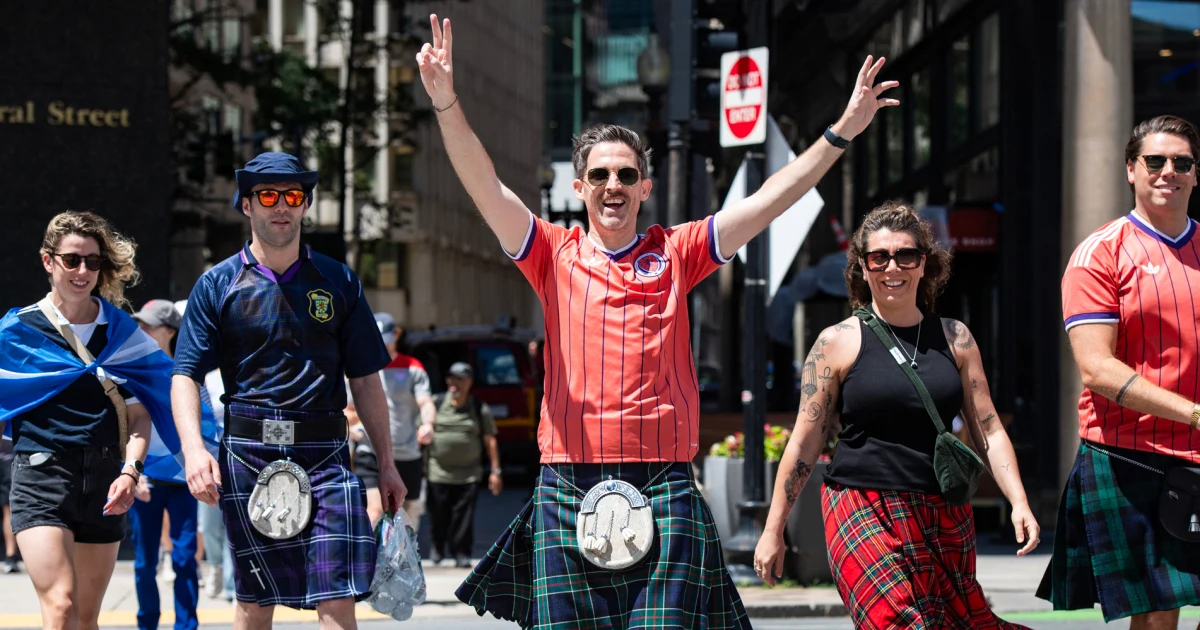
Scotland fans, known collectively as the Tartan Army, have also made their presence felt during the team’s knockout matches in Boston and Miami.
An estimated 50,000 Scotland fans traveled to Boston for the team’s matches, determined to party hard despite Scotland’s mixed performance in the tournament. Dressed in traditional Scottish kilts, the fans frequently herald their arrival with the sounds of bagpipes blaring through the streets.
Ahead of Scotland’s ill-fated clash with Brazil on Wednesday, a large Tartan Army contingent took in a Miami Marlins baseball game, bringing bagpipes and the party with them. Fans have also indulged in a more modern Scottish tradition, adorning statues in both cities with traffic cones.
Scottish bagpipes are not the only unique instruments around the tournament, with Swiss fans recognizable from their ringing cowbells. One well-known sonic symbol that won’t be seen at this year’s tournament, however, is South Africa’s vuvuzela — a plastic horn that was banned from World Cup stadiums along with other noisemakers after its widespread use at the 2010 tournament hosted in the country.
“What we are observing in the stands and along the streets of North America at this World Cup is a very interesting expression of national identity, which illustrates a shift in how culture is produced and circulated in global sport,” said Paul Widdop, an associate professor and reader in sport business at Manchester Metropolitan University in Britain.
“What matters is not whether these practices are authentic or traditional,” Widdop said via email. “What matters is that they work as simple, repeatable forms of cultural expression that can be recognized across borders.”
For fans from the Democratic Republic of the Congo, the symbol of national identity has taken a very different form.
Throughout the tournament, the Congolese have rallied around Michel Nkuka Mboladinga, a fan who attends matches as a living statue representing one of the country’s national heroes, assassinated independence leader and Prime Minister Patrice Lumumba.
The superfan, better known as Lumumba Vea, first gained attention during last year’s Africa Cup of Nations, where he stood completely motionless throughout matches dressed as Lumumba.
Dressed in a bright red jacket and tie, Mboladinga returned to the spotlight in Boston on Tuesday during his country’s group-stage match against Colombia, recreating the pose of Lumumba’s statue in Kinshasa, the Congolese capital.
Widely regarded as a symbol of Congolese independence, Lumumba led the country out of Belgian colonial rule in 1960 before becoming its first prime minister and being assassinated just months later.
Although Congo lost 1-0 to Colombia, “nations are not only being represented” on the field, Widdop said. “They are being made visible through these affective performances off it.”
At a time when Congo continues to grapple with armed conflict in its eastern regions and recurring public health crises, symbols of national resilience can carry particular emotional weight.
Mboladinga, who missed his country’s opening World Cup match against Portugal because of Ebola-related quarantine restrictions, has now become a social media star.
Fans who communicate through these forms of symbolic expression, Widdop said, “are not only expressing identity, but producing recognizable emotional signals about their country that others can instantly understand.”
Related Stories
 World
World
World Cup news: UEFA ready to hit Gianni Infantino with criminal complaint over failed $20 billion plan
47 seconds ago
 World
World
Video. Latest news bulletin | August 27th, 2026
57 seconds ago
 World
World
Another Canadian charged in international drug trafficking scheme
1 minute ago
 World
World
‘Saree Goes Global’: Indian diaspora showcases rich textile heritage at NYC’s Times Square
2 minutes ago
 World
World
World Championships: Key Takeaways
59 minutes ago
 World
World
Neave and Boughen lead FIM Flat Track World Championship charge into Scheessel
2 hours ago
 World
World
The Latest: Regional powers seek off
2 hours ago
 World
World
Ratko Mladić, the ‘Butcher of Bosnia’, dies aged 84
2 hours ago