
"They Promised 'Revitalization,' but Startup Cube Faces Repeated Water Leaks"
Created to Support Urban Manufacturing and Youth EntrepreneurshipWater Leaks Close Entire Second Floor Since 2024Problems Persist Despite Multiple Repairs... Further Renovation Planned for Second Half of Year
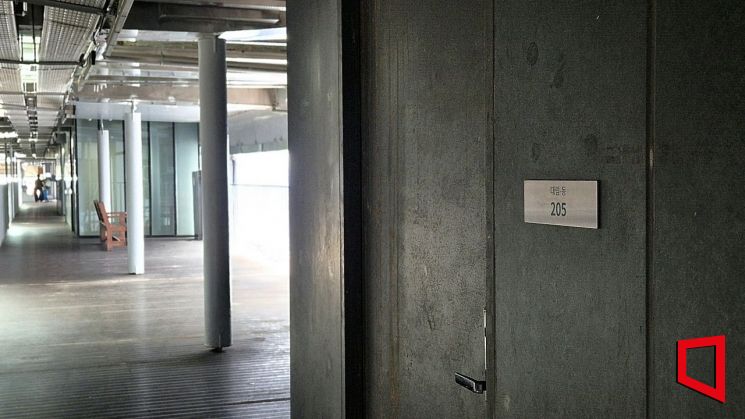
On the 11th, at the Sewoon Makers Cube in Jongno-gu, Seoul. When I reached the second floor, the lights were off, and not a single person was walking in the corridor. Inside the Cube, most of the rooms were either completely empty without any furniture, or filled with leftover items such as chairs and power strips that had not yet been cleared out. In some of the cubes, the signs left behind by previous tenants—former resident companies—were left damaged and discarded. The paint on the pillars in the corridor was peeling, and water was dripping from the ceiling.
Corridor view on the second floor of Sewoon Makers Cube in Jongno-gu, Seoul, visited on the 11th. The Cube, a youth startup space, is firmly closed. Photo by O Ji-eun
Although the Seoul Metropolitan Government established a startup space within Sewoon Shopping Center to promote urban manufacturing and support youth entrepreneurship, due to facility issues, one of the two floors has been left entirely abandoned. Despite several repair works, repeated water leakage has rendered the floor nonfunctional for nearly three years.
As of this month, according to the Seoul Metropolitan Government, 25 youth-led businesses are currently occupying Sewoon Makers Cube. Excluding ancillary facilities, there are 38 spaces designated for startups and creators, with 32 available for youth businesses. Of the two floors that make up Sewoon Makers Cube, the seven spaces located on the second floor have been completely closed since 2024.
The primary reason is water leakage from the ceiling. According to the operating center, as leakage problems on the second floor worsened starting in 2023, tenant companies began leaving one by one. The Seoul city government carried out waterproofing work four times to block the leaks and even applied waterproofing paint, but the problem of water seeping in remained unsolved after each construction project. An official from the operating center stated, "Although we conducted multiple rounds of repairs, civil complaints about leakage kept recurring, so we had no other choice but to close the space."
Sewoon Shopping Center, which was built in 1967 as Korea's first mixed-use residential-commercial building, was once considered an iconic landmark in Seoul. However, with the city's core commercial districts shifting south to the Gangnam area, the center fell into decline. Since the late 1970s, demolition or redevelopment plans had been discussed, but no substantial progress was made for decades. Over time, Sewoon Makers Cube was established in this location as part of the "DaSi Sewoon Project," initiated by the Seoul Metropolitan Government in 2017 to revitalize the Sewoon district as a hub for urban manufacturing and startups. The project aimed to connect the area's existing manufacturing base in electronics and machinery with young entrepreneurs, supporting activities such as product development and prototype creation.
The hallway on the 2nd floor of Sewoon Makers Cube in Jongno-gu, Seoul, visited on the 11th. The pillar paint is peeling, and water is dripping from the ceiling. Photo by O Ji-eun
While Seoul city officials are planning another round of repairs during the second half of the year, there is concern about how effective this will be, given that water leaks recurred after previous attempts. Some have also pointed out that the original design itself was poor. Analyses suggest that when the so-called "cube" containers were installed, no gap was left at the ceiling, resulting in rainwater pooling on the roof and causing repeated leaks inside.
Kim Yoonjae, a professor at Myongji University's Graduate School of Real Estate, pointed out, "Water leakage issues are extremely difficult to completely fix, even with repairs, so there needs to be a reconsideration of the space's overall use—including the possibility of demolition." He added, "Because the startup spaces were created within existing buildings, there were likely limitations in terms of overall scale, sunlight, and ventilation," and explained, "A plan that fully reflects both the needs of users and intended purposes is essential from the initial design stage."
An official from the Seoul city government stated, "We have earmarked a budget of 300 million won for repairs in the second half of this year, and we plan to start the renovation work soon." The official added, "Once repairs are complete, we aim to allow tenants to move in again starting next year."
© The Asia Business Daily. All rights reserved. Unauthorized AI training and use prohibited.
Related Stories
 Business
US funding for Thai SMR feasibility study
2 hours ago
 Business
Creative Sprint 2026 strengthens the business behind social impact
2 hours ago
 Business
Kenya Startup Failures Worsened By Flameout Of Once
7 hours ago
 Business
Where have all the entrepreneurs gone in the startup age?
9 hours ago
 Business
Shams, Wio Bank partner to support UAE entrepreneurs and SMEs
13 hours ago
 Business
$63 million fund targets Africa’s fragmented startup ecosystem
14 hours ago
 Business
These 2 Builders Discovered the Potency of Going Analog: Reflections on the Human Power of CMU’s Startup Week
14 hours ago
 Business
Former Infosys chief’s AI startup nabs another $53M
15 hours ago