
Tilvin Silva’s India visit What it says about JVP’s socialisation in international politics
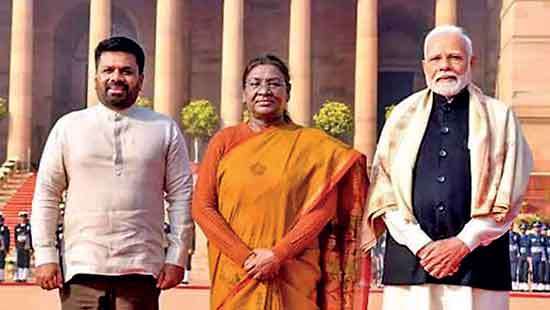
President Anura Kumara Dissanayake’s visit to India was proof of India’s multi-track diplomacy
The JVP has skilfully rehabilitated its self-image from the dark days of the late 80s and a virulent anti- Indian campaign. According to BJP Foreign Affairs Department in-charge Vijay Chauthaiwale, the visit is intended to strengthen BJP-JVP engagement, facilitate an exchange of organisational experiences and further deepen ties between the two political parties
JVP General Secretary Tilvin Silva was all smiles with Indian external affairs minister S. Jaishankar in a hand-out photo issued to the media during his five-day visit to India. Mr. Silva’s visit — though not necessarily a destiny-making moment of navigating geopolitical rivalry, as local policy buffs and foreign media tag any visit by a Sri Lankan leader to India or China— nonetheless offers interesting insights into JVP’s socialisation in foreign relations.
Mr Silva is leading a five-member JVP delegation on the invitation of the Bharatiya Janata Party (BJP) under its global outreach programme. The distinction between the party and the state is important here because unlike in China, where both are the same, in India the distinction still exists. The Hindutva BJP and the Marxist JVP are not ideological bedfellows, and though the JVP’s commitment to Marxism might have mellowed, BJP’s commitment to Hindutva had only hardened.
The ideological divergence might not be a constraint for the previous delegates to BJP events to Know that the BJP programme included Germany’s Christian Democrats and Social Democrats, the UK’s Tories and Labour, Israel’s Likud Party, Russia’s ruling United Russia Party, the Awami League of Bangladesh and the Nepali Congress and Communist Party of Nepal.
The distinction lies not in the invitees, but in those who had been left out, such as the Bangladesh National Party, which led an ‘India out’ campaign, the Chinese Communist Party and arch-nemesis Pakistan.
The visit is part of India’s multi-track diplomacy, alongside high-profile state visits by President Anura Kumara Dissanayake to India in December 2024 as his first foreign visit, and Prime Minister Modi’s visit to Colombo in April last year, and Prime Minister Harini Amarasuriya’s visit in October. Also, Indian defence minister Rajnath Singh visited Colombo this month, the first visit by an Indian defence minister in 38 years.
India’s proactive outreach to the JVP was not necessarily new, and New Delhi invited Anura Kumara Dissanayake before the presidential election, when the opinion polls suggested he was leading.
New Delhi then feared that the JVP might tilt towards China, given its ideological loyalties and anti-Indian past. In some ways it was a pleasant surprise that those anxieties have so far been proven unfounded. But, at that moment, it was a reasonable conjecture that the JVP would soon succumb to its temptation and ideological loyalties and put the Rajapaksas to shame.
However, in power, the JVP’s foreign policy approach has been guided by pragmatic realism, which many believed, given its protest slogans and past track record, it would be incapable of.
Even its general indifference towards regional institutions with a geopolitical twist, such as BRICS and the Shanghai Cooperation Organisation, is driven by an understanding of the limits of small-power activism and its perils.
The JVP/NPP government has managed competing relations with both India and China.
President Dissanayake visited China within barely a month after his Indian visit, and signed a host of investment agreements including a US$ 3.7 billion deal for a Sinopec-owned petroleum refinery in Hambantota, which is still in limbo. Tilvin Silva also led a delegation to Beijing and met Shi Taifeng, the head of the CPC Central Committee’s Organisation Department and Liu Jianchao, Minister of the International Department of the CPC Central Committee (IDCPC). A host of Chinese Communist Party mandarins have visited the JVP headquarters, and foreign minister Wang Yi visited Sri Lanka on a brief stopover in January this year.
Chinese Communist Party for decades had engaged in high profile global outreach programmes with ruling and likeminded parties in Asia, Africa and Latin America. The BJP is a Johnny-come-late, nor is it the state itself.
Unlike the popular misconception that China is preying upon the smaller nations, it is often the domestic leaders who open themselves up to Chinese influence, which may not necessarily be deleterious. It is also the domestic leaders, guided by their domestic/political and personal calculations, that entangle their smaller nations in great power competitions they can not simply extricate themselves from later on. That happens often when a country relegates relations with all other competing nations in favour of one.
Both the Rajapaksas and Yahapalanaya in its early years were guilty of that malady. The JVP, of all the political parties, has proven to be more competent and realistic in handling foreign policy than its predecessors. Tilvin Silva deserves his Indian janket.
Related Stories
 India
India
GOPIO Announces 2026 Biennial Convention and Conference in Mumbai
1 hour ago
 India
India
Former IAS officer Divya Mittal announces entry into politics, says will begin journey from Uttar Pradesh
5 hours ago
 India
India
Gyanesh Kumar: India's election chief at the centre of a growing political storm
10 hours ago
 India
India
Indian scientists settled abroad reverse decades of brain drain under new VAIBHAV network
15 hours ago
 India
India
Ahead of INDIA Bloc's meeting, Suvendu Adhikari attacks Mamata Banerjee for making friends with 'Dimagi Na
16 hours ago
 India
India
UP Rajya Sabha polls: Smriti Irani, Kumar Vishwas on BJP’s list; SP too steps up preparations
16 hours ago
 India
India
More than 120 join Viksit Bharat Run in Suva
17 hours ago
 India
India
India coach hails the impact of star batting pair
18 hours ago