
Tornado warnings are rising faster than actual tornadoes. Is that a good thing?
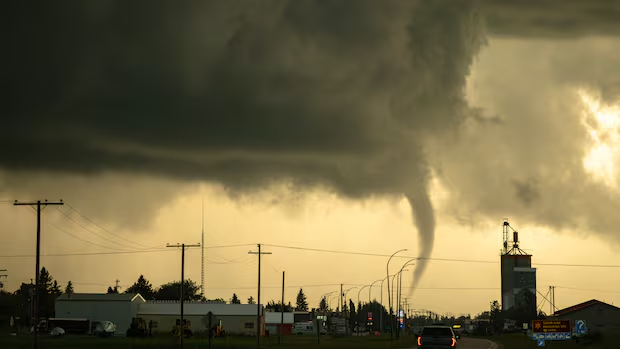
Tornado warnings are rising faster than actual tornadoes. Is that a good thing?
Some worry about 'warning fatigue' as Environment Canada alerts spike this year
If you feel like you've been inundated with tornado warnings this year, it's not just you.
Canada is not only on track for a potentially record-setting tornado year, but warnings from Environment and Climate Change Canada (ECCC) are outpacing the twisters.
The federal weather agency says it had sent out 124 warnings across the country by July 22, at which point it said 74 tornadoes had actually touched down.
By comparison, ECCC issued 107 warnings all of last year and recorded 116 tornadoes touching down. In 2024, the agency issued 100 warnings and logged 132 tornadoes.
The agency provided CBC News with data going back to 2017, and this year has already seen by far the most alerts.
ECCC's tornado warnings have increased significantly over the past 10 years. In 2018, for example, just 34 warnings were issued and 105 touched down.
A spokesperson said in an email the number of warnings could sometimes fall below the number of tornadoes touching down "even if they were perfectly forecasted," because several tornadoes can form in one group, but the forecaster may only send out a single warning for the affected region.
ECCC did not provide further comment on the numbers by deadline.
The uptick is good news to David Sills, director of Western University's Northern Tornadoes Project (NTP) in London, Ont., which tracks tornadoes across the country and sends teams out to survey damages.
"Certainly there can be false alarms when you send out those warnings, but that's the choice: either you're increasing the number and having a bit more false alarms, or you're just missing tornadoes," Sills said.
NTP issued a failing "report card" for ECCC's warning system in 2022, based on data from 2019 to 2021 that found the agency was missing twisters and was behind target on its warnings both in terms of frequency and timing.
2 central Alberta tornadoes confirmed as 'significant' EF-2 twisters as active season continues
'Just dumbfounding': Tornado damages buildings, homes in central Alberta county
"I know that's hard for a lot forecasters. They don't want to have false alarms," Sills said. "But if you want to get lead time with these things, you have to make quick decisions.… You can't be dithering about making a decision on a tornado warning."
He says this year has been his team's busiest since the project launched in 2017, with numbers on track for a record high across Canada. NTP has tracked 83 tornadoes so far in 2026, with 70 of those touching down in Alberta, Saskatchewan and Manitoba.
But Greg Johnson, a storm chaser based in Regina, is less impressed by all the warnings.
"I've seen storms that have no chance of producing a tornado. And I'm getting a thing on my phone and I'm literally standing looking at the thing and going, there is no way that this should be tornado-warned," he said.
Johnson says part of the problem is the warnings are broadcast over such wide regions they go out to people who, in some cases, are so far away from the storm they can't even see it.
He worries people will get "warning fatigue" from too many alerts for storms that don't actually put them in danger.
Canada on track for historic tornado season
"If you're getting warnings every day and you're not seeing any tornadoes, next time the warning comes, you go, 'Damn, well, I'm not gonna change what I'm doing just because of this dumb warning, because I get these every day,'" he said.
Johnson says he understands forecasters don't want to miss a tornado, but there should be a "happy medium."
Meteorologists rely on computer modelling and Doppler radars to track and forecast storms.
An Environment Canada spokesperson said tornadoes are challenging to predict, as only 20 per cent of severe thunderstorms form tornadoes and instead of detecting most tornadoes directly, radar is used to examine the structure of the thunderstorm and wind patterns to see whether the right conditions exist for a tornado.
Experts told CBC News that forecasting is more precise in the U.S., where there are more tornadoes, denser populations and more forecasters looking at radar systems.
Peter Kimbell, a warning preparedness meteorologist with ECCC, told CBC's Ottawa Morning that improvements to the current system are in the works.
How has tornado forecasting technology changed over time?
Possible tornado rips through Harrington Que., in the Laurentians
ECCC forecasters in Toronto are responsible for deciding when to transmit tornado warnings through Canada's Alert Ready system, and Kimbell said the technology can sometimes be slow to catch up — sometimes causing forecasters to issue warnings to an area that's wider than the immediate danger zone.
"So maybe there’s a bit of an overwarning going on now, but 20, 30, 40 years ago, we weren’t even able to do that at all, and so the risk was that no one really got the warning," he said.
Kevin Maimann is a senior writer for CBC News based in Edmonton. He has covered a wide range of topics for publications including VICE, the Toronto Star, Xtra Magazine and the Edmonton Journal. You can reach Kevin by email at kevin.maimann@cbc.ca.
With files from Kimberley Molina and CBC News
Related Stories
 Canada
Trump says it’s time to ‘teach Canada you can’t do this anymore.’ Live updates here.
6 minutes ago
 Canada
2 Air Canada employees arrested in RCMP drug probe at Montreal airport
6 minutes ago
 Canada
U.S. military says it killed four in strike on alleged drug
1 hour ago
 Canada
2 Air Canada employees arrested by RCMP in connection with alleged drug trafficking
1 hour ago
 Canada
Two Air Canada employees arrested in connection with drug trafficking
1 hour ago
 Canada
PM Carney to attend keynote von der Leyen speech: EU official
1 hour ago
 Canada
Canada’s resistance to Trump’s trade demands offers Europe a blueprint. Will the EU take it?
1 hour ago
 Canada
Canada wants to get closer to the EU
2 hours ago