
Toronto mayoral candidates pitch homelessness solutions without pledging new funds
Toronto mayoral candidates pitch homelessness solutions without pledging new funds
One expert says it is politically convenient for candidates to claim to fix the issue without spending more
How Toronto's leading mayoral candidates want to address homelessness
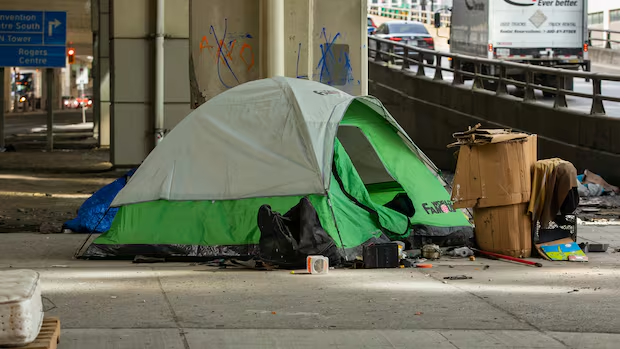
All of the leading candidates to be Toronto’s next mayor say they can address homelessness in the city without spending substantially more, even as a poll suggests voters think money from property taxes should be spent addressing it.
Recent data from the Financial Accountability Office of Ontario (FAO) shows Toronto saw an eight per cent drop in the number of people experiencing homelessness last year, but the problem is still pressing.
More than 19,000 different people slept in a shelter bed or on the street in 2024-25, according to the figures. It’s an issue that’s been increasingly flaming the ongoing mayoral election campaign.
"The greatest single injustice that people point to in this city are the numbers of unhoused people that they see all around us," mayoral candidate Chris Alexander said at a news conference last week.
"In the subway, in parks, in shelters. People want to do something about that."
(Note: After this story was originally published Tuesday morning, Alexander dropped out of the race for mayor.)
The three leading candidates for mayor — incumbent Olivia Chow, outgoing Coun. Brad Bradford and Alexander — have plans to address homelessness, none of which involve pouring substantially more money into addressing the problem.
Homelessness on the rise in Ontario while province on track to spend less, report says
The lack of new promised funding appears to be the opposite of what voters want to see.
A recent poll from Mainstreet Research reported that nearly one in four respondents thought it was most important that money from property tax increases should go toward addressing affordable housing and providing homelessness services.
What are the candidates promising?
Chow, Bradford and Alexander have all pushed plans that broadly work within the existing $786 million homelessness budget at city hall.
As mayor for the past three years, Chow’s campaign says her approach to date has worked, pointing to the improving homelessness figures released in September by the FAO.
"As Mayor, Olivia Chow has proven that a caring approach to homelessness works," the incumbent’s media team wrote in a statement to CBC News, pointing to Toronto's Rent Bank funding, supportive housing and shelter beds.
"Olivia Chow is building more shelter beds and homes to get people off the streets and put a roof over their heads, and she will continue to do so."
The FAO’s figures reveal that, between 2022-23 and 2024-25, the city reported 1,730 fewer people on its homelessness list.
Mayoral incumbent Olivia Chow says her plan has been working to address homelessness over the past three years. (Spencer Gallichan-Lowe/CBC)
Bradford’s campaign said the issue was not "a choice between spending more and spending less," suggesting supportive housing should be prioritized, along with leaning on other levels of government to help unhoused people struggling with addiction.
"We don’t always have to reinvent the wheel, we don’t have to duplicate programs," Bradford said at a campaign event last week.
"I think there’s an inclination within city hall that the only way to address the problem is with more bureaucracy. More money, more staff is not necessarily the way to fix all the challenges facing Toronto."
Alexander put the issue at the centre of the campaign last week, when he announced his plan. It centres on the city taking over unoccupied units and then renting them to unhoused people.
The mayoral candidate, who is polling in third behind Bradford and Chow, said his idea would come with $26 million in start-up costs. After that is spent, he said it wouldn’t cost more because people would move out of shelters into the new supportive housing.
Is it feasible without spending more?
While all three candidates have plans that, at least on their surfaces, wouldn’t cost the city more money, experts are skeptical Toronto can help the over 19,000 people who experienced homelessness last year without ponying up more.
"I think the longer the short is, it's not that simple. That's a convenient message to give if you're vying for office, if you want to come across as being socially responsible and fiscally responsible," Nick Falvo, a housing research consultant, told CBC News in an interview.
"You say you're gonna do both: you're gonna create a better situation for people who are homeless, and you're going to do that without raising tax dollars. It's a convenient political message and I don't think it holds up to scrutiny by public policy analysis."
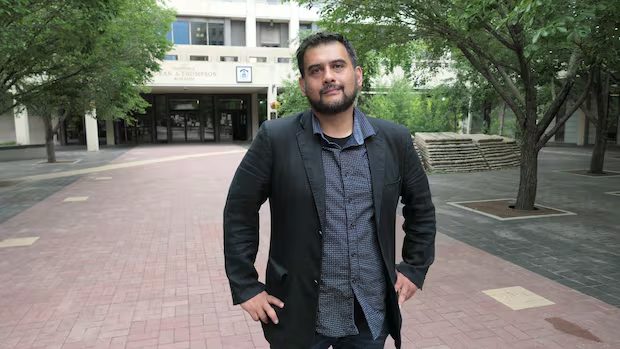
Nick Falvo, a housing research consultant, says promising better homelessness solutions without spending more money is politically convenient during an election campaign. (Zoom / CBC News)
Steve Pomeroy, industry professor at the Canadian Housing Evidence Collaborative, said spending the current homelessness budget with more care could produce better results without taking more tax dollars.
A key issue, he pointed out, is how funding to help with homelessness is divided between city programs and a range of community groups. He said all are reluctant to give up the money that’s been earmarked for them.
"You have so many fingers in that pot and it's hard to get them to agree to give up some of their funding that they have contractual arrangements that have been in place for many years," he said. "It's a Sisyphean problem of pushing the rock up the hill."
Early voting in Toronto’s municipal elections begins on Tuesday, with polling day set for Oct. 26.
There are 53 candidates running to be mayor. You can find the full list on the city’s website.
Related Stories
 Canada
Quebec separatists win election, vow independence vote
59 minutes ago
 Canada
Exports to the U.S. spiked in August before Trump’s 50% tariffs: StatCan
59 minutes ago
 Canada
Edmonton public school trustees to consider whether to try to improve school access for migrant students
59 minutes ago
 Canada
Michelin Guide awards Vancouver restaurant with city's first 2
59 minutes ago
 Canada
People's Party of Canada partly liable in Winnipeg defamation case, appeals court rules
2 hours ago
 Canada
Separation is unpopular in Quebec. Why did the province elect sovereigntists?
2 hours ago
 Canada
Alberta separatists see validation in Quebec election results
2 hours ago
 Canada
U.S. resident charged with helping Canadian school shooter in rampage that killed 8 in Tumbler Ridge
3 hours ago