
Treaty 6 band members share mixed feelings on Alberta's referendum at 150th anniversary gathering
Treaty 6 band members share mixed feelings on Alberta's referendum at 150th anniversary gathering
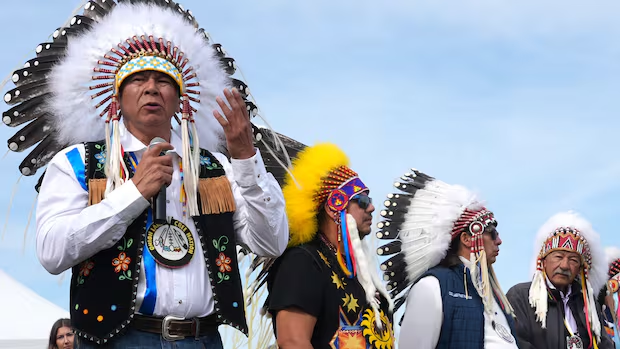
Event marking 150th anniversary took place Sept. 6 to 11 at Fort Pitt Provincial Park
As hundreds of people from across the Prairies recently gathered to mark a century and a half since the signing of Treaty 6, many attendees considered what the agreement will mean for future generations as Albertans prepare to vote in a referendum on whether the province should remain part of Canada or hold a binding referendum on seeking independence.
“It’s a bunch of mixed emotions,” Taylor Dumais, a Kehewin Cree Nation band member, told CBC News. “I am proud to be here celebrating 150 years [of Treaty 6], but I am also incredibly angry that there’s even a referendum on the table right now.”
The six-day event was held in Saskatchewan’s Fort Pitt Provincial Park, nestled between the edge of the North Saskatchewan River and the Alberta-Saskatchewan border. Put on by Onion Lake Cree Nation, the anniversary event took place Sept. 6 to 11, and featured ceremony, forums and keynote speeches on treaty history, traditional law and international Indigenous rights.
Dumais said although gatherings like the one at Fort Pitt can help educate both Indigenous and non-Indigenous people on the roles, responsibilities and rights enshrined in treaties, she believes the upcoming vote on whether to explore separation highlights gaps in the broader understanding of who treaties apply to.
“We are fighting for our rights, which aren’t just our rights as Indigenous people,” Dumais said. “They also belong to the non-Indigenous people that live here.”
Onion Lake Cree Nation band member Jared Muskego said he has more questions than answers when it comes to the Oct. 19 vote. He grew up in Edmonton and recently returned to live on the First Nation, which straddles Alberta and Saskatchewan and is one of Canada’s only reserves with land in two provinces.
“I’m thinking, ‘How’s it going to work?’ We’re right in the middle,” Muskego told CBC News. “We have community members that live on the Alberta side, right on — literally — the border.”
Referendum uncertainty looms large over 150th Treaty 6 anniversary
He said finding answers to the questions around how separation could impact homes, businesses and the community as a whole likely won’t be easy, but he hopes knowledge from elders and those immersed in the issue can provide insight in the coming weeks.
Janice Makokis, an assistant law professor at the University of Windsor and a legal adviser for Onion Lake Cree Nation, said she believes Alberta independence doesn’t have a legal leg to stand on.
Because Alberta became a province nearly three decades after Treaty 6 was signed, she said the agreement is international in nature.
“Our treaties will supersede whatever happens within the provincial discussion around this referendum,” Makokis told CBC News.
Treaty 6 was signed 150 years ago. First Nations worry a push for Alberta independence puts it at risk
“No provincial government can just come into this discussion and say, ‘We’re going to break up this country, and we’re not even going to include First Nations in this conversation,’ because we were here before. And you cannot dismantle an international treaty.”
Earlier this year, a group of First Nations challenged Elections Alberta’s approval of Alberta separatist group Stay Free Alberta’s citizen initiative petition application, arguing the province failed to fulfil its duty to consult and that separation would violate treaty rights.
In May, an Alberta judge quashed the petition’s approval. The group behind the petition and the Alberta government later filed appeals. The province argues approving the petition did not trigger a duty to consult, and the judge did not consider the democratic purpose of the petition process.
Lawyer Keith Wilson with the separatist third-party advertiser Let Alberta Decide recently told CBC News he believes “the treaties will carry on” if Alberta leaves Canada, and that First Nations would play a role in deciding what an independent Alberta could look like.
Alberta government files appeal on court decision to throw out separatist referendum petition
Kathy Walker, treaty commissioner of Saskatchewan, echoed Makokis’s sentiment. She said living agreements like Treaty 6 are not only foundational to First Nations law, but also protected by the Canadian Constitution.
“I find it very unlikely that a referendum that is not in keeping with those laws will be able to move forward,” Walker told CBC News at Fort Pitt.
But as uncertainty remains and legal challenges continue, Walker and others say the topic polarizing the province has also been a catalyst for bringing communities together and highlighting the importance of treaty tenets like wītaskiwinihk, Cree for "sharing the land in peace and harmony."
“I feel that the nations have been taking a very strong position and they’re very united in treaty and are growing stronger every day,” Walker said. “And so I feel hopeful, especially being at a gathering like this, that the treaty relationship that has withstood for the last 150 years will continue for the next 150.”
And while the prospect of what a vote to explore Alberta independence would mean for Onion Lake Cree Nation and all other Treaty 6 communities was a theme explored over several days of the 150th anniversary gathering, attendees said the spirit of the event remained positive.
“It hasn’t really been a major focus,” Walker said.
“We’re big on kinship, big on community. We are here to celebrate,” said Dumais.
Onion Lake Cree Nation Chief Pete Chief said honouring the legacy of his great-great-grandfather and others who signed Treaty 6 on the same spot in 1876 has been a long-standing tradition, one that predates the province of Alberta and one he believes will continue long after the referendum this fall.
“As long as, again, the sun shines, the grass grows and the rivers flow, we’ll still always honour that,” Chief told CBC News.
Lexi Freehill is a reporter for CBC News in Lloydminster covering all things Eastern Alberta. She grew up near Marwayne, graduated from Mount Royal University with a degree in Journalism, and previously reported for the Town and Country paper in the Athabasca area. You can reach her at lexi.freehill@cbc.ca with story tips, concerns, and the best kayaking spots.
Related Stories
 Canada
Read Stephen Harper's full speech on the need for Canada to defend its sovereignty against the U.S.
13 minutes ago
 Canada
Harper backs ending U.S. trade talks
13 minutes ago
 Canada
Was Quebec consulted about Carney’s airport privatization plan?
14 minutes ago
 Canada
Carney says deepening ‘alliance’ with European Union is a work in progress
14 minutes ago
 Canada
Ukraine war live: Zelensky celebrates ‘hit’ against Moscow with new anti
46 minutes ago
 Canada
How are Quebec businesses and workforces adapting to tariffs?
1 hour ago
 Canada
Carney's new love
1 hour ago
 Canada
B.C. Supreme Court rules province wasn't authorized to force foreign
2 hours ago