
Trump awards Musk and other tech titans National Medals of Science
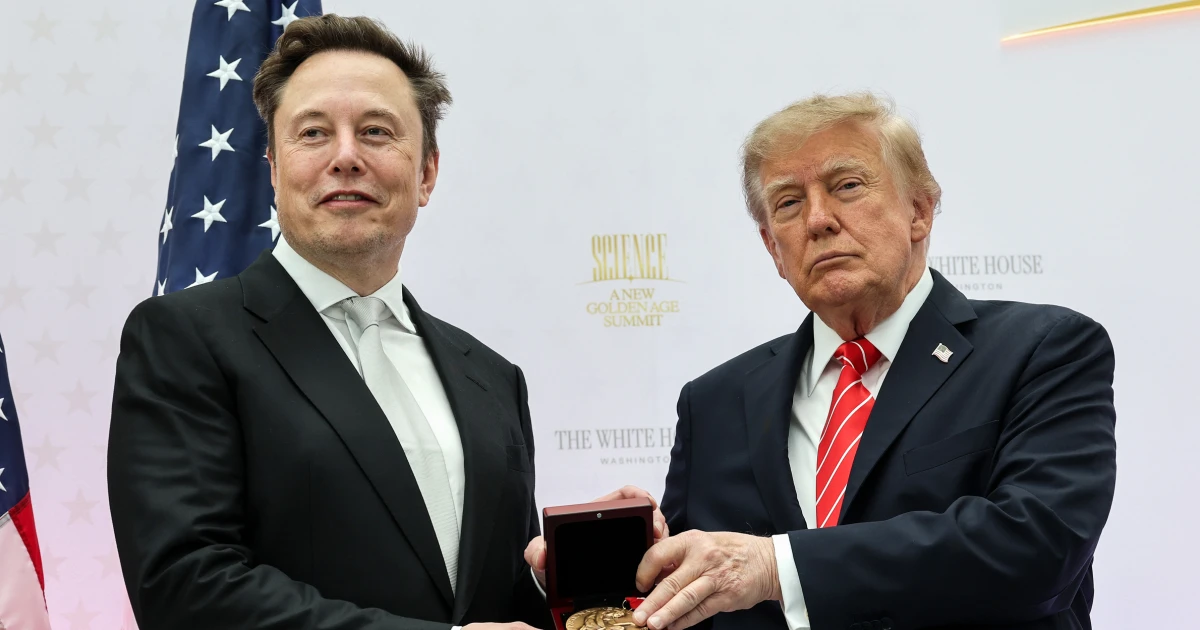
WASHINGTON — President Donald Trump joined some of America’s most powerful tech leaders Thursday at a summit the White House billed as the start of a “golden age” of American science.
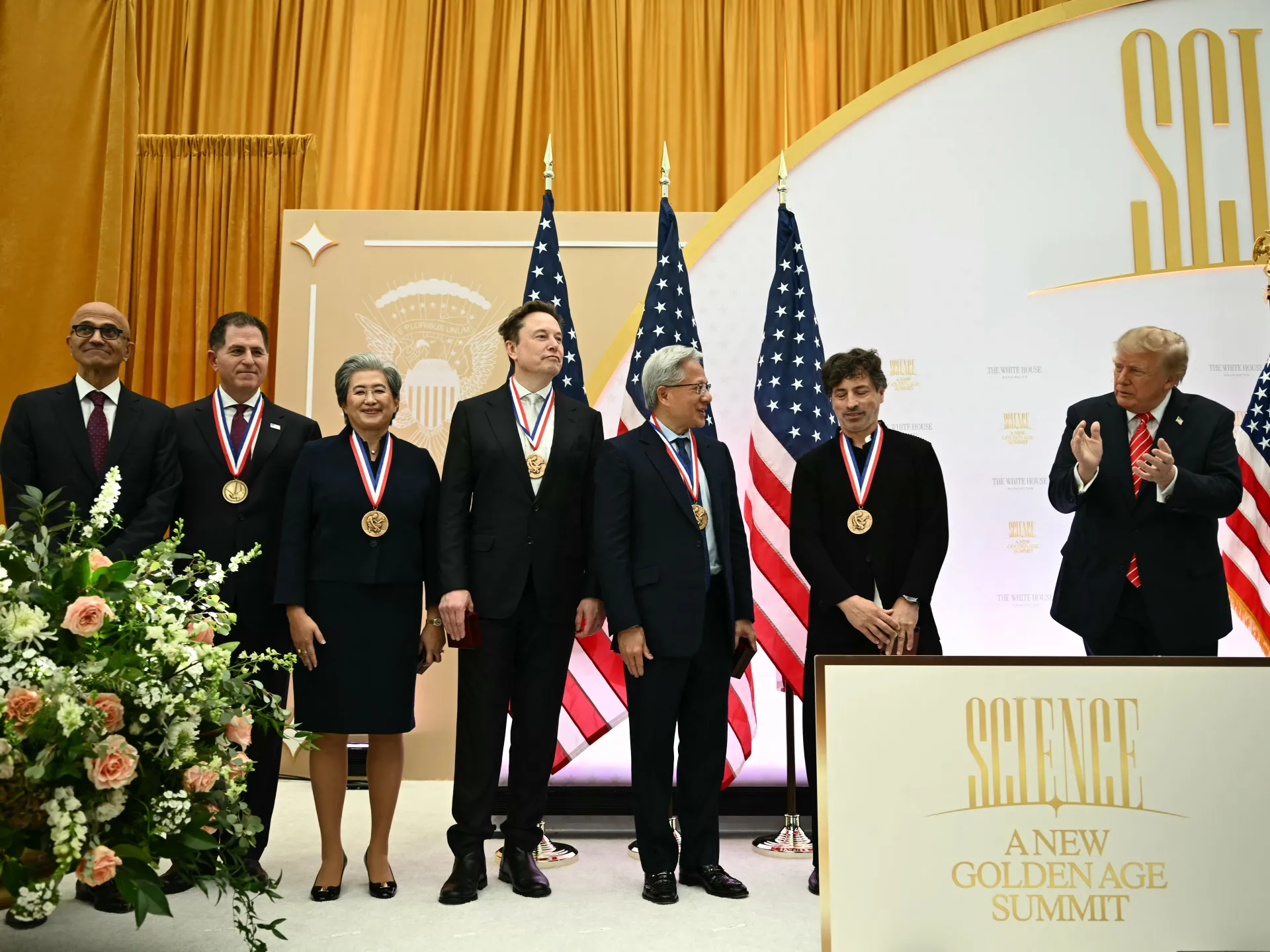
Elon Musk, Google co-founder Sergey Brin, Nvidia CEO Jensen Huang, AMD CEO Lisa Su, Microsoft CEO Satya Nadella and Dell founder Michael Dell gathered with Trump and a host of administration officials and scientific luminaries for the Science: A New Golden Age Summit at the U.S. Institute of Peace.
“We live in an age of American wonders and technological marvels, and with the help of the brilliant men and women here today, we will always be on top,” Trump said.
Trump awarded the National Medal of Science to Musk, Brin, Huang and Su. He awarded the National Medal of Technology and Innovation to Nadella and Dell.
Trump presented each of the recipients with medals and certificates of honor, later asking some of their families to join him onstage to take photos.
“You’re going to go down in the annals of history as being great,” Trump told the recipients.
White House spokesperson Liz Huston said in a statement: “The Trump Administration is grateful for the contributions of these incredible leaders in science and technology. These recipients are helping ensure America keeps leading the world in innovation.”
The celebration took place just hours after Vice President JD Vance announced that the Trump administration would suspend Microsoft, whose CEO was a guest of honor at the event, and several other companies from a program that allows foreign workers to apply for green cards.
Several of the summit’s speakers emphasized the importance of immigrants to America’s scientific power.
“I was an immigrant, and my parents brought us here to pursue the American dream,” Huang told NBC News as he walked through the venue with his parents. “It’s an incredible honor and something that could only happen here in America.”
Carnegie Mellon University President Farnam Jahanian highlighted the importance of a welcoming immigration system in a conversation about the future of American research universities. Jahanian pointed out that China produces more engineers and scientists than the U.S., Europe and Japan put together.
“We need to have an immigration policy that can recruit the best talent to come to this country, speaking as an immigrant who has benefited from the opportunities this country has,” Jahanian said. “It’s important to recruit the best talent to come here so they stay here and contribute.”
The summit, an all-day affair meant to highlight the American scientific enterprise, built on a July report from Michael Kratsios, head of the Office of Science and Technology Policy, about how the Trump administration aims to reinvigorate scientific discovery and innovation.
“This is the golden age,” Trump said, taking the stage to kick off the celebration’s afternoon program. “We are an extremely high-IQ audience for a change,” he said, drawing chuckles from the audience.
The Science: A New Golden Age report and Thursday’s gathering aim to tackle what the White House sees as growing scientific bureaucracy and stagnating innovation. Kratsios highlighted the ballooning costs of clinical trials and the falling rates of novel drugs approved for patient use as examples of increased scientific sluggishness.
The report says the administration will streamline funding to promising scientists instead of routing it through established institutions.
The event kicked off with a series of announcements about funding for new scientific initiatives. Among them is a pledge of around $2.4 billion of AI computing credits and scientific tools by America’s leading AI companies for federal agencies working on a variety of scientific issues prioritized by the White House. The areas include quantum algorithms, AI-driven physical laboratories and improvement of the efficiency of nuclear engineering.
Kratsios also presided over an announcement by NASA Administrator Jared Isaacman and Energy Secretary Chris Wright of a new partnership to embrace nuclear technology in space exploration.
“Thanks to President Trump, America’s nuclear renaissance is reaching a new frontier,” Wright said. Isaacman said nuclear power would allow NASA spacecraft to travel farther and operate longer, “opening an entirely new frontier for exploration and discovery.”
The day focused on a handful of scientific fields, including artificial intelligence — now referred to as “super intelligence” by the Trump administration — nuclear power, quantum computing and metascience, or the study of science itself.
“Super intelligence is going to be the biggest unlock for scientists,” Kratsios said, opening the celebration. Representatives from America’s leading AI companies, including OpenAI, Anthropic, Google, Amazon Web Services and Micron Technology, took the stage to announce their new partnerships with the federal government.
A variety of scientists from academic institutions and companies gave a series of lightning talks about their research, which largely focused on nuclear energy and using AI to accelerate their research.
The speakers oscillated between using “AI” and “SI” — the term preferred by administration officials since Trump issued an executive order renaming the technology.
John Martinis, a professor of physics at the University of California, Santa Barbara, and recipient of the Nobel Prize in physics, said the technology was already accelerating his group’s research. Asked what a golden age of science would look like to him, Martinis said he didn’t have to look far.
“I feel like we’re in it right now,” he said. “It’s really exciting what’s happening with SI.”
Related Stories
 Technology
Trump gives top US science awards to Elon Musk and other tech executives
53 minutes ago
 Technology
Michael Burry Raises Red Flag Over Popular Big Tech Stock
1 hour ago
 Technology
SAIT to build $150
1 hour ago
 Technology
The micro drama industry is booming. It's giving Meta two wins at the same time.
2 hours ago
 Technology
Top Deep
4 hours ago
 Technology
NASA's SSPICY Mission to Test In
4 hours ago
 Technology
2 Education Startups Help Raise The Bar As Students’ Math Scores Plummet In India
5 hours ago
 Technology
Karnataka’s sting operation politics: threat of a video is half the battle
6 hours ago