
Trump looms over U.S. midterms. Will he help or hurt Republicans?
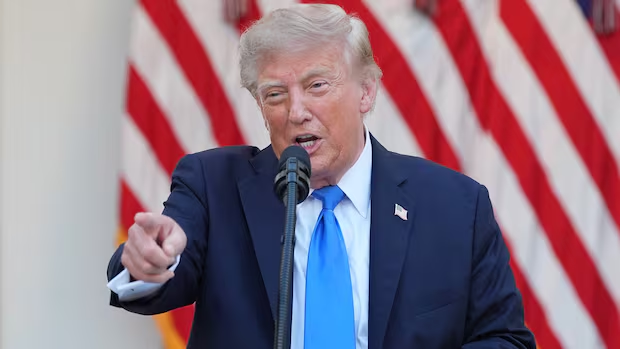
Trump looms over U.S. midterms. Will he help or hurt Republicans?
Unpopular president vows to campaign in tight races, a prospect that delights Democrats
U.S. President Donald Trump is promising to campaign alongside Republicans who are at risk of losing their Congressional races in the upcoming midterm elections.
Many Democrats are secretly hoping this is one promise that Trump keeps.
The midterm elections on Nov. 3 will determine which party controls the U.S. Senate and House of Representatives for the next two years.
Midterms have historically not been kind to the sitting president's party, particularly so when the president has an approval rating as low as Trump's.
Yet Trump is showing no signs of staying away from the campaign spotlight, even as polling evidence mounts that he is dragging down support for Republican candidates rather than giving them a boost.
"I'm going to be going around and doing a lot of speeches," Trump told a gathering of Congressional Republicans at the White House on Wednesday evening.
Republicans back Trump on Canada, even though most Americans don't
He said he will focus his efforts on 35 tight races for the Senate and the House.
"I'm going to go to every one of those 35 places," Trump told the Republican lawmakers.
"I'll be at every one of your states, your cities, wherever it is that you're running," he said. "All the way to November 3rd and beyond, we're going to be helping you."
Some Republicans downplay Trump in campaign
Whether Trump's plan to give himself a prominent role actually helps GOP candidates in those tight races or hurts them will be one of the key questions of the midterms.
Several Republicans in hotly-contested districts are already downplaying Trump in their campaign messaging and removing references to him from their websites, The Associated Press reported last week.
Republicans in closely-fought districts and purple states face a dilemma on how closely to link their campaigns to Trump, says Alex Theodoridis, a professor at the University of Massachusetts Amherst and co-director of UMass Poll.
"A lot of their base that they need to turn out to have any sort of chance in a swing district really does want them to back President Trump," Theodoridis told CBC News.
He says Trump has proven adept at motivating his core supporters, those who consider themselves part of the president's Make America Great Again wing of the Republican Party.
Yet MAGA voters alone are not enough to win tight races. Many independent voters and even some moderate Republicans who chose Trump in the 2024 president election have since soured on him and could influence midterm results by not bothering to cast a vote.
For Republicans running in swing districts and purple states, that adds up to "a tightrope walk," said Theodoridis.
"It's a challenge. If you're a candidate right now, you have to distance yourself from the president, but not too much."
The latest UMass national poll puts Trump's overall approval rating at 32 per cent, the lowest it has been at any point in his presidency. The poll was conducted online from Aug. 21 to 26 with a sample of 1,000 adults representative of the gender, age, race and education breakdown of the U.S. population.
In published representative polls, Trump's approval rating is currently averaging about 38 per cent, according to the Silver Bulletin polling aggregator.
More than two-thirds of respondents to the UMass poll said they disapprove of Trump's handling of the war on Iran, and three-quarters said they disapprove of his handling of inflation.
Notably, the UMass poll suggests Trump's approval rating has dropped among political independents and non-MAGA Republicans, whose votes helped propel him back into the White House.
'Send Trump to every swing district'
Voters who haven't made up their mind who they'll support in the midterms are four times more likely to consider Trump's endorsement of a candidate as a negative rather than a positive, according to a YouGov/The Economist poll, conducted online Aug. 28 to 31 among a representative panel of 1,592 U.S. adults.
Such polling has created a scenario that sees some Democrats itching for the president to get lots of exposure in the midterm campaign, including Ted Lieu, vice chair of the House Democratic Caucus.
"I urge the White House to send Donald Trump to every single swing district in America," Lieu told a recent news conference. "He can explain to the American people in those districts why gas prices are up, why the cost of living is up."
This school of thought sees Trump as a powerful force in driving Democrats to the midterm polls while doing little to motivate Republicans to turn out.
With U.S. midterm elections looming, Democrats are clashing over how to win
Republicans back Trump in his trade war with Canada
The two most important factors predicting the outcome of U.S. midterms are the approval rating of the incumbent president and the level of enthusiasm for casting a ballot among each party's registered voters, says Al Hunt, co-host of the Politics War Room podcast with veteran Democratic strategist James Carville.
Trump's approval rating is "exceptionally low," Hunt wrote on Substack in August, arguing this puts the Democrats in position for "impressive gains" in the midterms.
"The economy and the war, both big negatives for the GOP, won’t get any better in the [time until election day]."
That's still no guarantee the midterms will deliver both the House and the Senate to the Democrats. Trump appears poised to spend much of the next two months trying to persuade voters that handing control of Congress to his rivals will only make the cost of living worse.
Mike Crawley is a correspondent for CBC News, based in Washington. He began his career as a newspaper reporter in B.C., spent six years as a freelance journalist in various parts of Africa, then joined the CBC in 2005. Mike reported on Ontario politics for 15 years. He was born and raised in Saint John, N.B.
Related Stories
 Canada
Albertans head to polls in historic referendum on whether they want to stay in Canada
1 day ago
 Canada
In the news today: four soldiers killed, Alberta referendum, AI privacy fears
1 day ago
 Canada
How a grass fire at a Canadian military base killed four soldiers
1 day ago
 Canada
How will household electricity rebate reduction, temporary winter pricing change impact Ontarians?
1 day ago
 Canada
Residents told to boil tap water due to bacteria
1 day ago
 Canada
Oil
1 day ago
 Canada
Albertans vote on path to independence as Carney fights to keep Canada united
1 day ago
 Canada
Two of 4 soldiers killed in fast
1 day ago