
Trump's trade war: Fact

Trump's trade war: Fact-checking Canada's natural gas leverage over the U.S.
Canadian shipments of natural gas to the U.S. are tiny compared with America's domestic production
Prime Minister Mark Carney claims "Canada fuels American growth," pointing to U.S.-bound natural gas exports as evidence in a recent speech. His remarks beg the question: What would happen if Canada halted shipments south of the border?
So far, energy products such as oil and natural gas have not been used as leverage in the escalating Canada-U.S. trade war. The idea is controversial. Alberta Premier Danielle Smith has routinely opposed it, while Ontario's Doug Ford insists all options must be on the table.
"The U.S.'s narrow merchandise trade deficit only exists because the U.S. buys so much of its energy from Canada," Carney said on Saturday, the morning after trade talks broke down between Canadian and American negotiators in Washington.
"[Canada supplies] 99 per cent of their natural gas imports, 85 per cent of their electricity imports, 60 per cent of their crude oil imports."
The word "imports" does a lot of heavy lifting here, with respect to natural gas. According to the U.S. Energy Information Administration (EIA), U.S. imports from Canada averaged 8.6 billion cubic feet per day in 2025, representing virtually all of America's non-domestic supply. However, this is only a sliver of overall U.S. natural gas consumption – about eight per cent by the EIA's numbers.
Canada-U.S. trade war hits Christmas ornaments | Hanomansing Tonight
Dulles Wang, director of Americas gas and LNG at the energy research firm Wood Mackenzie, says that last number is actually as low as five per cent, by his firm's estimates.
"It's relatively small," he told CBC News.
Natural gas pipelines sprawl across North America like a massive spider web, crossing the Canada-U.S. border in about two dozen locations. From heating homes, to generating electricity, and powering industries, the commodity plays a pivotal role in the daily lives of millions of people.
Enbridge, headquartered in Calgary, is North America's largest natural gas provider. In 2024, the company completed a $19 billion series of deals to acquire three U.S. utilities.
Carney says he doesn't 'see the value' in using energy as leverage in U.S. trade talks
Fact-checking the White House statement of facts about Canada
"Gas flows across the borders constantly, every day, every hour of the day. And we're not just talking about [a] one-direction flow in terms of trade," Wang said.
"The U.S. imports Canadian supplies, mostly for the western and the Midwest markets. At the same time, the U.S. also exports gas, and that's also going into the Canadian markets, mostly on the eastern side."
While Canadian shipments of natural gas to the U.S. may be small compared with America's domestic production, Wang notes it's where these deliveries take place that's important.
"You're not going to see any Canadian gas making its way down to Texas, because Texas actually produces more gas than it consumes," he said.
"In places like the Pacific Northwest, we're talking about Seattle, Oregon, and also Northern California … over 90 per cent of the gas is actually coming in from Canada."
Driven by rising use of artificial intelligence, these regions have seen a surge in data centre construction backed by American hyperscaler tech giants such as Amazon, Google, Microsoft and Meta. These energy-hungry facilities often use natural gas as a baseload power source to supplement clean energy.
"So not only will people freeze, but also your data centres won't be running either," Wang said.
Canada would be 'shooting itself in the foot'
Halting U.S.-bound natural gas shipments would be painful for the industry in Canada, according to Wang. He predicts a glut of supply trapped in Canada would see prices plunge as storage facilities max out capacity.
"We're talking about a quite severe economic impact to the downside if we were to stop exporting gas to the U.S.," Wang said. "Canada … would be shooting itself in the foot, so to speak, by eliminating their only customer, and crashing prices."
"There's no winner in this," he added.
Canada's federal government wants more non-U.S. buyers. Last year, the first shipments of liquefied natural gas left the LNG Canada facility in Kitamat, B.C., bound for Asian markets.
What we know about how the Canada-U.S. trade talks fell apart
The government's Major Projects Office is backing the second phase of this project, as well as the floating Ksi Lisims LNG export facility that's awaiting approval for construction off on the B.C. coast.
"That level of commitment needs to be there to support these projects, otherwise we're probably just going to continue to be stranded, or dependent on the U.S. market," Wang said.
Jeff Lagerquist is a senior writer with CBC News based in Toronto. Originally from Erin, Ont., he studied journalism at Toronto Metropolitan University. Jeff previously worked as a senior reporter for Yahoo Finance Canada. He was also a reporter and digital producer for CTV National News, BNN Bloomberg and The Financial Post. He was also a Columbia University energy journalism fellow for 2025.
Related Stories
 Canada
A Chinese humanoid robot sets a new 100
53 minutes ago
 Canada
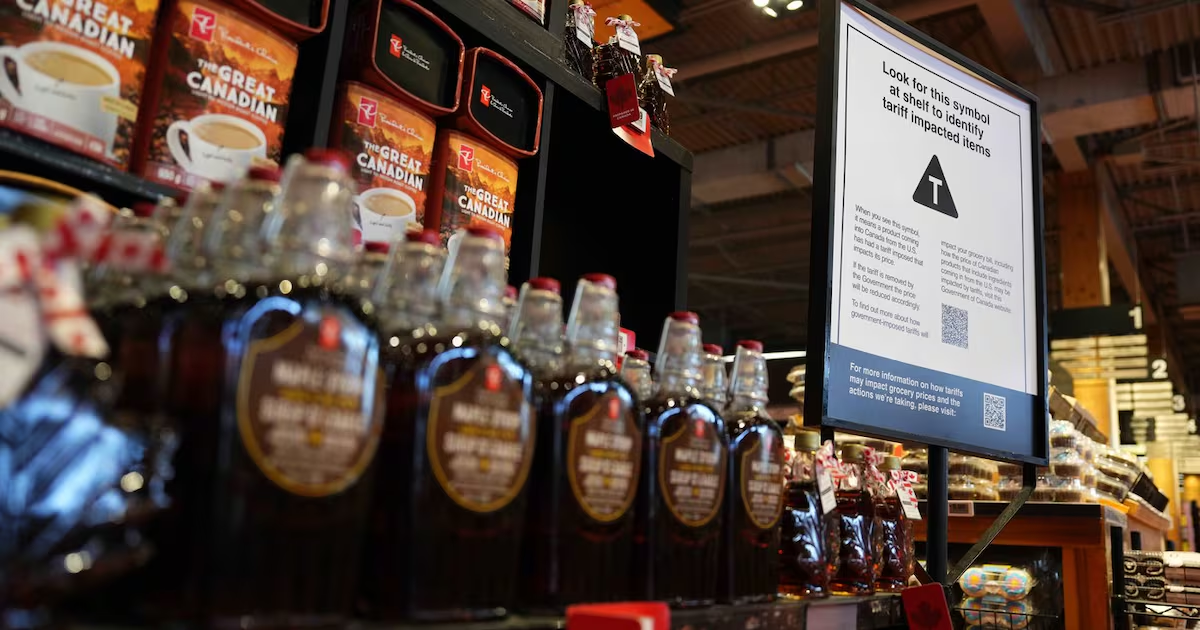
Grocers revive signage to indicate tariff
54 minutes ago
 Canada
Would U.S. tariffs actually change after Trump, or is this the new normal?
54 minutes ago
 Canada
More charges for former Manitoba MP Inky Mark after 445 guns, explosives found in home: RCMP
54 minutes ago
 Canada
Investigation underway after 18-year
1 hour ago
 Canada
Latest officer suspension linked to third racism incident, Montreal police say
1 hour ago
 Canada
How is EI changing under Canada’s tariff relief plan
1 hour ago
 Canada
‘A really dark place’: Experts warn where Canada
1 hour ago