
Two visions for ambient AI and the future of the EHR
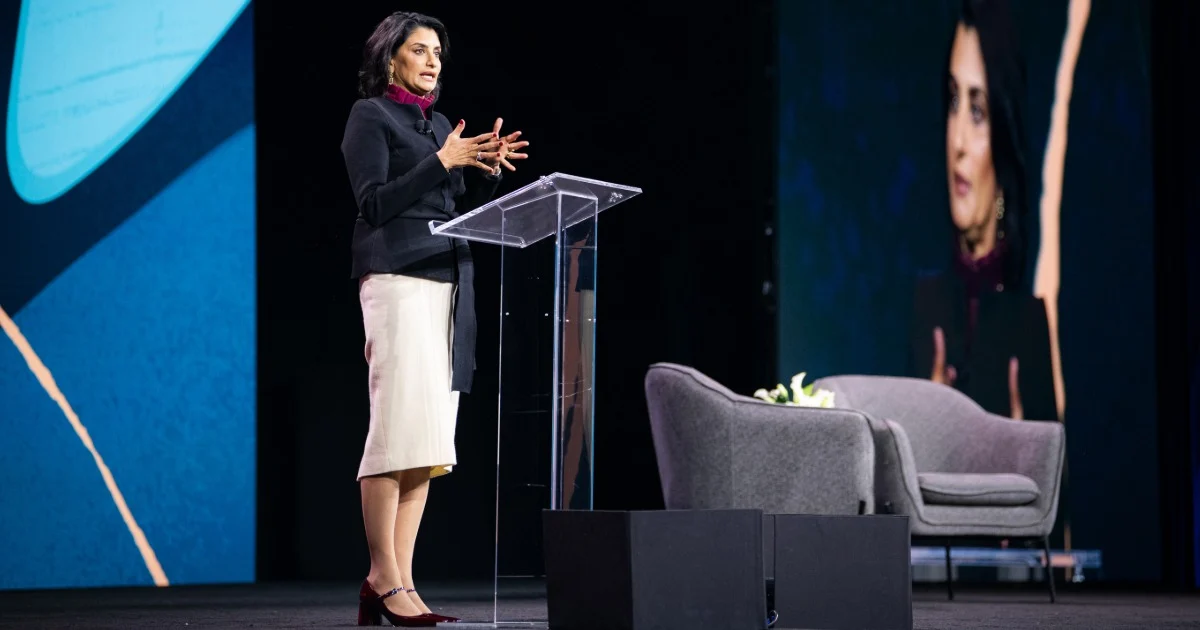
Seema Verma, EVP and general manager at Oracle Health
Ambient artificial intelligence entered healthcare as a way to listen to clinical encounters and draft notes. Its next act could be far more consequential: changing the electronic health record from the screen clinicians constantly navigate into the trusted infrastructure working beneath an AI-driven interface.
That possibility is beginning to divide healthcare leaders. Seema Verma, general manager of Oracle Health, expects AI to become a primary way clinicians interact with healthcare technology. Dr. John Chelico, chief medical information officer at health system CommonSpirit Health, is considerably more cautious; he expects AI to improve the EHR but not to push its interface into the background.
Their disagreement is not about whether AI will become more capable. Both expect it to retrieve information, prepare work and reduce administrative burden. The difference is how much of the clinical experience can safely be mediated by AI – and how often physicians still will need to see, navigate and interpret the underlying record themselves.
"We do expect AI to become a primary way clinicians interact with healthcare technology," said Verma. "But that doesn't make the EHR less important. In fact, as AI becomes more capable, the value of a trusted system of record increases."
In that model, the EHR remains the authoritative clinical and transactional foundation. It maintains the longitudinal patient record, executes clinical workflows, and supports compliance, reimbursement and interoperability. AI becomes the conversational layer that helps clinicians use that foundation more naturally.
"Ambient documentation is an important first step, but the larger opportunity is to move from an AI scribe to an AI assistant, then ultimately to AI that can help coordinate work across the care continuum," said Verma.
That could include retrieving relevant information, preparing orders for clinician review, coordinating follow-up and reducing administrative work that now requires navigating multiple applications. Over time, Verma expects clinicians to spend less time operating software and more time supervising intelligent tools and caring for patients.
Chelico agrees that AI should surface the right information at the right moment. But he does not believe the EHR itself is becoming little more than background infrastructure.
"I don't see clues where the EHR will become background noise," he said. "For the most part, the AI technology will help bring things to light for the providers. But at the end of the day, there are pieces of the EHR that still need to be front and center and still need to have the doctors interact with it."
Oracle Health is explicitly trying to change the traditional relationship between clinician and software. Historically, Verma said, clinicians have adapted to systems by searching menus, moving across screens and manually assembling information. AI offers a chance for the system to adapt to the clinician instead.
"At Oracle, we are redefining the EHR so that it's less of a system of record to aid in executing workflows and more of a system of intelligence to actually execute the workflows," she said.
Verma expects the traditional interface to become less dominant but not disappear. Clinicians still will need direct access to review complex cases, reconcile information, validate recommendations and complete specialty-specific work.
She emphasized that any concise AI response must preserve the ability to inspect the underlying information and verify how a recommendation was generated.
Chelico sees that continuing need as more than an exception. In his view, medicine remains too visually and cognitively complex to be reduced to voice commands and summaries.
"There are too many things that are needed that can't just be done through voice alone," he said. "The data-rich environment of an EHR cannot just be replaced by an AI tool giving you a summarization."
Chelico pointed to the challenge of building a differential diagnosis from months of outpatient visits, laboratory results, treatments and changing symptoms. AI may highlight something a physician missed or suggest an unexplored direction, he said, but clinicians still must trend information and construct the larger clinical story.
Chelico illustrated the point with his mother's recent cardiac care. Multiple tests, including a negative stress test, suggested she did not have a cardiac problem. Yet one later laboratory result indicated possible injury. When the full picture was assembled, cardiac catheterization revealed an 80% occlusion in the left anterior descending artery.
"If you didn't put the whole story together, you wouldn't have understood she had an 80% occlusion," he said.
For Chelico, the case demonstrates why evidence and guidelines cannot eliminate clinical intuition. Physicians also interpret persistence, appearance, context and the patient's response to reassuring test results.
"An AI tool can't do that," he said. "It can't look a patient in the face and say, 'You know what, I know you're still complaining and all the data in the world's telling me that you're not having cardiac issues.'"
"As AI moves from documentation to orchestrating clinical workflows, the standard for trust has to rise," Verma said.
She said organizations must know what AI is recommending, why it made the recommendation, what information it used, and whether the output aligns with clinical evidence and organizational policy. Human oversight, transparency and traceability are essential, she said, and AI should show its work by linking recommendations to underlying data and evidence.
Oracle Health applies a formal governance framework to AI features before release, Verma said. It includes role-based access controls; audit trails; continuous monitoring; and evaluation of performance, reliability, fairness, privacy and security throughout the technology's lifecycle.
Chelico reaches the same governance imperative from the buyer's side. Nearly every vendor now adds some AI capability – from clinical platforms to back-office tools. That means CIOs must ask how organizational and patient data are used, whether models learn from that information, how recommendations are generated, and how bias and hallucinations are addressed.
"Just because AI says that, it doesn't mean it's true or it's evidence-based," he said.
At CommonSpirit Health, the operating rule is straightforward: A human remains in the loop whenever a clinical decision is made. AI may prepare an order or a list of orders, Chelico said, but the clinician who signs remains responsible.
"I'm all for it," he said of AI-assisted order entry. "But ultimately the person that signs the order or the list of orders or whatever comes out of it, it is ultimately the responsibility of that person putting their license on the line."
One enterprise strategy, different expectations
Verma and Chelico also agree that CIOs should not treat AI as a disconnected set of experiments. Verma urged health systems to think of AI as part of the core healthcare platform rather than as a collection of standalone applications that can create new integration, security, governance and workflow problems.
Her priorities are to strengthen the data foundation, redesign workflows before automating them, establish multidisciplinary governance and measure value through time returned, steps eliminated, quality improved and outcomes achieved – not simply the number of AI tools deployed.
"The long-term strategy shouldn't be an EHR strategy and an AI strategy operating independently," Verma said. "It should be a single enterprise strategy in which the EHR provides the trusted operational and clinical foundation where care is documented, governed and executed – while AI makes that foundation more intelligent, adaptive and easier to use."
Chelico likewise expects AI to make the EHR more intuitive by presenting information in the right context. An orthopedic surgeon, a primary care physician and an emergency physician may need different information from the same record. AI can help identify and elevate what matters without forcing each user to search the entire chart.
But Chelico draws a firm line around where the durable record belongs. Any AI-generated documentation, decisions or contextual information that matters to care should not live in a separate system.
"The EHR will always be the legal record of everything that is happening for the patient," he said. "And that's not going away."
The result is not a clean verdict but two plausible paths. Verma sees AI becoming the clinician's front door while the EHR grows more strategic beneath it. Chelico sees AI as an increasingly powerful guide inside a workspace clinicians still must see and understand directly.
Ambient AI began by promising to write the note. Its larger legacy may be forcing healthcare to decide what the EHR is for – and whether the next generation of clinicians will experience it mainly as a screen, a system of intelligence or an invisible backbone supporting both.
Follow Bill's health IT coverage on LinkedIn: Bill SiwickiEmail him: [email protected]Healthcare IT News is a HIMSS Media publication.
WATCH NOW: For Duke, AI strategy is business strategy
Related Stories
 AI News
Bill Gross bets AI can help mass
1 hour ago
 AI News
Nigeria records 93% rise in AI micro
1 hour ago
 AI News
The Italian gelato maker using AI to invent new flavours
1 hour ago
 AI News
Closing the Gap Between Agentic CX Pilots and Production
1 hour ago
 AI News
New Brunswick data centre debate highlights cross
2 hours ago
 AI News
How to Structure an AI Agent Referral Fee Agreement Between Startups
2 hours ago
 AI News
No, AI didn’t delete a Swedish reality TV series
2 hours ago
 AI News
There is no AI in Armageddon. Artificial intelligence is a tool, not an apocalypse
2 hours ago